
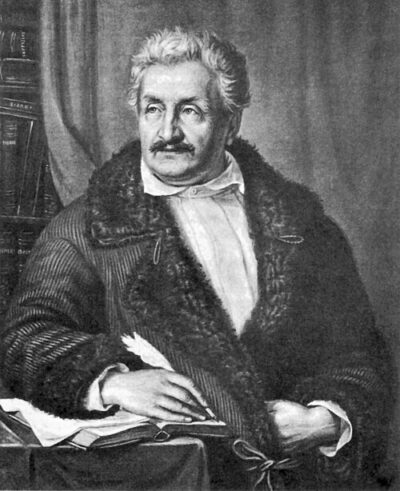
Jakob Philipp Fallmerayer
Jakob Philipp Fallmerayer was an Austrian historian. Born December 10, 1790, in Tschötsch. Died April 26, 1861, in Munich. Positions held include Member of the Frankfurt Parliament. Educated at LMU Munich.
Facts
19 facts · 2 confirmed by two sources · 5 cited · 12 from one source
Where this comes from
Papalocal keeps its own record. It started from these sources; what each one said is kept here as it was copied, so a change on their side never changes this page by itself. Tap one to read its version.
What Wikidata says · copied November 18, 2026 · revision 2567352589
- Described as
- Austrian historian (1790-1861)
- Born
- December 10, 1790 · 4 references
- Died
- April 26, 1861 · 1 reference
- Born in
- Tschötsch · 1 reference
- Died in
- Munich · 1 reference
- Buried in
- Alter Südfriedhof
- Citizen of
- Kingdom of Bavaria
- Occupation
- explorer; historian · 1 reference; university teacher; journalist; politician; classical philologist · 1 reference; philologist · 1 reference; orientalist · 1 reference
- Positions held
- Member of the Frankfurt Parliament
- Worked for
- LMU Munich
- Education
- LMU Munich
- Member of
- Bavarian Academy of Sciences and Humanities; Hungarian Academy of Sciences
- Wikipedias with a page
- 20
Wikidata item Q683058 (wikidata.org/wiki/Q683058), public domain (CC0). Copied November 18, 2026.
What Wikipedia says · copied November 18, 2026 · revision 1372825820
Jakob Philipp Fallmerayer (Austrian German: [ˈfalməˌraɪ̯ɐ]; 10 December 1790 – 26 April 1861) was a German Tyrolean traveller, journalist, politician and historian, best known for his discontinuity theory concerning the racial origins of the Greeks, and for his travel writings.
- Born, in its opening lines
- December 10, 1790
- Died, in its opening lines
- April 26, 1861
From the Wikipedia article “Jakob Philipp Fallmerayer” (en.wikipedia.org/wiki/Jakob_Philipp_Fallmerayer), by its contributors, under CC BY-SA 4.0 (creativecommons.org/licenses/by-sa/4.0/). Copied November 18, 2026; not changed.
Confirmed Two sources agree. Cited One source, and it names where it got it. One source One source, without a reference of its own. Sources disagree The sources disagree. We show the best-supported value and keep theirs below.
