
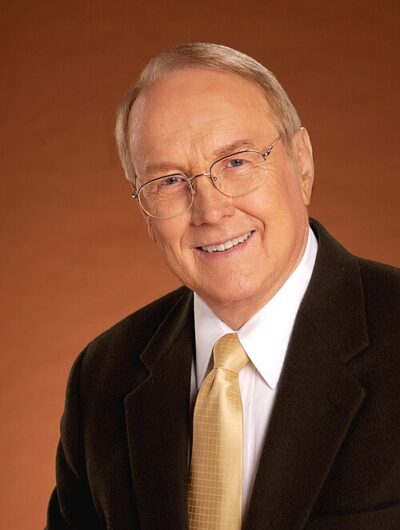
James Dobson
James Dobson was an American Evangelical Christian psychologist, author, and radio broadcaster. Born April 21, 1936, in Shreveport. Died August 21, 2025, in Colorado Springs. Teams include Point Loma Nazarene Sea Lions men's tennis. Educated at University of Southern California.
Facts
24 facts · 2 confirmed by two sources · 10 cited · 12 from one source
Where this comes from
Papalocal keeps its own record. It started from these sources; what each one said is kept here as it was copied, so a change on their side never changes this page by itself. Tap one to read its version.
What Wikidata says · copied November 18, 2026 · revision 2571591372
- Described as
- American Evangelical Christian psychologist, author, and radio broadcaster (1936–2025)
- Other names
- James Clayton Dobson, Jim Dobson, James C. Dobson
- Born
- April 21, 1936 · 2 references
- Died
- August 21, 2025 · 1 reference
- Born in
- Shreveport · 1 reference
- Died in
- Colorado Springs
- Citizen of
- United States
- Occupation
- psychologist · 1 reference; radio personality; non-fiction writer; businessperson · 1 reference; politician · 1 reference; writer · 1 reference; theologian · 1 reference
- Political party
- Republican Party
- Worked for
- University of Southern California
- Education
- University of Southern California
- Teams
- Point Loma Nazarene Sea Lions men's tennis · 1 reference
- Field
- psychology · 1 reference; family psychology · 1 reference; religion · 1 reference; literary activity · 1 reference; activism · 1 reference
- Religion
- Evangelicalism
- Height
- 1.88 m (6 ft 2 in) (1954) · 1 reference
- Website
- https://www.drjamesdobson.org/
- Wikipedias with a page
- 17
Wikidata item Q955266 (wikidata.org/wiki/Q955266), public domain (CC0). Copied November 18, 2026.
What Wikipedia says · copied November 18, 2026 · revision 1384611287
James Clayton Dobson Jr. (April 21, 1936 – August 21, 2025) was an American evangelical Christian author, psychologist and founder of Focus on the Family (FotF), which he led from 1977 until 2010. In the 1980s, he was ranked as one of the most influential spokesmen for conservative social positions in American public life. Although never an ordained minister, he was called "the nation's most influential evangelical leader" by The New York Times while Slate portrayed him as being a successor to evangelical leaders Jerry Falwell and Pat Robertson.
As part of his role in the organization he produced the daily radio program Focus on the Family, which was broadcast in more than a dozen languages and on over 7,000 stations worldwide, and heard daily by more than 220 million people in 164 countries. Focus on the Family was also carried by about 60 U.S. television stations daily. In 2010, he launched the radio broadcast Family Talk with Dr. James Dobson.
Dobson advocated for "family values"—the instruction of children in heterosexuality and traditional gender roles, which he believed are mandated by the Bible. The goal of this was to promote heterosexual marriage, which he viewed as a cornerstone of civilization that was to be protected from his perceived dangers of feminism and the LGBTQ rights movement. Dobson sought to equip his audience to fight in the American culture war, which he called the "Civil War of Values".
His writing career began as an assistant to Paul Popenoe. After Dobson's rise to prominence through promoting corporal punishment of disobedient children in the 1970s, he became a founder of purity culture in the 1990s. He promoted his ideas via his various Focus on the Family affiliated organizations, the Family Research Council which he founded in 1981, Family Policy Alliance which he founded in 2004, the Dr. James Dobson Family Institute which he founded in 2010, and a network of US state-based lobbying organizations called Family Policy Councils.
- Born, in its opening lines
- April 21, 1936
- Died, in its opening lines
- August 21, 2025
From the Wikipedia article “James Dobson” (en.wikipedia.org/wiki/James_Dobson), by its contributors, under CC BY-SA 4.0 (creativecommons.org/licenses/by-sa/4.0/). Copied November 18, 2026; not changed.
Confirmed Two sources agree. Cited One source, and it names where it got it. One source One source, without a reference of its own. Sources disagree The sources disagree. We show the best-supported value and keep theirs below.
