
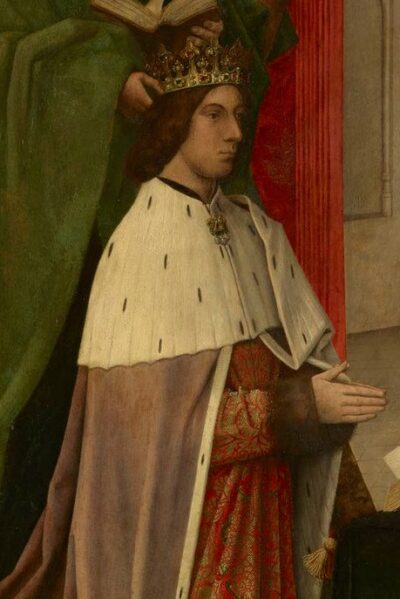
James III of Scotland
James III of Scotland was a King of Scotland from 1460 to 1488. Born July 10, 1451, in Stirling Castle. Died June 11, 1488, in Stirling. Positions held include Monarch of Scotland (1460–1488). Awards include Golden Rose.
Facts
21 facts · 1 confirmed by two sources · 7 cited · 12 from one source · 1 where the sources disagree
What’s different
- Died: we show June 11, 1488 (Sources disagree). Wikipedia says May 1452
Where this comes from
Papalocal keeps its own record. It started from these sources; what each one said is kept here as it was copied, so a change on their side never changes this page by itself. Tap one to read its version.
What Wikidata says · copied November 16, 2026 · revision 2569840710
- Described as
- King of Scotland from 1460 to 1488 (1451–1488)
- Other names
- James III
- Born
- July 10, 1451
- Died
- June 11, 1488 · 1 reference
- Born in
- Stirling Castle
- Died in
- Stirling · 1 reference
- Citizen of
- Kingdom of Scotland
- Occupation
- politician
- Positions held
- Monarch of Scotland (1460–1488)
- Awards
- Golden Rose
- Spouse
- Margaret of Denmark, Queen of Scotland (1469–1486) · 2 references
- Children
- James IV of Scotland · 1 reference; James Stewart, Duke of Ross · 1 reference; John Stewart, Earl of Mar · 1 reference
- Father
- James II of Scotland · 1 reference
- Mother
- Mary of Guelders · 1 reference
- Siblings
- Alexander Stewart, Duke of Albany; John Stewart, Earl of Mar; David Stewart, Earl of Moray; Mary Stewart; Margaret Stewart
- Religion
- Catholicism · 1 reference; Catholic Church
- Wikipedias with a page
- 58
Wikidata item Q222616 (wikidata.org/wiki/Q222616), public domain (CC0). Copied November 16, 2026.
What Wikipedia says · copied November 16, 2026 · revision 1385465603
James III (10 July 1451/May 1452 – 11 June 1488) was King of Scots from 1460 until his death at the Battle of Sauchieburn in 1488. He inherited the throne as a child following the death of his father, King James II, at the siege of Roxburgh Castle. James III's reign began with a minority that lasted almost a decade, during which Scotland was governed by a series of regents and factions who struggled for possession of the young king before his personal rule began in 1469.
James III was unpopular and ineffective, and faced two major rebellions during his reign. He was much criticised by contemporaries and later chroniclers for his promotion of unrealistic schemes to invade or take possession of Brittany, Guelders and Saintonge at the expense of his regular duties as king. While his reign saw Scotland reach its greatest territorial extent with the acquisition of Orkney and Shetland through his marriage to Margaret of Denmark, James was accused of debasing the coinage, hoarding money, failing to resolve feuds and enforce criminal justice, and pursuing an unpopular policy of alliance with England. His preference for his own "low-born" favourites at court and in government alienated many of his bishops and nobles, as well as members of his own family, leading to tense relationships with his brothers, his wife, and his heir. In 1482, James's brother Alexander, Duke of Albany attempted to usurp the throne with the aid of an invading English army, which led to the loss of Berwick-upon-Tweed and a coup by a group of nobles which saw the king imprisoned for a time, before being restored to power.
James's reputation as Scotland's first Renaissance monarch has sometimes been exaggerated. The artistic legacy of his reign was slight when compared to that of his two immediate successors and consists of the patronage of painters and musicians, coins that display realistic portraits of the king, the Trinity Altarpiece, and the King's Chapel at Restalrig. James III was killed at the Battle of Sauchieburn, following a rebellion in which his heir was the figurehead of the rebels, and was succeeded by him as James IV.
- Born, in its opening lines
- July 10, 1451
- Died, in its opening lines
- May 1452
From the Wikipedia article “James III of Scotland” (en.wikipedia.org/wiki/James_III_of_Scotland), by its contributors, under CC BY-SA 4.0 (creativecommons.org/licenses/by-sa/4.0/). Copied November 16, 2026; not changed.
Confirmed Two sources agree. Cited One source, and it names where it got it. One source One source, without a reference of its own. Sources disagree The sources disagree. We show the best-supported value and keep theirs below.
