
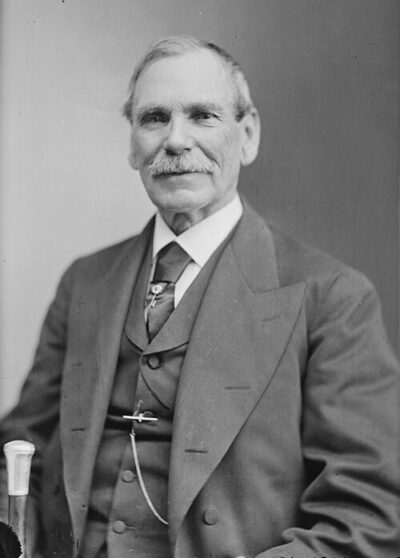
James Shields
James Shields was an Irish-American politician and general. Born May 10, 1806, in Altmore. Died June 1, 1879, in Ottumwa. Positions held include member of the Illinois House of Representatives, United States senator (3 times) (1849–1879) and member of the Missouri House of Representatives.
Facts
18 facts · 2 confirmed by two sources · 2 cited · 14 from one source
Where this comes from
Papalocal keeps its own record. It started from these sources; what each one said is kept here as it was copied, so a change on their side never changes this page by itself. Tap one to read its version.
What Wikidata says · copied November 18, 2026 · revision 2513952854
- Described as
- Irish-American politician and general (1806-1879)
- Born
- May 10, 1806
- Died
- June 1, 1879
- Born in
- Altmore
- Died in
- Ottumwa
- Buried in
- Saint Marys Cemetery · 1 reference
- Citizen of
- United States; Ireland
- Occupation
- politician · 1 reference; military officer; lawyer; judge
- Positions held
- member of the Illinois House of Representatives; United States senator (3 times) (1849–1879); member of the Missouri House of Representatives
- Political party
- Democratic Party
- Military branch
- Union Army; United States Army
- Military rank
- brigadier general · 1 reference
- Wikipedias with a page
- 16
Wikidata item Q923522 (wikidata.org/wiki/Q923522), public domain (CC0). Copied November 18, 2026.
What Wikipedia says · copied November 18, 2026 · revision 1381733672
James Shields (May 10, 1806 – June 1, 1879) was an Irish American politician and United States Army officer, who is the only person in U.S. history to serve as a senator for three different states, and one of only two to represent multiple states in the U.S. Senate (the other being Waitman T. Willey). A member of the Democratic Party, Shields represented Illinois from 1849 to 1855, in the 31st, 32nd, and 33rd Congresses, Minnesota from 1858 to 1859, in the 35th Congress, and Missouri in 1879, in the 45th Congress.
Born and initially educated in Ireland, Shields emigrated to the Americas in 1826. He was briefly a sailor, and spent time in Quebec, before settling in Kaskaskia, Illinois, where he studied and practiced law. In 1836, he was elected to the Illinois House of Representatives, and later as State Auditor. His work as auditor was criticized by a young Abraham Lincoln, who (with his then fiancée, Mary Todd) published a series of inflammatory pseudonymous letters in a local paper. Shields challenged Lincoln to a duel, and the two nearly fought on September 22, 1842, before making peace, and eventually becoming friends.
In 1845, Shields was appointed to the Illinois Supreme Court, from which he resigned to become Commissioner of the U.S. United States General Land Office. At the outbreak of the Mexican–American War, he left the Land Office to take an appointment as brigadier general of volunteers. He served with distinction and was twice wounded. In 1848, Shields was appointed to and confirmed by the Senate as the first governor of the Oregon Territory, which he declined. After serving as Senator from Illinois, he moved to Minnesota and founded the town of Shieldsville there. He was then elected as Senator from Minnesota. He served in the American Civil War, and at the Battle of Kernstown, his troops inflicted the only tactical defeat of Stonewall Jackson in the war (although he had been wounded the day before and was not present on the battlefield). Shields resigned his commission shortly thereafter due to a dispute over a promotion. After moving multiple times, Shields settled in Missouri and served again for three months in the Senate. He died in 1879 and represents Illinois in the National Statuary Hall.
- Born, in its opening lines
- May 10, 1806
- Died, in its opening lines
- June 1, 1879
From the Wikipedia article “James Shields (politician, born 1806)” (en.wikipedia.org/wiki/James_Shields_(politician,_born_1806)), by its contributors, under CC BY-SA 4.0 (creativecommons.org/licenses/by-sa/4.0/). Copied November 18, 2026; not changed.
Confirmed Two sources agree. Cited One source, and it names where it got it. One source One source, without a reference of its own. Sources disagree The sources disagree. We show the best-supported value and keep theirs below.
