
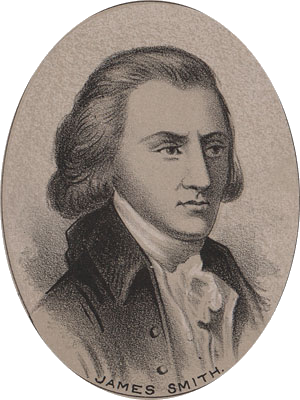
James Smith
James Smith was a signer to the United States Declaration of Independence as a representative of Pennsylvania. Born 1719, in Ulster. Died July 11, 1806, in York. Educated at University of Pennsylvania and University of Delaware.
Facts
12 facts · 2 confirmed by two sources · 1 cited · 9 from one source
Where this comes from
Papalocal keeps its own record. It started from these sources; what each one said is kept here as it was copied, so a change on their side never changes this page by itself. Tap one to read its version.
What Wikidata says · copied November 18, 2026 · revision 2552001177
- Described as
- signer to the United States Declaration of Independence as a representative of Pennsylvania (1719-1806)
- Born
- 1719
- Died
- July 11, 1806 · 2 references
- Born in
- Ulster
- Died in
- York
- Citizen of
- Ireland; United States; United Kingdom of Great Britain and Ireland
- Occupation
- writer; politician · 1 reference
- Education
- University of Pennsylvania; University of Delaware · 1 reference
- Spouse
- Eleanor Smith
- Wikipedias with a page
- 15
Wikidata item Q721599 (wikidata.org/wiki/Q721599), public domain (CC0). Copied November 18, 2026.
What Wikipedia says · copied November 18, 2026 · revision 1377960750
James Smith (c. 1719 – July 11, 1806) was an Irish-born American lawyer and surveyor. As a signer of the United States Declaration of Independence during his term as a delegate to the Second Continental Congress from Pennsylvania, he is remembered as a Founding Father of the United States.
Smith immigrated to Pennsylvania with his family as a boy and settled in the Susquehanna River valley. After training as a lawyer and working as a surveyor on the frontier, he settled in York, where he practiced law and was involved in several business activities. During the early years of the American Revolution, Smith became an advocate for independence from Great Britain. As a member of the Committee for the province of Pennsylvania, he helped draft instructions for Pennsylvania's delegates to the First Continental Congress urging them to pursue solidarity with other colonies and defend the liberties of the colonists. He also led the raising of Pennsylvania's first volunteer militia.
As a delegate to the Pennsylvania Provincial Conference in 1776, Smith advanced a resolution calling for independence shortly before the Second Continental Congress adopted the Declaration of Independence on July 4. The U.S. Declaration was modeled in the substance of its complaints on the Pennsylvania resolution. Smith was elected to the Second Continental Congress shortly afterward and in this capacity affixed his signature to the engrossed copy of the Declaration. As a member of Congress, he served on the Board of War, supporting the Continental war effort against Britain. Smith left the Continental Congress in 1778 and returned to his law practice. He continued to serve in various public offices in Pennsylvania and remained active in public affairs until his death in 1806.
- Born, in its opening lines
- c. 1719
- Died, in its opening lines
- July 11, 1806
From the Wikipedia article “James Smith (Pennsylvania politician)” (en.wikipedia.org/wiki/James_Smith_(Pennsylvania_politician)), by its contributors, under CC BY-SA 4.0 (creativecommons.org/licenses/by-sa/4.0/). Copied November 18, 2026; not changed.
Confirmed Two sources agree. Cited One source, and it names where it got it. One source One source, without a reference of its own. Sources disagree The sources disagree. We show the best-supported value and keep theirs below.
