
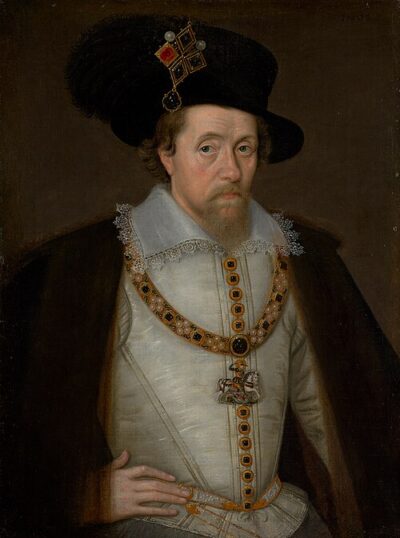
James VI and I
James VI and I was a King of Scotland from 1567 to 1625, King of England and Ireland from 1603 to 1625. Born June 19, 1566, in Edinburgh Castle. Died March 27, 1625, in Theobalds House. Positions held include Monarch of Scotland (1587–1625), Monarch of England (1603–1625) and King of Ireland (1603–1625). Known for Daemonologie, The True Law of Free Monarchies and Basilikon Doron. Educated at tutor. Awards include Knight of the Garter.
Facts
42 facts · 2 confirmed by two sources · 13 cited · 26 from one source · 1 where the sources disagree
What’s different
- Cause of death: we show kidney failure (Sources disagree). Wikidata also lists dysentery
Where this comes from
Papalocal keeps its own record. It started from these sources; what each one said is kept here as it was copied, so a change on their side never changes this page by itself. Tap one to read its version.
What Wikidata says · copied November 16, 2026 · revision 2567548012
- Described as
- King of Scotland from 1567 to 1625, King of England and Ireland from 1603 to 1625 (1566–1625)
- Other names
- Charles James, Prince and Great Steward of Scotland, James VI, King of Scotland, James VI & I, James I, King of England James I, James I and VI, James I and James VI, C. Philopatris, Charles James, Duke of Rothesay, James, Prince and Great Steward of Scotland, James VI of Scotland and I of England, James I & VI, James Charles, Duke of Rothesay
- Born
- June 19, 1566 · 2 references
- Died
- March 27, 1625 · 1 reference
- Born in
- Edinburgh Castle · 1 reference
- Died in
- Theobalds House
- Buried in
- Westminster Abbey
- Cause of death
- dysentery; kidney failure · 1 reference
- Citizen of
- Kingdom of Scotland; Kingdom of England; Kingdom of Ireland
- Occupation
- poet; writer · 3 references; monarch; aristocrat
- Positions held
- Monarch of Scotland (1587–1625); Monarch of England (1603–1625); King of Ireland (1603–1625); Duke of Rothesay (1566–1587)
- Education
- tutor
- Known for
- Daemonologie; The True Law of Free Monarchies; Basilikon Doron; Some Reulis and Cautelis to be observit and eschewit in Scottis poesie; De jure regni apud Scotos
- Awards
- Knight of the Garter · 1 reference
- Spouse
- Anne of Denmark (1589–1619) · 2 references
- Children
- Henry Frederick, Prince of Wales · 3 references; Elizabeth Stuart, Queen of Bohemia · 2 references; Margaret Stuart · 1 reference; Charles I of England · 2 references; Robert Stuart, Duke of Kintyre and Lorne · 1 reference; Mary Stuart; Sophia of England · 1 reference; unnamed son Stuart · 1 reference; unnamed son Stuart · 1 reference; Jacob Kettler
- Father
- Henry Stuart, Lord Darnley · 3 references
- Mother
- Mary, Queen of Scots · 2 references
- Siblings
- stillborn twin Hepburn; stillborn twin Hepburn
- Religion
- Anglicanism; Church of Scotland
- Lived in
- Stirling Castle
- Wikipedias with a page
- 97
Wikidata item Q79972 (wikidata.org/wiki/Q79972), public domain (CC0). Copied November 16, 2026.
What Wikipedia says · copied November 16, 2026 · revision 1385893998
James VI and I (James Charles Stuart; 19 June 1566 – 27 March 1625) was King of Scotland as James VI from 24 July 1567, and King of England and Ireland as James I from the union of the Scottish and English crowns on 24 March 1603, until his death in 1625. Though he long attempted to get both countries to adopt a closer political union, the kingdoms of Scotland and England remained sovereign states ruled by James in personal union, with their own parliaments, judiciaries and laws.
James was the son of Mary, Queen of Scots, and a great-great-grandson of Henry VII, King of England and Lord of Ireland, and thus a potential successor to all three thrones. He acceded to the Scottish throne at the age of thirteen months, after his mother was forced to abdicate. Although his mother was a Catholic, James was raised as a Protestant. Four regents governed during his minority, which ended officially in 1578, though he did not gain full control of his government until 1583. In 1589, he married Anne of Denmark. Three of their children survived to adulthood: Henry Frederick, Elizabeth, and Charles. In 1603, James succeeded his cousin Elizabeth I, the last Tudor monarch of England and Ireland, who had died childless. He reigned in all three kingdoms for 22 years, a period known as the Jacobean era, until he died in 1625. After the Union of the Crowns in 1603, he based himself in England, returning to Scotland only once in 1617, and styled himself King of Great Britain and Ireland. He advocated for a single parliament for England and Scotland. During his reign, the Plantation of Ulster and the English colonisation of the Americas began.
At 57 years and 246 days, James's reign in Scotland was the longest of any Scottish monarch. He achieved most of his aims in Scotland but faced great difficulties in England, including the Gunpowder Plot in 1605 and conflicts with the English Parliament. Under James, the "Golden Age" of Elizabethan literature and drama continued, with writers such as William Shakespeare, John Donne, Ben Jonson, and Francis Bacon contributing to a flourishing literary culture. James was a prolific writer, authoring works such as Daemonologie (1597), The True Law of Free Monarchies (1598), and Basilikon Doron (1599). He sponsored an early translation of the Bible into English (later named for him as the Authorized King James Version), and the 1604 revision of the Book of Common Prayer. Contemporary courtier Anthony Weldon claimed that James had been termed "the wisest fool in Christendom" (wise in small things, foolish otherwise), an epithet associated with his character ever since. Since the latter half of the 20th century, historians have tended to revise James's reputation and treat him as a serious and thoughtful monarch. He was strongly committed to a peace policy and tried to avoid involvement in religious wars, especially the Thirty Years' War that devastated much of Central Europe. He tried but failed to prevent the rise of hawkish elements in the English Parliament who desired war with Catholic Spain. The first English king of the House of Stuart, he was succeeded by his second son, Charles I.
- Born, in its opening lines
- June 19, 1566
- Died, in its opening lines
- March 27, 1625
From the Wikipedia article “James VI and I” (en.wikipedia.org/wiki/James_VI_and_I), by its contributors, under CC BY-SA 4.0 (creativecommons.org/licenses/by-sa/4.0/). Copied November 16, 2026; not changed.
Confirmed Two sources agree. Cited One source, and it names where it got it. One source One source, without a reference of its own. Sources disagree The sources disagree. We show the best-supported value and keep theirs below.
