
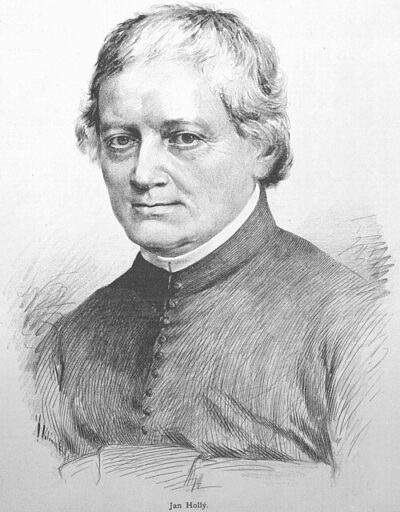
Ján Hollý
Ján Hollý was a Slovak Catholic priest, writer, poet and translator. Born March 24, 1785, in Borský Mikuláš. Died April 14, 1849, in Dobrá Voda.
Facts
14 facts · 2 confirmed by two sources · 4 cited · 8 from one source
Where this comes from
Papalocal keeps its own record. It started from these sources; what each one said is kept here as it was copied, so a change on their side never changes this page by itself. Tap one to read its version.
What Wikidata says · copied November 18, 2026 · revision 2565008059
- Described as
- Slovak Catholic priest, writer, poet and translator
- Other names
- Jan Holly
- Born
- March 24, 1785 · 5 references
- Died
- April 14, 1849 · 5 references
- Born in
- Borský Mikuláš · 1 reference
- Died in
- Dobrá Voda · 1 reference
- Citizen of
- Austrian Empire; Slovakia · 1 reference; Kingdom of Hungary
- Occupation
- linguist; poet; writer · 2 references; Catholic priest; translator · 1 reference; cleric · 1 reference
- Religion
- Catholic Church
- Wikipedias with a page
- 22
Wikidata item Q1383201 (wikidata.org/wiki/Q1383201), public domain (CC0). Copied November 18, 2026.
What Wikipedia says · copied November 18, 2026 · revision 1386013716
Ján Hollý (contemporary orthography: Gán Hollí; 24 March 1785 – 14 April 1849) was a Slovak poet and translator. He was the first greater Slovak poet to write exclusively in the newly standardized literary Slovak language. His predecessors mostly wrote in various regional versions of Czech, Slovakized Czech or Latin. Hollý translated Virgil's Aeneid and wrote his own epic poetry in alexandrine verse to show that the Slovak language recently standardized by Anton Bernolák was capable of expressing complex poetic forms.
- Born, in its opening lines
- March 24, 1785
- Died, in its opening lines
- April 14, 1849
From the Wikipedia article “Ján Hollý” (en.wikipedia.org/wiki/Ján_Hollý), by its contributors, under CC BY-SA 4.0 (creativecommons.org/licenses/by-sa/4.0/). Copied November 18, 2026; not changed.
Confirmed Two sources agree. Cited One source, and it names where it got it. One source One source, without a reference of its own. Sources disagree The sources disagree. We show the best-supported value and keep theirs below.
