
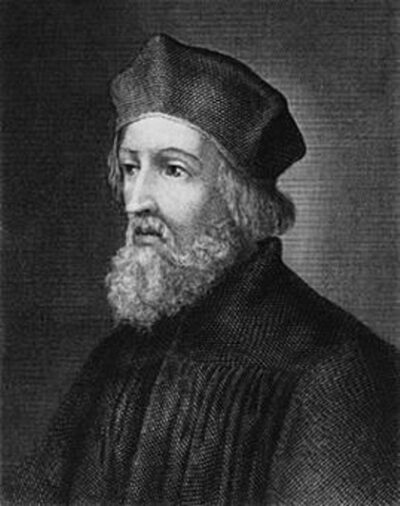
Jan Hus
Jan Hus was a Czech theologian, philosopher and preacher. Born 1370s, in Husinec. Died July 6, 1415, in Constance. Positions held include professor and rector. Educated at Charles University.
Facts
29 facts · 1 confirmed by two sources · 16 cited · 11 from one source · 1 where the sources disagree
What’s different
- Born: we show 1370s (Sources disagree). Wikipedia says c. 1369
Where this comes from
Papalocal keeps its own record. It started from these sources; what each one said is kept here as it was copied, so a change on their side never changes this page by itself. Tap one to read its version.
What Wikidata says · copied November 16, 2026 · revision 2568996516
- Described as
- Czech theologian, philosopher and preacher (1369-1415)
- Other names
- John Hus, John Huss, Iohannes Hus, Johannes Huss, John Goose
- Born
- 1370s
- Died
- July 6, 1415 · 2 references
- Born in
- Husinec · 2 references
- Died in
- Constance · 3 references
- Buried in
- Rhine · 1 reference
- Cause of death
- death by burning
- Citizen of
- Kingdom of Bohemia; Holy Roman Empire · 1 reference
- Occupation
- translator; theologian · 1 reference; university teacher · 1 reference; writer · 1 reference; philosopher · 1 reference; pastor · 1 reference; linguist · 1 reference; teacher · 1 reference
- Positions held
- professor; rector · 1 reference
- Worked for
- Charles University
- Education
- Charles University (–1393)
- Field
- theology · 1 reference; educational system · 1 reference; Protestant Reformation · 1 reference; literature · 1 reference; linguistics · 1 reference; Czech studies · 1 reference
- Religion
- Proto-Protestantism; Catholicism
- Lived in
- Birth house of Jan Hus
- Wikipedias with a page
- 106
Wikidata item Q43977 (wikidata.org/wiki/Q43977), public domain (CC0). Copied November 16, 2026.
What Wikipedia says · copied November 16, 2026 · revision 1384568932
Jan Hus (; Czech: [ˈjan ˈɦus] ; c. 1369 – 6 July 1415), sometimes anglicized as John Hus or John Huss, and referred to in historical texts as Johannes Hus or Johannes Huss, was a Czech Christian theologian and philosopher who became a Church reformer and the inspiration of Hussitism, a key predecessor to Protestantism, and a seminal figure in the Bohemian Reformation. Hus is considered to be the first Church reformer, even though some designate the theorist John Wycliffe. His teachings had a strong influence, most immediately in the approval of a reformed Bohemian religious denomination and, over a century later, on Martin Luther.
After being ordained as a Catholic priest, Hus began to preach in Prague. He opposed many aspects of the Catholic Church in Bohemia, such as its views on ecclesiology, simony, the Eucharist, and other theological topics. Hus was a master, dean, and rector at the Charles University in Prague between 1409 and 1410.
Alexander V issued a Papal bull that excommunicated Hus; however, it was not enforced, and Hus continued to preach. Hus then spoke out against Alexander V's successor, Antipope John XXIII, for his selling of indulgences. Hus's excommunication was then enforced, and he spent the next two years living in exile.
When the Council of Constance assembled, Hus was asked to be there and present his views on the dissension within the Church. When he arrived, he not only enjoyed the safe conduct to the city but "During the first few weeks of his residence in Constance, Hus enjoyed a tolerable share of liberty." At a later date he was arrested and put in prison. He was eventually taken in front of the council and asked to recant his views. He refused. On 6 July 1415, he was burned at the stake for heresy against the teachings of the Catholic Church.
After Hus was executed, the followers of his religious teachings (known as Hussites) refused to elect another Catholic monarch and defeated five consecutive papal crusades between 1420 and 1431 in what became known as the Hussite Wars. Both the Bohemian and the Moravian populations remained majority Hussite until the 1620s, when a Protestant defeat in the Battle of the White Mountain resulted in the Lands of the Bohemian Crown coming under Habsburg dominion for the next 300 years and being subject to immediate and forced conversion to Catholicism in an intense campaign.
- Born, in its opening lines
- c. 1369
- Died, in its opening lines
- July 6, 1415
From the Wikipedia article “Jan Hus” (en.wikipedia.org/wiki/Jan_Hus), by its contributors, under CC BY-SA 4.0 (creativecommons.org/licenses/by-sa/4.0/). Copied November 16, 2026; not changed.
Confirmed Two sources agree. Cited One source, and it names where it got it. One source One source, without a reference of its own. Sources disagree The sources disagree. We show the best-supported value and keep theirs below.
