
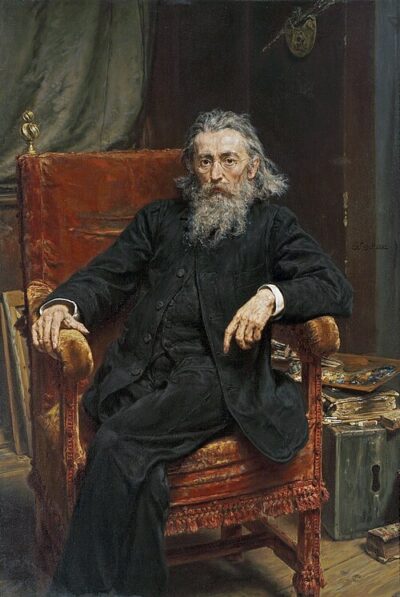
Jan Matejko
Jan Matejko was a Polish painter. Born June 24, 1838, in Free City of Kraków. Died November 1, 1893, in Kraków. Known for Prussian Homage, Battle of Grunwald and Constitution of May 3, 1791. Educated at Jan Matejko Academy of Fine Arts in Krakow and Jagiellonian University. Awards include Knight of the Legion of Honour and Order of the Iron Crown (Austria).
Facts
40 facts · 2 confirmed by two sources · 5 cited · 33 from one source
Where this comes from
Papalocal keeps its own record. It started from these sources; what each one said is kept here as it was copied, so a change on their side never changes this page by itself. Tap one to read its version.
What Wikidata says · copied November 16, 2026 · revision 2565110609
- Described as
- Polish painter (1838–1893)
- Other names
- Jan Alojzy Matejko, Johann Matejko, Jana Matejki, j. matejko, jan matejko, J. Mateijko, Matejko, Jean Aloysius Matejko
- Born
- June 24, 1838 · 4 references
- Died
- November 1, 1893 · 11 references
- Born in
- Free City of Kraków · 2 references
- Died in
- Kraków · 2 references
- Buried in
- Rakowicki Cemetery
- Citizen of
- Free City of Kraków; Cisleithania
- Occupation
- painter · 1 reference; university teacher
- Worked for
- Jagiellonian University
- Education
- Jan Matejko Academy of Fine Arts in Krakow (1852–1858); Jagiellonian University · 1 reference; Academy of Fine Arts, Munich; Bartłomiej Nowodworski High School
- Member of
- Serbian Academy of Sciences and Arts; Serbian Learned Society; Towarzystwo Naukowe Krakowskie · 1 reference; Académie des beaux-arts
- Genre
- history painting; portrait painting; animal painting; religious painting
- Known for
- Prussian Homage; Battle of Grunwald; Constitution of May 3, 1791; Stańczyk
- Awards
- Knight of the Legion of Honour; Order of the Iron Crown (Austria) · 1 reference
- Field
- painting; art of drawing; education
- Spouse
- Teodora Matejko · 1 reference
- Children
- Helena Unierzyska; Beata Kirchmajer
- Father
- Franciszek Ksawery Matejko
- Mother
- Joanna Karolina Rossberg
- Siblings
- Franciszek Matejko; Maria Matejko
- Religion
- Catholicism · 1 reference
- Lived in
- Kraków
- Wikipedias with a page
- 62
Wikidata item Q189117 (wikidata.org/wiki/Q189117), public domain (CC0). Copied November 16, 2026.
What Wikipedia says · copied November 16, 2026 · revision 1383692232
Jan Alojzy Matejko (Polish pronunciation: [ˈjan aˈlɔjzɨ maˈtɛjkɔ] ; also known as Jan Mateyko; 24 June 1838 – 1 November 1893) was a Polish painter, a leading 19th-century exponent of history painting, known for depicting nodal events from Polish history. His works include large scale oil paintings such as Stańczyk (1862), Rejtan (1866), Union of Lublin (1869), Astronomer Copernicus, or Conversations with God (1873), or Battle of Grunwald (1878). He was the author of numerous portraits, a gallery of Polish monarchs in book form, and murals in St. Mary's Basilica, Kraków. He is considered by many as the most celebrated Polish painter, and sometimes as the "national painter" of Poland.
Born to a Czech father and German-Polish mother, Matejko spent most of his life in Kraków. He enrolled at the Kraków Academy of Fine Arts at age fourteen, where he studied under notable artists such as Wojciech Korneli Stattler and Władysław Łuszczkiewicz and completed his first major historical painting in 1853. His early exposure to revolutions in Kraków and the military service of his brothers influenced his artistic themes. After studying art in Munich and Vienna, he returned to Kraków and set up a studio. He gradually gained recognition, selling key paintings that settled his debts and created some of his most famous works, including Stańczyk and Skarga's Sermon. Matejko's art played a key role in promoting Polish history and national identity at a time when Poland was partitioned and lacked political autonomy.
At the same time, Matejko's painting style has been criticised as old-fashioned and overly theatrical, labeled as "antiquarian realism". His works often lost their nuanced historical significance when displayed abroad due to the audience's unfamiliarity with Polish history. Matejko's support for the Polish cause was not just through his art; he also contributed financially and materially to the January Uprising of 1863. Later, he became director of the art academy in Kraków, which was eventually renamed the Jan Matejko Academy of Fine Arts. A number of his students became prominent artists in their own right, including Maurycy Gottlieb, Jacek Malczewski, Józef Mehoffer and Stanisław Wyspiański. He received several honors during his lifetime, including the French Légion d'honneur. Matejko was among the notable people to receive an unsolicited letter from the German philosopher Friedrich Nietzsche, as the latter tipped, in January 1889, into his psychotic breakdown while in Turin.
- Born, in its opening lines
- June 24, 1838
- Died, in its opening lines
- November 1, 1893
From the Wikipedia article “Jan Matejko” (en.wikipedia.org/wiki/Jan_Matejko), by its contributors, under CC BY-SA 4.0 (creativecommons.org/licenses/by-sa/4.0/). Copied November 16, 2026; not changed.
Confirmed Two sources agree. Cited One source, and it names where it got it. One source One source, without a reference of its own. Sources disagree The sources disagree. We show the best-supported value and keep theirs below.
