
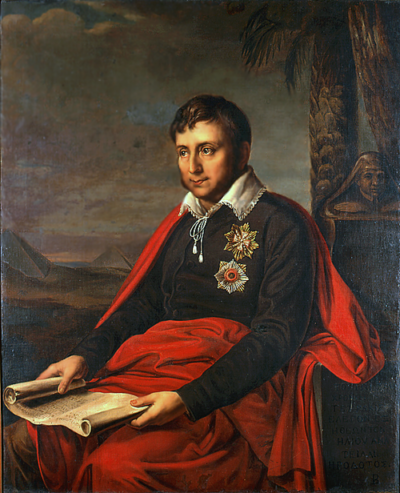
Jan Potocki
Jan Potocki was a Polish nobleman, writer (creating in French), traveler, politician and historian. Born March 8, 1761, in Pykiv. Died December 23, 1815, in Uladivka. Positions held include Deputy to the Sejm of the Polish–Lithuanian Commonwealth. Awards include Order of the White Eagle, Order of St. Vladimir, 1st class and Order of Saint Stanislaus.
Facts
34 facts · 2 confirmed by two sources · 7 cited · 25 from one source
Where this comes from
Papalocal keeps its own record. It started from these sources; what each one said is kept here as it was copied, so a change on their side never changes this page by itself. Tap one to read its version.
What Wikidata says · copied November 16, 2026 · revision 2565545281
- Described as
- Polish nobleman, writer (creating in French), traveler, politician and historian (1761-1815)
- Other names
- Count Jan Potocki
- Born
- March 8, 1761 · 11 references
- Died
- December 23, 1815 · 1 reference
- Born in
- Pykiv
- Died in
- Uladivka
- Cause of death
- gunshot wound
- Citizen of
- Polish–Lithuanian Commonwealth; Russian Empire
- Occupation
- anthropologist; historian · 1 reference; writer · 1 reference; engineer · 1 reference; archaeologist · 1 reference; military engineer; traveler · 1 reference; soldier · 1 reference
- Positions held
- Deputy to the Sejm of the Polish–Lithuanian Commonwealth
- Member of
- Saint Petersburg Academy of Sciences
- Awards
- Order of the White Eagle; Order of St. Vladimir, 1st class; Order of Saint Stanislaus
- Field
- travel; literature; history of Europe; aristocrat
- Spouse
- Julia Lubomirska; Konstancja Potocka
- Children
- Alfred Wojciech Potocki · 1 reference; Artur Potocki · 1 reference; Andrzej Bernard Potocki; Thérèse Potocka
- Father
- Józef Potocki
- Mother
- Anna Teresa Ossolińska
- Siblings
- Seweryn Potocki
- Lived in
- Saint Petersburg · 1 reference
- Wikipedias with a page
- 37
Wikidata item Q367109 (wikidata.org/wiki/Q367109), public domain (CC0). Copied November 16, 2026.
What Wikipedia says · copied November 16, 2026 · revision 1375969060
Count Jan Potocki (Polish pronunciation: [ˈjan pɔˈtɔt͡skʲi]; 8 March 1761 – 23 December 1815) was a Polish nobleman, ethnologist, linguist, traveller and author of the Enlightenment period, whose life and exploits made him a celebrated figure in Poland. He is known chiefly for his picaresque novel, The Manuscript Found in Saragossa.
Born into affluent Polish nobility, Potocki lived abroad from an early age and was primarily educated in Switzerland. He frequently visited the salons of Paris and toured Europe before temporarily returning to Poland in 1778. As a soldier, he fought in Austrian ranks in the War of the Bavarian Succession, and in 1789 was appointed a military engineer in the Polish army. During his extensive voyages he actively documented prevailing customs, ongoing wars, revolutions and national awakenings, which made him a pioneer of travel literature. Fascinated by the occult, Potocki studied ancient cultures, rituals and secret societies. Simultaneously, he was a member of parliament and took part in the Great Sejm shortly before the Polish–Lithuanian Commonwealth ceased to exist.
In spite of his literary career, Count Potocki became burdened by mental illness and melancholy. He committed suicide by gunshot in 1815; however, the circumstances of his death remain controversial to this day.
- Born, in its opening lines
- March 8, 1761
- Died, in its opening lines
- December 23, 1815
From the Wikipedia article “Jan Potocki” (en.wikipedia.org/wiki/Jan_Potocki), by its contributors, under CC BY-SA 4.0 (creativecommons.org/licenses/by-sa/4.0/). Copied November 16, 2026; not changed.
Confirmed Two sources agree. Cited One source, and it names where it got it. One source One source, without a reference of its own. Sources disagree The sources disagree. We show the best-supported value and keep theirs below.
