
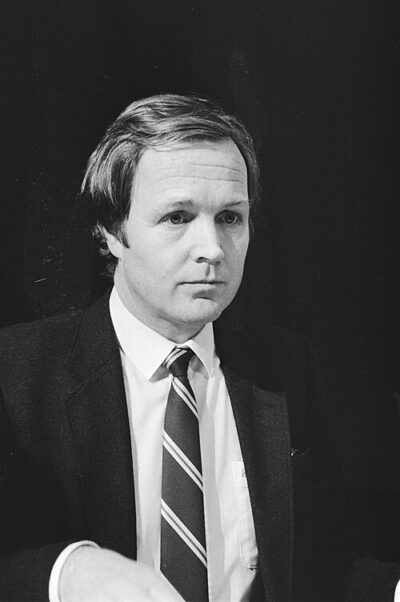
Jan Terlouw
Jan Terlouw was a Dutch politician, physicist and author. Born November 15, 1931, in Kamperveen. Died May 16, 2025, in Twello. Positions held include member of the House of Representatives of the Netherlands (1971–1981), member of the Senate of the Netherlands (1999–2003) and Deputy Prime Minister of the Netherlands (1981–1982). Educated at Utrecht University. Awards include Gouden Griffel (2 times), De Kinderjury and honorary doctorate of the Vrije Universiteit Brussel.
Facts
32 facts · 2 confirmed by two sources · 9 cited · 21 from one source
Where this comes from
Papalocal keeps its own record. It started from these sources; what each one said is kept here as it was copied, so a change on their side never changes this page by itself. Tap one to read its version.
What Wikidata says · copied November 18, 2026 · revision 2570353067
- Described as
- Dutch politician, physicist and author
- Other names
- J.C. Terlouw, Jan Cornelis Terlouw
- Born
- November 15, 1931 · 5 references
- Died
- May 16, 2025 · 1 reference
- Born in
- Kamperveen · 1 reference
- Died in
- Twello · 1 reference
- Name at birth
- Jan Cornelis Terlouw
- Citizen of
- Kingdom of the Netherlands · 2 references
- Occupation
- politician · 2 references; screenwriter; children's writer · 1 reference; astrophysicist; nuclear physicist; physicist · 1 reference
- Positions held
- member of the House of Representatives of the Netherlands (1971–1981) · 1 reference; member of the Senate of the Netherlands (1999–2003) · 1 reference; Deputy Prime Minister of the Netherlands (1981–1982); Leader of the Democrats 66 (1973–1982); Minister of Economic Affairs (1981–1982) · 1 reference; municipal councillor of Utrecht (1970–1971); King's Commissioner of Gelderland (1991–1996)
- Political party
- Democrats 66
- Worked for
- Massachusetts Institute of Technology; Royal Institute of Technology; Utrecht University · 1 reference
- Education
- Utrecht University
- Awards
- Gouden Griffel (2 times) (1972, 1973) · 1 reference; De Kinderjury (1990) · 1 reference; honorary doctorate of the Vrije Universiteit Brussel (2017) · 1 reference; Commander of the Order of Orange-Nassau (1982)
- Spouse
- Alexandra Terlouw-van Hulst · 1 reference
- Children
- Sanne Terlouw; Ashley Terlouw
- Lived in
- Twello · 1 reference
- Wikipedias with a page
- 22
Wikidata item Q1397450 (wikidata.org/wiki/Q1397450), public domain (CC0). Copied November 18, 2026.
What Wikipedia says · copied November 18, 2026 · revision 1347306220
Jan Cornelis Terlouw (15 November 1931 – 16 May 2025) was a Dutch politician, physicist and author. A member of the Democrats 66 (D66) party, he served as Deputy Prime Minister of the Netherlands from 1981 to 1982 under Prime Minister Dries van Agt.
Terlouw studied physics at the Utrecht University where he obtained his master's degree and then worked as a researcher at the FOM before finishing his thesis and obtaining his PhD in mathematics and physics. Terlouw worked as a nuclear physics researcher at the Massachusetts Institute of Technology (MIT) from February 1960 until April 1962, and for the Royal Institute of Technology (KTH) from August 1965 until December 1966. After the 1971 general election Terlouw was elected to the House of Representatives on 11 May 1971 and served as a frontbencher and spokesperson for economic affairs and science. After Party Leader and Parliamentary leader Hans van Mierlo announced he was stepping down, Terlouw was unanimously selected as his successor on 1 September 1973.
For the 1977 and 1981 general elections, Terlouw served as lead candidate, and following a cabinet formation with Christian democratic Leader Dries van Agt and Labour Leader Joop den Uyl formed the second Van Agt cabinet, with Terlouw appointed Deputy Prime Minister and Minister of Economic Affairs, taking office on 11 September 1981. The cabinet fell just seven months into its term and was replaced by the caretaker third Van Agt cabinet, with Terlouw continuing his offices. For the 1982 general election, Terlouw again served as lead candidate but shortly thereafter announced he was stepping down as Leader on 8 September 1982.
Terlouw continued to be active in politics and in December 1982 he was nominated as the next Secretary-General of the European Conference of Ministers of Transport (ECMT - evolved in 2006 into the International Transport Forum, ITF) serving from 30 January 1983 until 15 October 1991. In October 1991 Terlouw was nominated as the next Queen's Commissioner of Gelderland serving from 1 November 1991 until 1 December 1996. Terlouw also became active in the public sector, and worked as a professor of Urbanization at the University of Amsterdam from January 1997 until January 2000. After the Senate election of 1999 Terlouw was elected as a Member of the Senate serving from 8 June 1999 until 10 June 2003 and served as a frontbencher and spokesperson for the interior, economic affairs and defence.
Terlouw retired from active politics at 71 but continued to be active in the public sector as a non-profit director and served on several state commissions (nl) and councils on behalf of the government, and worked as a professor of Literature at the Tilburg University from September 2003 until September 2004. Following his retirement Terlouw continued to be active as an advocate and activist for social norms, sustainable development, animal welfare and for more European integration. Terlouw was known for his abilities as a consensus builder and negotiator and continued to comment on political affairs in his final years.
Terlouw was active as a prolific author since the 1970s, having written more than dozen young adult fiction books: his 1972 novel Winter in Wartime was adapted and released as a feature film in 2008.
- Born, in its opening lines
- November 15, 1931
- Died, in its opening lines
- May 16, 2025
From the Wikipedia article “Jan Terlouw” (en.wikipedia.org/wiki/Jan_Terlouw), by its contributors, under CC BY-SA 4.0 (creativecommons.org/licenses/by-sa/4.0/). Copied November 18, 2026; not changed.
Confirmed Two sources agree. Cited One source, and it names where it got it. One source One source, without a reference of its own. Sources disagree The sources disagree. We show the best-supported value and keep theirs below.
