
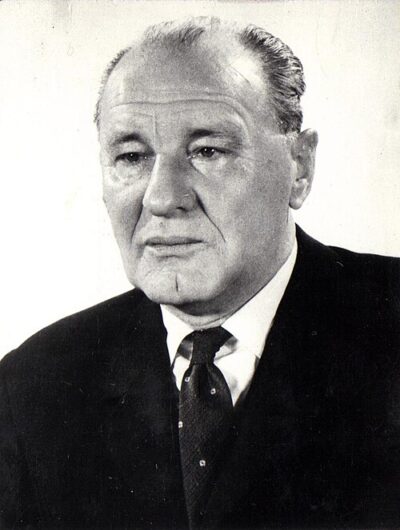
János Kádár
János Kádár was a former General Secretary of the Hungarian Socialist Workers' Party. Born May 26, 1912, in Rijeka. Died July 6, 1989, in Budapest. Positions held include Prime Minister of Hungary (2 times) (1956–1965), member of Central Committee of the Hungarian Socialist Workers' Party (1957–1989) and member of the Provisional National Assembly (1945). Awards include Order of Lenin, Hero of the Soviet Union and Order of Klement Gottwald.
Facts
35 facts · 2 confirmed by two sources · 9 cited · 23 from one source · 1 where the sources disagree
What’s different
- Buried in: we show Budapest (Sources disagree). Wikidata also lists Fiume Road Graveyard
Where this comes from
Papalocal keeps its own record. It started from these sources; what each one said is kept here as it was copied, so a change on their side never changes this page by itself. Tap one to read its version.
What Wikidata says · copied November 16, 2026 · revision 2562763874
- Described as
- former General Secretary of the Hungarian Socialist Workers' Party
- Other names
- Janos Kadar, János Csermanek, János József Czermanik
- Born
- May 26, 1912 · 11 references
- Died
- July 6, 1989 · 10 references
- Born in
- Rijeka · 2 references
- Died in
- Budapest · 1 reference
- Buried in
- Fiume Road Graveyard · 1 reference; Budapest · 3 references
- Name at birth
- Czermanik János József
- Citizen of
- Hungary
- Occupation
- politician · 1 reference; economist
- Positions held
- Prime Minister of Hungary (2 times) (1956–1965); member of Central Committee of the Hungarian Socialist Workers' Party (1957–1989) · 1 reference; member of the Provisional National Assembly (1945) · 1 reference; member of the National Assembly of Hungary (2 times) (1945–1989) · 1 reference; party secretary (1954–1956) · 1 reference; member of the HWP Central Directorate Resolution (1948–1951) · 1 reference
- Political party
- Hungarian Communist Party; Hungarian Working People's Party; Hungarian Socialist Workers' Party; Communist Party of Hungary
- Awards
- Order of Lenin (1972) · 1 reference; Hero of the Soviet Union (1964); Order of Klement Gottwald; Grand Cross of the Order of Merit of Hungary; Lenin Peace Prize; Jubilee Medal "In Commemoration of the 100th Anniversary of the Birth of Vladimir Ilyich Lenin"; Order of Merit of the Hungarian People's Republic; Order of José Martí; Order of the October Revolution; Order of Merit of the Republic of Poland · 1 reference; Order of the Queen of Sheba · 1 reference; Star of the Republic of Indonesia · 1 reference; Order of the Yugoslav Star · 1 reference; Order of the Nile · 1 reference; Order of the National Flag · 1 reference
- Spouse
- Mária Tamáska
- Wikipedias with a page
- 66
Wikidata item Q200850 (wikidata.org/wiki/Q200850), public domain (CC0). Copied November 16, 2026.
What Wikipedia says · copied November 16, 2026 · revision 1385916297
János József Kádár (né Csermanek; 26 May 1912 – 6 July 1989) was a Hungarian Communist leader and the General Secretary of the Hungarian Socialist Workers' Party, a position he held for 32 years. Declining health led to his retirement in 1988, and he died in 1989 after being hospitalized for pneumonia.
Kádár was born in Fiume in poverty to a single mother. After living in the countryside for some years, Kádár and his mother moved to Budapest. He joined the Party of Communists in Hungary's youth organization, KIMSZ, and went on to become a prominent figure in the pre-1939 Communist party, eventually becoming First Secretary. As a leader, he would dissolve the party and reorganize it as the Peace Party, but the new party failed to win much popular support.
After World War II, with Soviet support, the Communist party took power in Hungary. Kádár rose through the party ranks, serving as Interior Minister from 1948 to 1950. In 1951, he was imprisoned by the government of Mátyás Rákosi but was released in 1954 by reformist Prime Minister Imre Nagy. On 25 October 1956, during the Hungarian Revolution, Kádár replaced Ernő Gerő as General Secretary of the Party, taking part in Nagy's revolutionary government. A week later, he broke with Nagy over his decision to withdraw from the Warsaw Pact. After Soviet intervention in Hungary, Kádár was selected to lead the country. He ordered Nagy to be executed shortly after coming to power. He gradually moderated, releasing the majority of remaining prisoners of this period in an amnesty in 1963. His leadership was characterized by unrelenting Realpolitik; for a long time, he successfully maneuvered between Moscow's wishes, local interests and the expectations of the Western world. In an interview with a Western journalist, he called himself a "toiler for compromise".
Kádár was succeeded by Károly Grósz as General Secretary on 22 May 1988. (Grósz would only serve a year in this post due to the fall of Communism in Europe in 1989.) During his time as leader of Hungary, Kádár pushed for an improvement in standards of living. Kádár increased international trade with non-communist countries, in particular those of Western Europe. Kádár's policies differed from those of other Communist leaders, such as Nicolae Ceaușescu, Enver Hoxha, and Erich Honecker, all of whom favored more orthodox interpretations of Marxism–Leninism. Kádár's reformist policies and the increasing commercial ties to the Western World would in turn worsen relations with Leonid Brezhnev in the Soviet Union. As the leader of Hungary, Kádár attempted to liberalize the Hungarian economy with a greater focus on consumer goods, in what would become known as Goulash Communism. Kádár’s legacy remains contested; nevertheless, nostalgia for the Kádár era continues to be widespread in Hungary. A 2020 survey conducted by Policy Solutions found that 54% of respondents believe that life was better under Kádár than it is at present, whereas 31% disagreed with this assessment.
- Born, in its opening lines
- May 26, 1912
- Died, in its opening lines
- July 6, 1989
From the Wikipedia article “János Kádár” (en.wikipedia.org/wiki/János_Kádár), by its contributors, under CC BY-SA 4.0 (creativecommons.org/licenses/by-sa/4.0/). Copied November 16, 2026; not changed.
Confirmed Two sources agree. Cited One source, and it names where it got it. One source One source, without a reference of its own. Sources disagree The sources disagree. We show the best-supported value and keep theirs below.
