
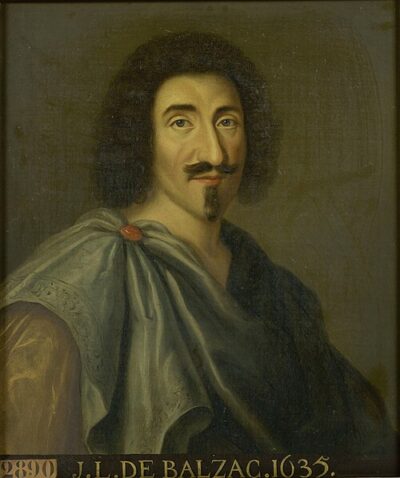
Jean-Louis Guez de Balzac
Jean-Louis Guez de Balzac was a French author, best known for his epistolary essays. Born May 31, 1597, in Angoulême. Died February 18, 1654, in Angoulême. Positions held include Member of the Académie française (1634–1654). Educated at University of Poitiers.
Facts
11 facts · 2 confirmed by two sources · 2 cited · 7 from one source
Where this comes from
Papalocal keeps its own record. It started from these sources; what each one said is kept here as it was copied, so a change on their side never changes this page by itself. Tap one to read its version.
What Wikidata says · copied November 16, 2026 · revision 2567490970
- Described as
- French author, best known for his epistolary essays
- Other names
- Jean Louis Guez de Balzac
- Born
- May 31, 1597 · 4 references
- Died
- February 18, 1654 · 3 references
- Born in
- Angoulême · 1 reference
- Died in
- Angoulême
- Buried in
- Angoulême
- Citizen of
- France
- Occupation
- writer · 2 references; historian
- Positions held
- Member of the Académie française (1634–1654)
- Education
- University of Poitiers
- Member of
- Académie Française (1634–)
- Wikipedias with a page
- 33
Wikidata item Q1248124 (wikidata.org/wiki/Q1248124), public domain (CC0). Copied November 16, 2026.
What Wikipedia says · copied November 16, 2026 · revision 1351119067
Jean-Louis Guez de Balzac (31 May 1597 – 18 February 1654) was a French author in Baroque Précieuses style, best known for his epistolary essays, which were widely circulated and read in his day. He was one of the founding members of the Académie française.
- Born, in its opening lines
- May 31, 1597
- Died, in its opening lines
- February 18, 1654
From the Wikipedia article “Jean-Louis Guez de Balzac” (en.wikipedia.org/wiki/Jean-Louis_Guez_de_Balzac), by its contributors, under CC BY-SA 4.0 (creativecommons.org/licenses/by-sa/4.0/). Copied November 16, 2026; not changed.
Confirmed Two sources agree. Cited One source, and it names where it got it. One source One source, without a reference of its own. Sources disagree The sources disagree. We show the best-supported value and keep theirs below.
