
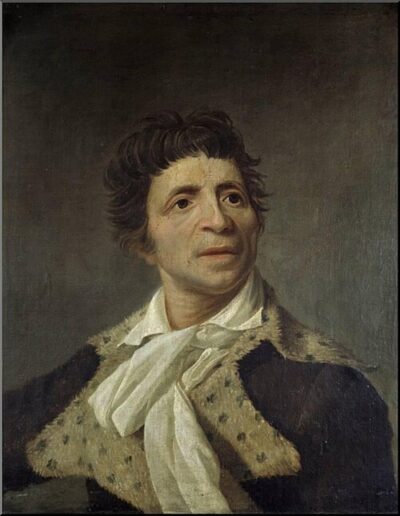
Jean-Paul Marat
Jean-Paul Marat was a politician and journalist during the French Revolution. Born May 24, 1743, in Boudry. Died July 13, 1793, in Paris. Positions held include deputy to the National Convention (1792–1793). Known for Les Chaînes de l'esclavage. Educated at University of St Andrews.
Facts
19 facts · 2 confirmed by two sources · 7 cited · 10 from one source
Where this comes from
Papalocal keeps its own record. It started from these sources; what each one said is kept here as it was copied, so a change on their side never changes this page by itself. Tap one to read its version.
What Wikidata says · copied November 16, 2026 · revision 2569086725
- Described as
- politician and journalist during the French Revolution (1743-1793)
- Other names
- Jean Paul Marat
- Born
- May 24, 1743 · 12 references
- Died
- July 13, 1793 · 12 references
- Born in
- Boudry · 2 references
- Died in
- Paris · 2 references
- Buried in
- Panthéon (1793–1795)
- Cause of death
- stab wound
- Citizen of
- France · 2 references
- Occupation
- politician · 4 references; journalist · 1 reference; physician · 1 reference
- Positions held
- deputy to the National Convention (1792–1793) · 2 references
- Political party
- Jacobins · 1 reference; Cordeliers
- Education
- University of St Andrews
- Known for
- Les Chaînes de l'esclavage
- Spouse
- Simone Évrard
- Father
- Jean-Baptiste Marat
- Siblings
- Charlotte Albertine Marat · 1 reference; David de Boudry
- Wikipedias with a page
- 87
Wikidata item Q122290 (wikidata.org/wiki/Q122290), public domain (CC0). Copied November 16, 2026.
What Wikipedia says · copied November 16, 2026 · revision 1384913596
Jean-Paul Marat (UK: , US: ; French: [ʒɑ̃pɔl maʁa]; born Mara; 24 May 1743 – 13 July 1793) was a French scientist, physician, political theorist, journalist, and politician. Before the French Revolution, he pursued a career in medicine and science and spent more than ten years abroad. He published works on subjects including optics, electricity, political theory, and criminal law. During the Revolution he became one of its most prolific, radical and controversial journalists. Through his newspaper L'Ami du peuple (The Friend of the People), Marat responded rapidly to political events but also publicized complaints and grievances brought to him by ordinary citizens, presenting himself as their advocate against officials and others whom he accused of injustice or abuse.
Marat became closely associated with the sans-culottes and the radical politics of Paris. Unable to find printers willing to publish some of his more controversial writings, he established his own printing press and continued to publish despite repeated attempts by the authorities to suppress his newspaper, spending periods in hiding.
Marat was elected to the National Convention in September 1792 and aligned with the Montagnards in their struggle against the Girondins. His journalism became notorious for increasingly violent calls for the punishment and sometimes the pre-emptive killing of those he regarded as enemies of the Revolution. Marat repeatedly justified such violence as a means of preventing greater bloodshed. His writings and political activity have consequently remained central to debates about political violence during the Revolution, including the September Massacres.
In early June 1793, he played an active part in the conflict that culminated in the fall of the Girondins. On 13 July 1793, Marat was assassinated by Charlotte Corday, a Girondin sympathizer, while taking a bath to alleviate a debilitating skin condition.
Marat's assassination transformed his political image. Jacques-Louis David took a leading role in organizing his funeral ceremonies, while popular societies, the sections of Paris, and the Montagnards increasingly represented him as the murdered Ami du peuple and as a martyr of the Revolution. His remains were transferred to the Panthéon in September 1794, but during the Thermidorian Reaction his public cult rapidly collapsed and he was removed from the Panthéon in February 1795.
- Born, in its opening lines
- May 24, 1743
- Died, in its opening lines
- July 13, 1793
From the Wikipedia article “Jean-Paul Marat” (en.wikipedia.org/wiki/Jean-Paul_Marat), by its contributors, under CC BY-SA 4.0 (creativecommons.org/licenses/by-sa/4.0/). Copied November 16, 2026; not changed.
Confirmed Two sources agree. Cited One source, and it names where it got it. One source One source, without a reference of its own. Sources disagree The sources disagree. We show the best-supported value and keep theirs below.
