
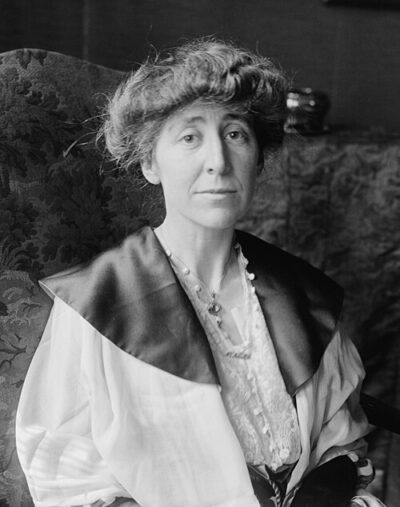
Jeannette Rankin
Jeannette Rankin was an American congresswoman for Montana. Born June 11, 1880, in Missoula. Died May 18, 1973, in Carmel-by-the-Sea. Positions held include United States representative (2 times) (1917–1943). Educated at University of Montana and University of Washington. Awards include National Women's Hall of Fame, War Resisters League Peace Award and Georgia Women of Achievement.
Facts
29 facts · 2 confirmed by two sources · 16 cited · 11 from one source
Where this comes from
Papalocal keeps its own record. It started from these sources; what each one said is kept here as it was copied, so a change on their side never changes this page by itself. Tap one to read its version.
What Wikidata says · copied November 13, 2026 · revision 2564471263
- Described as
- American congresswoman for Montana (1880-1973)
- Other names
- Jeannette P. Rankin, Jeannette Pickering Rankin
- Born
- June 11, 1880 · 6 references
- Died
- May 18, 1973 · 7 references
- Born in
- Missoula · 3 references
- Died in
- Carmel-by-the-Sea · 4 references
- Buried in
- Missoula Cemetery · 2 references
- Name at birth
- Jeannette Pickering Rankin · 1 reference
- Citizen of
- United States
- Occupation
- politician · 2 references; social worker · 1 reference; pacifist · 2 references; women's rights activist · 1 reference; peace activist; suffragist; feminist · 1 reference
- Positions held
- United States representative (2 times) (1917–1943)
- Political party
- Republican Party
- Education
- University of Montana (–1902); University of Washington · 1 reference; Columbia University School of Social Work (1908–1909) · 2 references
- Member of
- Women's International League for Peace and Freedom
- Awards
- National Women's Hall of Fame (1993) · 2 references; War Resisters League Peace Award (1958) · 1 reference; Georgia Women of Achievement (2005) · 1 reference
- Siblings
- Edna Rankin McKinnon; Grace Rankin Kinney; Wellington D. Rankin · 1 reference
- Lived in
- Missoula · 1 reference; Rankin Ranch; Watkinsville
- Wikipedias with a page
- 51
Wikidata item Q232407 (wikidata.org/wiki/Q232407), public domain (CC0). Copied November 13, 2026.
What Wikipedia says · copied November 13, 2026 · revision 1384220430
Jeannette Pickering Rankin (June 11, 1880 – May 18, 1973) was an American politician and women's rights advocate who became the first woman to hold federal office in the United States. She was elected to the U.S. House of Representatives as a Republican from Montana in 1916 for one term, then was elected again in 1940. Rankin remains the only woman ever elected to Congress from Montana.
Each of Rankin's congressional terms coincided with the initiation of U.S. military intervention in both world wars. A lifelong pacifist, she was one of 50 House members who opposed the declaration of war on Germany in 1917. In 1941, she was the sole member of Congress to vote against the declaration of war on Japan following the attack on Pearl Harbor. She remains the last member of Congress to vote against a declaration of war. The last time the United States issued a formal declaration of war was in June 1942, when the United States declared war on Hungary, Romania, and Bulgaria, from which Rankin abstained.
A suffragist during the Progressive Era, Rankin organized and lobbied for legislation enfranchising women in several states, including Montana, New York, and North Dakota. While in Congress, she introduced legislation that eventually became the 19th Constitutional Amendment, granting unrestricted voting rights to 26 million women nationwide. She championed a multitude of diverse women's rights and civil rights causes throughout a career that spanned more than six decades. In 1920, she helped found the American Civil Liberties Union and served as a vice president.
- Born, in its opening lines
- June 11, 1880
- Died, in its opening lines
- May 18, 1973
From the Wikipedia article “Jeannette Rankin” (en.wikipedia.org/wiki/Jeannette_Rankin), by its contributors, under CC BY-SA 4.0 (creativecommons.org/licenses/by-sa/4.0/). Copied November 13, 2026; not changed.
Confirmed Two sources agree. Cited One source, and it names where it got it. One source One source, without a reference of its own. Sources disagree The sources disagree. We show the best-supported value and keep theirs below.
