
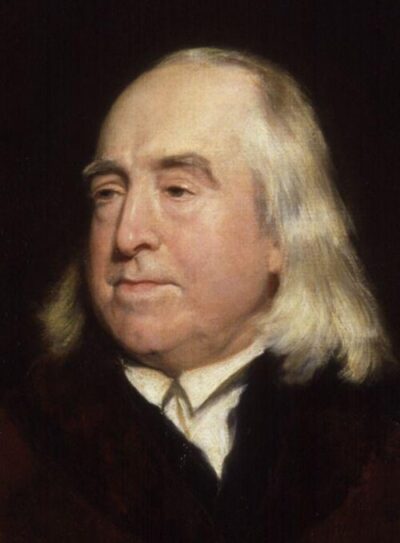
Jeremy Bentham
Jeremy Bentham was a British philosopher, jurist, and social reformer. Born February 15, 1748, in London. Died June 6, 1832, in London. Educated at Westminster School and The Queen's College.
Facts
27 facts · 1 confirmed by two sources · 13 cited · 11 from one source · 2 where the sources disagree
What’s different
- Born: we show February 15, 1748 (Sources disagree). Wikipedia says February 4, 1747
- Born in: we show London (Sources disagree). Wikidata also lists Houndsditch
Where this comes from
Papalocal keeps its own record. It started from these sources; what each one said is kept here as it was copied, so a change on their side never changes this page by itself. Tap one to read its version.
What Wikidata says · copied November 16, 2026 · revision 2567719967
- Described as
- British philosopher, jurist, and social reformer (1748–1832)
- Other names
- Bentham
- Born
- February 15, 1748 · 7 references
- Died
- June 6, 1832 · 10 references
- Born in
- Houndsditch; London · 2 references
- Died in
- London · 2 references
- Buried in
- University of London
- Citizen of
- Kingdom of Great Britain; France (1792) · 1 reference; United Kingdom of Great Britain and Ireland
- Occupation
- philosopher · 1 reference; merchant; lawyer; political scientist · 1 reference; suffragist · 1 reference; human rights defender · 1 reference; jurist · 2 references; animal rights advocate
- Education
- Westminster School (1755–1760) · 1 reference; The Queen's College (1760–) · 1 reference
- Field
- philosophy; law · 1 reference; social philosophy · 1 reference; civil and political rights · 1 reference; civil rights · 1 reference
- Father
- Jeremiah Bentham · 2 references
- Mother
- Alicia Woodward Grove · 1 reference
- Siblings
- Samuel Bentham · 1 reference
- Religion
- deism
- Wikipedias with a page
- 107
Wikidata item Q60887 (wikidata.org/wiki/Q60887), public domain (CC0). Copied November 16, 2026.
What Wikipedia says · copied November 16, 2026 · revision 1381607790
Jeremy Bentham (; 4 February 1747/8 O.S. [15 February 1748 N.S.] – 6 June 1832) was an English philosopher, jurist, and social reformer regarded as the founder of modern utilitarianism.
Bentham defined as the "fundamental axiom" of his philosophy the principle that "it is the greatest happiness of the greatest number that is the measure of right and wrong". He became a leading theorist in Anglo-American philosophy of law, and a political radical whose ideas influenced the development of welfarism. He advocated individual and economic freedoms, the separation of church and state, freedom of expression, equal rights for women, the right to divorce, and (in an unpublished essay) the decriminalizing of homosexual acts. He called for the abolition of slavery, and the abolition of capital punishment and physical punishment, including that of children. He has also become known as an early advocate of animal rights. Though strongly in favour of the extension of individual legal rights, he opposed the idea of natural law and natural rights (both of which are considered "divine" or "God-given" in origin), calling them "nonsense upon stilts". However, he viewed the Magna Carta as important, citing it to argue that the treatment of convicts in Australia was unlawful. Bentham was also a sharp critic of legal fictions.
Bentham's students included his secretary and collaborator James Mill, the latter's son, John Stuart Mill, the legal philosopher John Austin and American writer and activist John Neal. He "had considerable influence on the reform of prisons, schools, poor laws, law courts, and Parliament itself."
On his death in 1832, Bentham left instructions for his body to be first dissected and then to be permanently preserved as an "auto-icon" (or self-image), which would be his memorial. This was done, and the auto-icon is now on public display in the entrance of the Student Centre at University College London (UCL). Although he has been described as the "spiritual founder" of UCL due to his advocacy for the general availability of education, his direct involvement in the university's founding was limited.
Bentham is famous for his book An Introduction to the Principles of Morals and Legislation (1789), which presents his theory of utilitarianism and which is the first major book on the topic.
- Born, in its opening lines
- February 4, 1747
- Died, in its opening lines
- June 6, 1832
From the Wikipedia article “Jeremy Bentham” (en.wikipedia.org/wiki/Jeremy_Bentham), by its contributors, under CC BY-SA 4.0 (creativecommons.org/licenses/by-sa/4.0/). Copied November 16, 2026; not changed.
Confirmed Two sources agree. Cited One source, and it names where it got it. One source One source, without a reference of its own. Sources disagree The sources disagree. We show the best-supported value and keep theirs below.
