
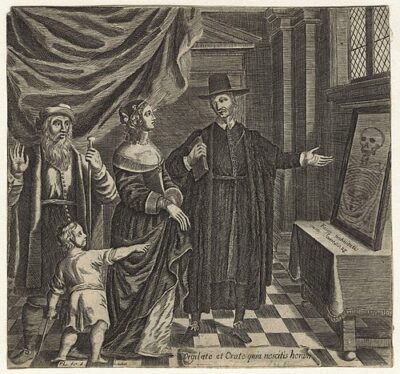
Jeremy Taylor
Jeremy Taylor was an English clergyman. Born August 15, 1613, in Cambridge. Died August 13, 1667, in Lisburn. Positions held include bishop. Educated at Gonville and Caius College.
Facts
14 facts · 2 confirmed by two sources · 4 cited · 8 from one source
Where this comes from
Papalocal keeps its own record. It started from these sources; what each one said is kept here as it was copied, so a change on their side never changes this page by itself. Tap one to read its version.
What Wikidata says · copied November 18, 2026 · revision 2567359070
- Described as
- English clergyman (1613–1667)
- Other names
- Shakespeare of Divines, Ceremi Teylor
- Born
- August 15, 1613 · 2 references
- Died
- August 13, 1667 · 5 references
- Born in
- Cambridge · 1 reference
- Died in
- Lisburn
- Buried in
- Dromore Cathedral
- Citizen of
- Kingdom of England
- Occupation
- theologian; writer · 2 references; Anglican priest; cleric · 1 reference; bishop · 1 reference
- Positions held
- bishop
- Education
- Gonville and Caius College
- Religion
- Anglicanism
- Wikipedias with a page
- 21
Wikidata item Q669076 (wikidata.org/wiki/Q669076), public domain (CC0). Copied November 18, 2026.
What Wikipedia says · copied November 18, 2026 · revision 1376824985
Jeremy Taylor (1613–1667) was an English cleric in the Church of England who achieved fame as an author during the Protectorate of Oliver Cromwell. He is sometimes known as the "Shakespeare of Divines" for his poetic style of expression, and he is frequently cited as one of the greatest prose writers in the English language.
Taylor was under the patronage of William Laud, Archbishop of Canterbury. He went on to become chaplain in ordinary to King Charles I as a result of Laud's sponsorship. This made him politically suspect when Laud was tried by Parliament and executed in January 1644/5 during the English Civil War. After the parliamentary victory over the King, he was briefly imprisoned several times.
Eventually, he was allowed to live quietly in Wales, where he became the private chaplain of the Earl of Carbery. After the Restoration, he was made Bishop of Down and Connor in Ireland. He also became Vice-Chancellor of the University of Dublin.
He is remembered in the liturgical calendars of the Church of England and other Anglican churches.
- Born, in its opening lines
- 1613
- Died, in its opening lines
- 1667
From the Wikipedia article “Jeremy Taylor” (en.wikipedia.org/wiki/Jeremy_Taylor), by its contributors, under CC BY-SA 4.0 (creativecommons.org/licenses/by-sa/4.0/). Copied November 18, 2026; not changed.
Confirmed Two sources agree. Cited One source, and it names where it got it. One source One source, without a reference of its own. Sources disagree The sources disagree. We show the best-supported value and keep theirs below.
