
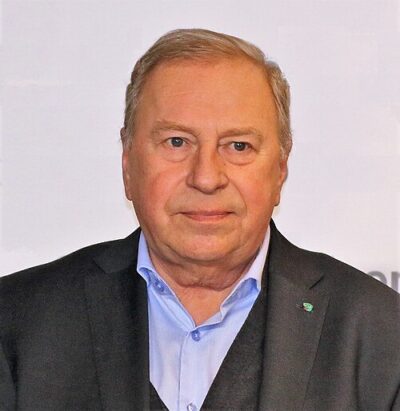
Jerzy Stuhr
Jerzy Stuhr was a Polish film and theater actor and screenwriter. Born April 18, 1947, in Kraków. Died July 9, 2024, in Kraków. Educated at Jagiellonian University and AST National Academy of Theatre Arts in Kraków. Awards include Golden Medal for Merit to Culture, Commander with Star of the Order of Polonia Restituta and Honoris Gratia.
Facts
43 facts · 2 confirmed by two sources · 16 cited · 25 from one source
Where this comes from
Papalocal keeps its own record. It started from these sources; what each one said is kept here as it was copied, so a change on their side never changes this page by itself. Tap one to read its version.
What Wikidata says · copied November 16, 2026 · revision 2569183920
- Described as
- Polish film and theater actor and screenwriter (1947–2024)
- Other names
- Jerzy Oskar Stuhr
- Born
- April 18, 1947 · 5 references
- Died
- July 9, 2024 · 2 references
- Born in
- Kraków · 2 references
- Died in
- Kraków · 1 reference
- Buried in
- Rakowicki Cemetery · 1 reference
- Citizen of
- Poland · 1 reference
- Occupation
- film director; university teacher; screenwriter · 1 reference; writer; film actor; stage actor; theatre director; pedagogue
- Worked for
- AST National Academy of Theatre Arts in Kraków · 1 reference; University of Silesia in Katowice · 1 reference; Helena Modrzejewska National Old Theater in Kraków · 1 reference
- Education
- Jagiellonian University (–1970); AST National Academy of Theatre Arts in Kraków; Stefan Żeromski Lyceum in Bielsko-Biała · 1 reference
- Member of
- Polish Film Academy · 1 reference; Central Commission for Academic Degrees and Titles · 1 reference
- Awards
- Golden Medal for Merit to Culture (2005) · 1 reference; Commander with Star of the Order of Polonia Restituta (2011) · 1 reference; Honoris Gratia (2012) · 1 reference; Knight of the Order of the Smile (2014); Paszport Polityki (1997) · 1 reference; Gold Cross of Merit · 1 reference; Polish Film Awards · 1 reference; Laur Krakowa XXI wieku (2007) · 1 reference; City of Kraków Award (1995) · 1 reference; Złote Lwy (1997) · 1 reference; Knight of the Order of Merit of the Italian Republic (2000) · 1 reference; Order of the Smile (2014); Annual award ACFK (2007) · 1 reference
- Field
- acting · 1 reference; dubbing · 1 reference; film direction · 1 reference; pedagogy of acting · 1 reference; creative and professional writing · 1 reference
- Spouse
- Barbara Stuhr (1971–2024) · 1 reference
- Children
- Maciej Stuhr · 1 reference; Marianna Stuhr · 1 reference
- Wikipedias with a page
- 50
Wikidata item Q55369 (wikidata.org/wiki/Q55369), public domain (CC0). Copied November 16, 2026.
What Wikipedia says · copied November 16, 2026 · revision 1379532305
Jerzy Oskar Stuhr (Polish: [ˈjɛʐɨ ˈɔskar ˈʂtur]; 18 April 1947 – 9 July 2024) was a Polish film and theatre actor. Considered one of the most popular, influential and versatile Polish actors and an icon of Polish cinema, he also worked as a screenwriter, film director, voice actor and drama professor. He served as the rector of the Ludwik Solski Academy for the Dramatic Arts in Kraków for two terms: from 1990 to 1996 and again from 2002 to 2008.
Throughout his long and prolific professional career spanning over five decades, he appeared in 65 films including Camera Buff (1979), Sexmission (1984), A Year of the Quiet Sun (1984), Dekalog: Ten (1989), Three Colours: White (1994), Kiler (1997), Love Stories (1997) and The Big Animal (2000).
He received numerous awards and honours including the Order of Merit of the Italian Republic (2000), Gloria Artis Medal for Merit to Culture (2005), Polish Academy Award for Best Supporting Actor for his role in Persona non grata (2006), Złota Kaczka Award (2008), Commander's Cross with Star of the Order of Polonia Restituta (2011), and Polish Academy Life Achievement Award (2018).
- Born, in its opening lines
- April 18, 1947
- Died, in its opening lines
- July 9, 2024
From the Wikipedia article “Jerzy Stuhr” (en.wikipedia.org/wiki/Jerzy_Stuhr), by its contributors, under CC BY-SA 4.0 (creativecommons.org/licenses/by-sa/4.0/). Copied November 16, 2026; not changed.
Confirmed Two sources agree. Cited One source, and it names where it got it. One source One source, without a reference of its own. Sources disagree The sources disagree. We show the best-supported value and keep theirs below.
