
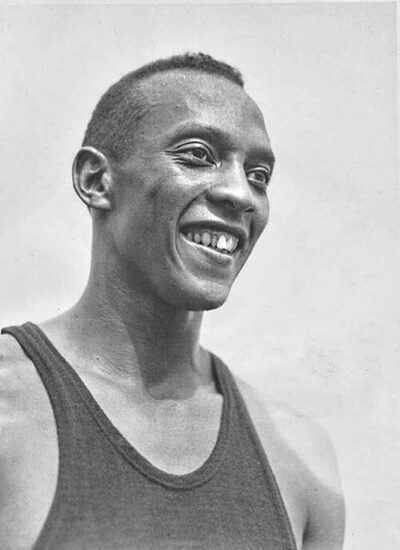
Jesse Owens
Jesse Owens was an American track and field athlete. Born September 12, 1913, in Oakville. Died March 31, 1980, in Tucson. Educated at Ohio State University and East Technical High School. Awards include Presidential Medal of Freedom, Congressional Gold Medal and Theodore Roosevelt Award.
Facts
30 facts · 2 confirmed by two sources · 11 cited · 17 from one source
Where this comes from
Papalocal keeps its own record. It started from these sources; what each one said is kept here as it was copied, so a change on their side never changes this page by itself. Tap one to read its version.
What Wikipedia says · copied November 13, 2026 · revision 1382647459
James Cleveland "Jesse" Owens (September 12, 1913 – March 31, 1980) was an American track and field athlete. He made history at the 1936 Olympic Games by winning four gold medals, setting individual Olympic records in each event, plus another as a member of the 400-meter relay. He is widely regarded as one of the greatest athletes in track and field history.
Owens excelled in short sprints and the long jump and was lauded in his lifetime as "perhaps the greatest and most famous athlete in track and field history". Earlier he won four events, set five world records, and tied another—all in less than an hour, at the 1935 Big Ten Championships in Ann Arbor, Michigan, a feat that has never been equaled and was called "the greatest 45 minutes ever in sport". He won four NCAA titles in both 1935 and 1936, bringing his total to eight—an unparalleled achievement still unmatched.
He achieved international fame at the 1936 Summer Olympics in Berlin, Germany, by winning four gold medals: 100 meters, long jump, 200 meters, and 4 × 100-meter relay. He was the most successful athlete at the Games and, as a black American man, was credited by ESPN with "single-handedly crushing Hitler's myth of Aryan supremacy".
The Jesse Owens Award is USA Track & Field's accolade for the year's best track and field athlete. In a 1950 Associated Press poll, Owens was voted the greatest track and field athlete for the first half of the century. In 1999, he made the six-man short-list for the BBC's Sports Personality of the Century. That same year, ESPN ranked him sixth-greatest North American athlete of the twentieth century and the highest-ranked in his sport.
- Born, in its opening lines
- September 12, 1913
- Died, in its opening lines
- March 31, 1980
From the Wikipedia article “Jesse Owens” (en.wikipedia.org/wiki/Jesse_Owens), by its contributors, under CC BY-SA 4.0 (creativecommons.org/licenses/by-sa/4.0/). Copied November 13, 2026; not changed.
What Wikidata says · copied November 14, 2026 · revision 2569021209
- Described as
- American track and field athlete (1913–1980)
- Other names
- James Cleveland Owens, James Cleveland "Jesse" Owens
- Born
- September 12, 1913 · 13 references
- Died
- March 31, 1980 · 13 references
- Born in
- Oakville · 2 references
- Died in
- Tucson · 3 references
- Buried in
- Oak Woods Cemetery · 1 reference
- Cause of death
- lung cancer · 1 reference
- Citizen of
- United States
- Occupation
- sprinter; athletics competitor · 1 reference; long jumper; entrepreneur · 1 reference; athlete · 1 reference; Olympic champion · 1 reference
- Political party
- Republican Party
- Education
- Ohio State University · 2 references; East Technical High School; North Platte High School
- Member of
- Alpha Phi Alpha
- Sport
- athletics
- Awards
- Presidential Medal of Freedom (1976) · 1 reference; Congressional Gold Medal; Theodore Roosevelt Award (1974); Officer's Cross of the Order of Merit of the Federal Republic of Germany; Associated Press Athlete of the Year (1936); IAAF Hall of Fame (2012) · 1 reference; Silver Olympic Order (1976)
- Spouse
- M. Ruth Solomon
- Nickname
- The Buckeye Bullet · 1 reference
- Height
- 1.78 m (5 ft 10 in)
- Website
- http://www.jesseowens.com/
- Wikipedias with a page
- 97
Wikidata item Q52651 (wikidata.org/wiki/Q52651), public domain (CC0). Copied November 14, 2026.
Confirmed Two sources agree. Cited One source, and it names where it got it. One source One source, without a reference of its own. Sources disagree The sources disagree. We show the best-supported value and keep theirs below.
