
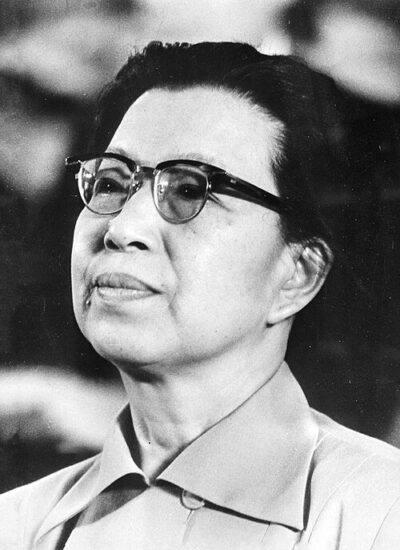
Jiang Qing
Jiang Qing was a Chinese political figure and wife of Mao Zedong. Born March 5, 1914, in Zhucheng. Died May 14, 1991, in Qincheng Prison, Ministry of Public Security. Positions held include spouse of the President of the People's Republic of China (1949–1959), First Lady of China (1949–1976) and member of the Politburo of the Chinese Communist Party (1969–1976). Educated at Military and Political University of Resistance Against Japan. Awards include Royal Order of Cambodia.
Facts
25 facts · 2 confirmed by two sources · 7 cited · 15 from one source · 1 where the sources disagree
What’s different
- Born: we show March 5, 1914 (Confirmed). Wikidata also lists March 19, 1914
- Born in: we show Zhucheng (Sources disagree). Wikidata also lists People's Republic of China
Where this comes from
Papalocal keeps its own record. It started from these sources; what each one said is kept here as it was copied, so a change on their side never changes this page by itself. Tap one to read its version.
What Wikidata says · copied November 16, 2026 · revision 2567400095
- Described as
- Chinese political figure and wife of Mao Zedong (1914–1991)
- Other names
- Lan Ping, Chiang Ch'ing
- Born
- March 5, 1914; March 19, 1914 · 1 reference
- Died
- May 14, 1991 · 9 references
- Born in
- Zhucheng · 1 reference; People's Republic of China · 1 reference
- Died in
- Qincheng Prison, Ministry of Public Security
- Buried in
- Beijing Futian Cemetery (2002–) · 1 reference
- Cause of death
- poison
- Name at birth
- 李淑蒙
- Citizen of
- People's Republic of China · 2 references; Republic of China (1914–1949)
- Occupation
- actor · 2 references; politician · 1 reference; film actor · 1 reference
- Positions held
- spouse of the President of the People's Republic of China (1949–1959); First Lady of China (1949–1976); member of the Politburo of the Chinese Communist Party (1969–1976)
- Political party
- Chinese Communist Party (1933–1977)
- Education
- Military and Political University of Resistance Against Japan (1937–)
- Member of
- Gang of Four
- Awards
- Royal Order of Cambodia (1964)
- Field
- acting · 1 reference; politics · 1 reference
- Spouse
- Tang Na (1936–1937); Mao Zedong (1939–1976)
- Children
- Li Na
- Religion
- atheism
- Wikipedias with a page
- 58
Wikidata item Q236017 (wikidata.org/wiki/Q236017), public domain (CC0). Copied November 16, 2026.
What Wikipedia says · copied November 16, 2026 · revision 1384055625
Jiang Qing (March 1914 (1914-03) – 14 May 1991 (1991-05-15); also spelled as Chiang Ch'ing) was a Chinese revolutionary, actress, and political figure. The fourth wife of Mao Zedong, she played a major role in the Cultural Revolution and led the Gang of Four.
Born to an abusive father and a mother who worked as a domestic servant and sometimes a prostitute, Jiang joined the Chinese Communist Party (CCP) in 1933. She pursued an acting career in Shanghai before going to Yan'an, where she married Mao in 1938. After the founding of the People's Republic of China in 1949, she wielded considerable influence over the arts while engaging in party power struggles, orchestrating campaigns against the film The Life of Wu Xun and the Peking opera Hai Rui Dismissed from Office, and promoting revolutionary operas.
Jiang reached the height of her power in late 1960s. A Politburo member at the Ninth and Tenth Central Committees and de facto leader of the Cultural Revolution Group, she was arrested following Mao's death and expelled from the party. Blamed for the upheavals of the Cultural Revolution, she was sentenced to death with a two-year reprieve in a televised trial, before her sentence was commuted to life imprisonment. She committed suicide in May 1991.
- Born, in its opening lines
- March 1914
- Died, in its opening lines
- May 14, 1991
From the Wikipedia article “Jiang Qing” (en.wikipedia.org/wiki/Jiang_Qing), by its contributors, under CC BY-SA 4.0 (creativecommons.org/licenses/by-sa/4.0/). Copied November 16, 2026; not changed.
Confirmed Two sources agree. Cited One source, and it names where it got it. One source One source, without a reference of its own. Sources disagree The sources disagree. We show the best-supported value and keep theirs below.
