
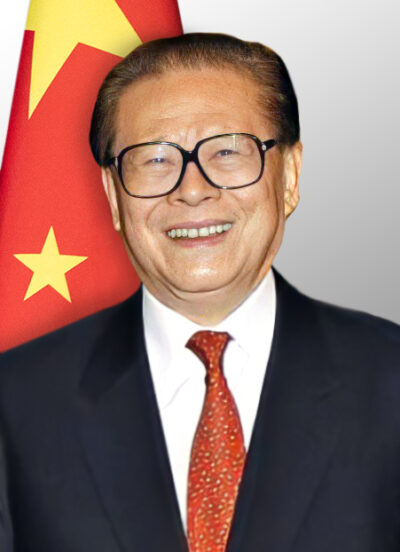
Jiang Zemin
Jiang Zemin was a former General Secretary of the Chinese Communist Party. Born August 17, 1926, in Yangzhou. Died November 30, 2022, in Shanghai. Positions held include General Secretary of the Chinese Communist Party (1989–2002), President of the People's Republic of China (1993–2003) and Chairman of the Central Military Commission of the People's Republic of China (1990–2005). Known for Selected Works Of Jiang Zemin, Science in China and Energy Development Trends and Major Energy Conservation Measures. Educated at Yangzhou High School of Jiangsu Province and National Central University. Awards include Order of the Golden Eagle, Grand Cross of the Order of Good Hope and Order of State of Republic of Turkey.
Facts
65 facts · 2 confirmed by two sources · 14 cited · 48 from one source · 1 where the sources disagree
What’s different
- Cause of death: we show leukemia (Sources disagree). Wikidata also lists multiple organ dysfunction syndrome
Where this comes from
Papalocal keeps its own record. It started from these sources; what each one said is kept here as it was copied, so a change on their side never changes this page by itself. Tap one to read its version.
What Wikidata says · copied November 16, 2026 · revision 2568196457
- Described as
- former General Secretary of the Chinese Communist Party (1926–2022)
- Other names
- Jiang Ze Min, Jiangzemin, Zemin Jiang, General Secretary Jiang Zemin, Chiang Tse-min, 江泽民总书记
- Born
- August 17, 1926 · 5 references
- Died
- November 30, 2022 · 2 references
- Born in
- Yangzhou · 1 reference
- Died in
- Shanghai · 2 references
- Buried in
- Yangtze Estuary
- Cause of death
- leukemia · 2 references; multiple organ dysfunction syndrome · 2 references
- Citizen of
- Republic of China (–1949); People's Republic of China (1949–)
- Occupation
- politician · 1 reference; electrical engineer · 1 reference
- Positions held
- General Secretary of the Chinese Communist Party (1989–2002) · 1 reference; President of the People's Republic of China (1993–2003); Chairman of the Central Military Commission of the People's Republic of China (1990–2005); Chairman of the Central Military Commission of the Chinese Communist Party (1989–2004); member of the Politburo of the Chinese Communist Party (1987–2002); mayor of Shanghai (1985–1988); Secretary of the Shanghai Committee of the Chinese Communist Party (1987–1989); National People's Congress deputy; member of the Politburo Standing Committee of the Chinese Communist Party (1989–2002) · 1 reference
- Political party
- Chinese Communist Party (1946–2022) · 1 reference
- Worked for
- Shanghai Jiao Tong University (1989–); Shanghai Yimin No.1 Food Factory (1947–1952); Shanghai Soap (1952–1953); China United Engineering Corporation Limited (1953–1954); FAW Group (1954–1962); Shanghai Electric Apparatus Research Institute (1962–1965); Wuhan Institute of Thermal Machinery (1965–1967); First Ministry of Machine-Building of the People's Republic of China (1970–1980)
- Education
- Yangzhou High School of Jiangsu Province (1937–1943) · 1 reference; National Central University (1943–1945); Chiao Tung University (1946–1947); Yangzhou Dongguan Primary School (1933–1937); Shanghai Jiao Tong University · 1 reference
- Known for
- Selected Works Of Jiang Zemin; Science in China; Energy Development Trends and Major Energy Conservation Measures; Reflections on Energy Issues in China
- Awards
- Order of the Golden Eagle; Grand Cross of the Order of Good Hope (1999) · 1 reference; Order of State of Republic of Turkey; Order of Prince Yaroslav the Wise, 1st class; Grand Cross of the Order of Tahiti Nui (2001); Pushkin Medal; Grand Cross of the Order of the Redeemer (2000) · 1 reference; Order of the Liberator · 1 reference; Order of José Martí · 1 reference; Order of the Crown of Brunei · 1 reference; Congolese Order of Merit · 1 reference; Order of Bethlehem (2000); Order of the Southern Cross · 1 reference; National Order of Mali · 1 reference
- Field
- politics · 1 reference; communist party · 1 reference
- Spouse
- Wang Yeping (1951–2022) · 1 reference
- Children
- Jiang Mianheng; Jiang Miankang
- Father
- Jiang Shijun
- Mother
- Wang Zhelan · 1 reference
- Siblings
- Jiang Zehui
- Religion
- atheism
- Lived in
- Jiangdu County (1926–1943); Nan-ching (1943–1945); Shanghai (5 times) (1946–2022); Changchun (1954–1962); Wuhan (1965–1970)
- Wikipedias with a page
- 101
Wikidata item Q16597 (wikidata.org/wiki/Q16597), public domain (CC0). Copied November 16, 2026.
What Wikipedia says · copied November 16, 2026 · revision 1384754040
Jiang Zemin (17 August 1926 – 30 November 2022) was a Chinese politician who served as the general secretary of the Chinese Communist Party (CCP) and the fourth paramount leader of China from 1989 to 2002, as the chairman of the Central Military Commission from 1989 to 2004, and as the president of China from 1993 to 2003. He was the core leader of the third generation of Chinese leadership, one of four core leaders alongside Mao Zedong, Deng Xiaoping, and Xi Jinping.
Born in Yangzhou, Jiangsu, Jiang grew up during the years of Japanese occupation. After studying electrical engineering at the National Central University, he transferred to the National Chiao Tung University, joining the CCP while he was in college, and graduating in 1947. After the establishment of the People's Republic of China in 1949, he received training at the Stalin Automobile Works in Moscow in the 1950s, and later returned to Shanghai in 1962 to serve in various institutes before being sent between 1970 and 1972 to Romania as part of an expert team to establish machinery manufacturing plants in the country. After 1979, he was appointed as the vice chair of two commissions by vice premier Gu Mu to oversee the newly established special economic zones (SEZs). He became the vice minister of the newly established Ministry of Electronics Industry and a member of the CCP Central Committee in 1982. Jiang was appointed as the mayor of Shanghai in 1985, and was later promoted to its Communist Party secretary, as well as a member of the CCP Politburo, in 1987.
Jiang came to power unexpectedly as a compromise candidate following the 1989 Tiananmen Square protests and massacre, when he replaced Zhao Ziyang as CCP general secretary after Zhao was ousted for his support for the student movement. Jiang also assumed the chairmanship of the Central Military Commission from Deng Xiaoping. As the involvement of the Eight Elders in Chinese politics steadily declined, Jiang consolidated his hold on power to become the "paramount leader" and "core leader" in 1989. Urged by Deng Xiaoping's southern tour in 1992, Jiang officially introduced the term socialist market economy in his speech during the 14th CCP National Congress held later that year, which accelerated reform and opening up. In the economy, Jiang's administration oversaw the breaking of the iron rice bowl, started several key infrastructure projects and privatized many state-owned enterprises. Jiang prohibited the military engaging in business, proposed the revitalize the country through science and education policy, and started various projects including Project 211, and Project 985 to improve education. In 1999, Jiang started a crack down on Falun Gong. In foreign policy, Jiang oversaw closer relations with Russia, with a friendship treaty signed in 2001, as well as the founding of the Shanghai Cooperation Organisation. Relations with the United States were marked by tensions, due to the Third Taiwan Strait Crisis in 1996, the US bombing of the Chinese embassy in Belgrade in 1999 and the 2001 Hainan island incident.
Under Jiang's leadership, the CCP preserved its rule amidst the Revolutions of 1989 and China experienced substantial economic growth. The returning of Hong Kong from the United Kingdom in 1997 and of Macau from Portugal in 1999, and entry into the World Trade Organization in 2001, were landmark moments of his era. China also witnessed improved relations with the outside world, while the Communist Party maintained its tight control over the state. The Three Represents, Jiang's contributions to party doctrine, legitimized the entry of private business owners and bourgeois elements into the CCP, and was written into the CCP constitution in 2002. Jiang gradually vacated his official leadership titles from 2002 to 2005, being succeeded in these roles by Hu Jintao, although he and his political faction continued to influence affairs until much later. In 2022, Jiang died at the age of 96 in Shanghai; he was accorded a state funeral.
- Born, in its opening lines
- August 17, 1926
- Died, in its opening lines
- November 30, 2022
From the Wikipedia article “Jiang Zemin” (en.wikipedia.org/wiki/Jiang_Zemin), by its contributors, under CC BY-SA 4.0 (creativecommons.org/licenses/by-sa/4.0/). Copied November 16, 2026; not changed.
Confirmed Two sources agree. Cited One source, and it names where it got it. One source One source, without a reference of its own. Sources disagree The sources disagree. We show the best-supported value and keep theirs below.
