
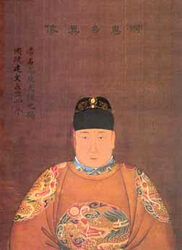
Jianwen Emperor
Jianwen Emperor was an emperor of China from 1398 to 1402. Born December 5, 1377, in Nanjing. Died July 13, 1402, in Nanjing. Positions held include Emperor of China (1398–1402).
Facts
18 facts · 2 confirmed by two sources · 2 cited · 14 from one source
Where this comes from
Papalocal keeps its own record. It started from these sources; what each one said is kept here as it was copied, so a change on their side never changes this page by itself. Tap one to read its version.
What Wikidata says · copied November 16, 2026 · revision 2568952241
- Described as
- emperor of China from 1398 to 1402
- Other names
- Hui Di, Jianwen Di, Emperor Rang, Gongminhuihuangdi, Zhu Yunwen, Huizong, Emperor Hui
- Born
- December 5, 1377
- Died
- July 13, 1402
- Born in
- Nanjing
- Died in
- Nanjing
- Citizen of
- Ming dynasty · 1 reference
- Occupation
- ruler
- Positions held
- Emperor of China (1398–1402)
- Spouse
- Empress Ma
- Children
- Zhu Wenkui; Zhu Wengui
- Father
- Zhu Biao · 1 reference
- Mother
- Empress Dowager Lü
- Siblings
- Princess Nanping; Princess Yilun; Zhu Xiongying; Zhu Yuntong; Zhu Yunjian; Zhu Yunhuoxi
- Wikipedias with a page
- 47
Wikidata item Q9961 (wikidata.org/wiki/Q9961), public domain (CC0). Copied November 16, 2026.
What Wikipedia says · copied November 16, 2026 · revision 1383200891
The Jianwen Emperor (5 December 1377 – 13 July 1402), personal name Zhu Yunwen, was the second emperor of the Ming dynasty of China, reigning from 1398 to 1402. Zhu Yunwen's father was Zhu Biao, the eldest son and heir apparent of the Hongwu Emperor, the founder of the Ming dynasty. Zhu Biao died in 1392, after which the Hongwu Emperor named Zhu Yunwen as his successor. Zhu Yunwen ascended the throne after the Hongwu Emperor's death in June 1398.
Upon his accession, the Jianwen Emperor immediately began revising the Hongwu Emperor's reforms, with the most significant change being the attempt to limit or eliminate the power of princes who were sons of the Hongwu Emperor. Zhu Di, the most powerful of these princes, rebelled against the Jianwen Emperor in 1399. He did this under the pretext of acting against allegedly corrupt court officials who had influenced the Emperor, following the Emperor's order for the imprisonment of Zhu Di's own followers. This sparked a civil war known as the Jingnan campaign, which Zhu Di framed as an effort to eliminate disorder. In 1402, Zhu Di captured the capital of Nanjing, and the imperial palace was burned to the ground. Even though three bodies were found at the burnt palace and were later announced to be those of the Emperor, his wife, and their eldest son, rumors of the Emperor's survival and refuge in a Buddhist monastery emerged. Zhu Di ascended the throne as the Yongle Emperor. He abolished the Jianwen Emperor's reforms and declared his reign illegitimate, thus abolishing the Jianwen era and extending the era of Hongwu to 1402. It was not until 1595 that the Jianwen Emperor's era and imperial title were restored by the Wanli Emperor.
- Born, in its opening lines
- December 5, 1377
- Died, in its opening lines
- July 13, 1402
From the Wikipedia article “Jianwen Emperor” (en.wikipedia.org/wiki/Jianwen_Emperor), by its contributors, under CC BY-SA 4.0 (creativecommons.org/licenses/by-sa/4.0/). Copied November 16, 2026; not changed.
Confirmed Two sources agree. Cited One source, and it names where it got it. One source One source, without a reference of its own. Sources disagree The sources disagree. We show the best-supported value and keep theirs below.
