
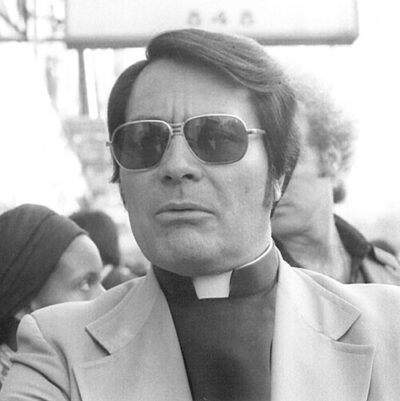
Jim Jones
Jim Jones was an American cult leader. Born May 13, 1931, in Crete. Died November 18, 1978, in Jonestown. Educated at Butler University and Richmond High School.
Facts
17 facts · 2 confirmed by two sources · 2 cited · 13 from one source
Where this comes from
Papalocal keeps its own record. It started from these sources; what each one said is kept here as it was copied, so a change on their side never changes this page by itself. Tap one to read its version.
What Wikidata says · copied November 13, 2026 · revision 2563179200
- Described as
- American cult leader (1931–1978)
- Other names
- James Warren Jones, James Jones
- Born
- May 13, 1931 · 3 references
- Died
- November 18, 1978 · 3 references
- Born in
- Crete · 1 reference
- Died in
- Jonestown
- Cause of death
- gunshot wound
- Name at birth
- James Warren Jones
- Citizen of
- United States
- Occupation
- murderer; pastor · 1 reference; cult leader; rapist; volunteer; religious leader · 1 reference
- Political party
- Communist Party of the United States of America
- Education
- Butler University; Richmond High School; Indiana University Bloomington
- Wikipedias with a page
- 51
Wikidata item Q213861 (wikidata.org/wiki/Q213861), public domain (CC0). Copied November 13, 2026.
What Wikipedia says · copied November 13, 2026 · revision 1385318722
James Warren Jones (May 13, 1931 – November 18, 1978) was an American cult leader, preacher, and mass murderer who founded and led the Peoples Temple, a Christian new religious movement between 1955 and 1978. Jones and the members of his inner circle planned and orchestrated a mass murder–suicide that resulted in the deaths of over 900 people (approximately 396 children). He described the action as "revolutionary suicide", a term coined by Huey P. Newton. The people went to their deaths at the remote jungle commune which they had developed at Jonestown, Guyana, which was operated like a mini-totalitarian police state under official permission and a formal land lease from the Government of Guyana. U.S. Congressman Leo Ryan, who had been visiting to investigate reports of human rights abuses and people wanting to leave, was also assassinated before his plane departed. Jones blended Pentecostal religious authority with Marxist–Leninist rhetoric, with an emphasis on racial equality during the civil rights movement, which resulted in most of his followers (and later victims) being African American.
As a child, Jones had developed an affinity for Pentecostalism and a desire to preach. He was ordained as a Christian minister in the Independent Assemblies of God, attracting his first group of followers while participating in the Pentecostal Latter Rain movement and the Healing Revival during the 1950s. Jones's initial popularity arose from his joint campaign appearances with the movement's prominent leaders William Branham and Joseph Mattsson-Boze, and their endorsement of his ministry.
Jones founded the organization that became the Peoples Temple in Indianapolis in 1955. In 1956, he began to be influenced by Father Divine and the Peace Mission movement. Jones distinguished himself through civil rights activism, founding the Temple as a fully integrated congregation. In 1964, he joined and was ordained a minister by the Disciples of Christ; his attraction to the Disciples was largely due to the autonomy and tolerance they granted to differing views within their denomination.
In 1965, Jones moved the Temple to California. The group established its headquarters in San Francisco, where he became deeply involved in political and charitable activity throughout the 1970s. Jones developed connections with prominent California politicians and was appointed as chairman of the San Francisco Housing Authority Commission in 1975. Beginning in the late 1960s, reports of abuse began to surface as Jones became increasingly vocal in his rejection of traditional Christianity; He began promoting a form of anti-capitalism that he called "Apostolic Socialism" and made claims of his own divinity. Jones became progressively more controlling of his followers in Peoples Temple, which had more than 3,000 members at its peak. His followers engaged in a communal lifestyle in which many turned over all their income and property to Jones and leaders of Peoples Temple, who directed all aspects of community life.
Following a period of negative publicity and reports of abuse at Peoples Temple, Jones ordered the construction of the Jonestown commune in Guyana in 1974; he convinced or compelled hundreds of his followers to live there with him. He claimed that he was constructing a socialist paradise free from the oppression of the United States government.
By 1978, reports surfaced of human rights abuses and accusations that people were being held in Jonestown against their will. U.S. Representative Leo Ryan led a delegation to the commune in November of that year to investigate these reports. While boarding a return flight with some former Temple members who wished to leave, Ryan and four others were murdered by gunmen from Jonestown.
Jones then ordered a mass murder-suicide that claimed the lives of 912 commune members; most of the members died by drinking Flavor Aid laced with cyanide. Those who resisted were forcefully injected with cyanide.
- Born, in its opening lines
- May 13, 1931
- Died, in its opening lines
- November 18, 1978
From the Wikipedia article “Jim Jones” (en.wikipedia.org/wiki/Jim_Jones), by its contributors, under CC BY-SA 4.0 (creativecommons.org/licenses/by-sa/4.0/). Copied November 13, 2026; not changed.
Confirmed Two sources agree. Cited One source, and it names where it got it. One source One source, without a reference of its own. Sources disagree The sources disagree. We show the best-supported value and keep theirs below.
