
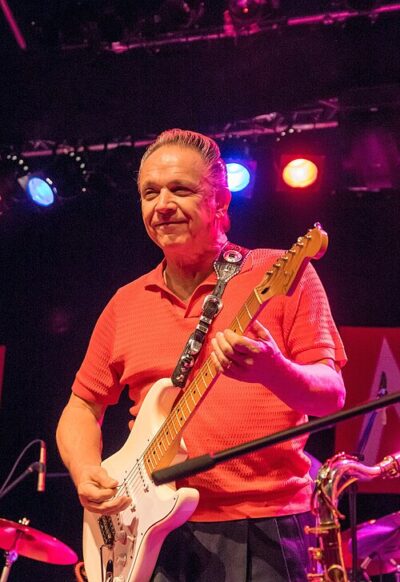
Jimmie Vaughan
Jimmie Vaughan is an American blues rock guitarist and singer. Born March 20, 1951, in Dallas. Awards include Blues Music Award.
Facts
18 facts · 1 confirmed by two sources · 5 cited · 12 from one source
Where this comes from
Papalocal keeps its own record. It started from these sources; what each one said is kept here as it was copied, so a change on their side never changes this page by itself. Tap one to read its version.
What Wikidata says · copied November 15, 2026 · revision 2563859332
- Described as
- American blues rock guitarist and singer
- Other names
- Jimmie Lawrence Vaughan
- Born
- March 20, 1951 · 1 reference
- Born in
- Dallas
- Citizen of
- United States
- Occupation
- composer; singer; guitarist; musician · 1 reference
- Political party
- Republican Party
- Member of
- The Fabulous Thunderbirds
- Genre
- rock music; blues · 1 reference
- Instrument
- guitar · 1 reference; voice · 1 reference
- Record label
- Epic Records
- Awards
- Blues Music Award
- Father
- James "Jimmie" Lee Vaughan · 1 reference
- Siblings
- Stevie Ray Vaughan
- Website
- https://www.jimmievaughan.com/
- Wikipedias with a page
- 24
Wikidata item Q538543 (wikidata.org/wiki/Q538543), public domain (CC0). Copied November 15, 2026.
What Wikipedia says · copied November 15, 2026 · revision 1376681127
Jimmie Lawrence Vaughan Jr. (born March 20, 1951) is an American blues rock guitarist and singer based in Austin, Texas. A founding member of The Fabulous Thunderbirds, he is the older brother of the deceased Texas blues guitarist Stevie Ray Vaughan.
Several notable blues guitarists have had a significant influence on Vaughan's playing style, including the "Three Kings" (Albert, Freddie, and B.B. King) and Johnny "Guitar" Watson.
- Born, in its opening lines
- March 20, 1951
From the Wikipedia article “Jimmie Vaughan” (en.wikipedia.org/wiki/Jimmie_Vaughan), by its contributors, under CC BY-SA 4.0 (creativecommons.org/licenses/by-sa/4.0/). Copied November 15, 2026; not changed.
Confirmed Two sources agree. Cited One source, and it names where it got it. One source One source, without a reference of its own. Sources disagree The sources disagree. We show the best-supported value and keep theirs below.
