
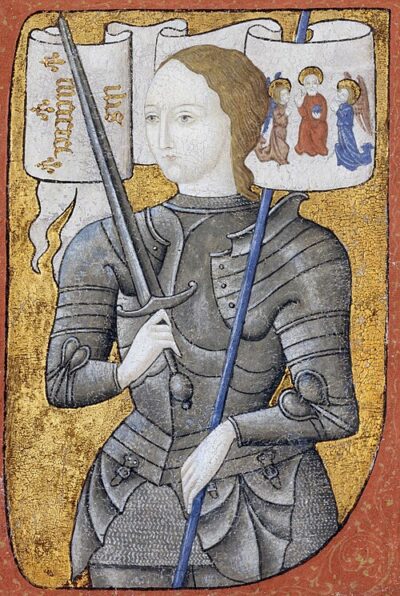
Joan of Arc
Joan of Arc was a French folk heroine (1412–1431), military leader who crowned Charles VII and Roman Catholic saint, canonized 500 years after her death. Born 1412, in Domrémy-la-Pucelle. Died May 30, 1431, in Rouen. Awards include Godfather promotion of Special Military School of Saint-Cyr.
Facts
18 facts · 2 confirmed by two sources · 3 cited · 12 from one source · 1 where the sources disagree
What’s different
- Name at birth: we show Jeanneton (Sources disagree). Wikidata also lists Jeannette
Where this comes from
Papalocal keeps its own record. It started from these sources; what each one said is kept here as it was copied, so a change on their side never changes this page by itself. Tap one to read its version.
What Wikidata says · copied November 16, 2026 · revision 2568199002
- Described as
- French folk heroine (1412–1431), military leader who crowned Charles VII and Roman Catholic saint, canonized 500 years after her death
- Other names
- Saint Joan of Arc, Maid of Orleans, The Maid of Orléans, The Maid of Orleans, Maid of Orléans, St. Joan of Arc, Jeanneton Darc, Ioanna de Arc, Jehanne Darc, Joan Romèe, Joanna Arcensis, Jeanneton Romée
- Born
- 1412 · 3 references
- Died
- May 30, 1431 · 7 references
- Born in
- Domrémy-la-Pucelle · 2 references
- Died in
- Rouen · 2 references
- Buried in
- Seine
- Cause of death
- death by burning · 1 reference
- Name at birth
- Jeanneton · 1 reference; Jeannette · 1 reference
- Citizen of
- Kingdom of France
- Occupation
- military personnel; religious leader
- Awards
- Godfather promotion of Special Military School of Saint-Cyr
- Father
- Jacques d'Arc
- Mother
- Isabelle Romée
- Siblings
- Catherine d'Arc; Jacques of Arc; Jean d'Arc; Pierre d'Arc
- Religion
- Catholic Church
- Wikipedias with a page
- 197
Wikidata item Q7226 (wikidata.org/wiki/Q7226), public domain (CC0). Copied November 16, 2026.
What Wikipedia says · copied November 16, 2026 · revision 1384831607
Joan of Arc (French: Jeanne d'Arc [ʒan daʁk] ; Middle French: Jehanne Darc [ʒəˈãnə ˈdark]; c. 1412 – 30 May 1431) is a patron saint of France, honored as a defender of the French nation for her role in the siege of Orléans and securing the coronation of Charles VII of France during the Hundred Years' War. Claiming to be acting under divine guidance, she became a military leader who gained recognition as a savior of France.
Joan was born to a propertied peasant family at Domrémy in northeast France. In 1428, she requested to be taken to Charles VII, later testifying that she was guided by visions from the archangel Michael, Saint Margaret, and Saint Catherine to help him save France from English domination. Convinced of her devotion and purity, Charles sent Joan, who was about seventeen years old, to Orléans as part of a relief army. She arrived at the city in April 1429, wielding her banner and bringing hope to the demoralized French army. Nine days after her arrival, the English abandoned the siege. Joan encouraged the French to aggressively pursue the English during the Loire Campaign, which culminated in another decisive victory at Patay, opening the way for the French army to advance on Reims unopposed, where Charles was crowned as the king of France with Joan at his side. These victories boosted French morale, paving the way for their final triumph in the Hundred Years' War several decades later.
After Charles's coronation, Joan participated in the unsuccessful siege of Paris in September 1429 and the failed siege of La Charité in November. Her role in these defeats reduced the court's faith in her. In early 1430, Joan organized a company of volunteers to relieve Compiègne, which had been besieged by the Burgundians—French allies of the English. She was captured by Burgundian troops on 23 May. After trying unsuccessfully to escape, she was handed to the English in November. She was put on trial by Bishop Pierre Cauchon on accusations of heresy, which included blaspheming by wearing men's clothes, acting upon visions that were demonic, and refusing to submit her words and deeds to the judgment of the church. She was declared guilty and burned at the stake on 30 May 1431, aged about nineteen.
In 1456, an inquisitorial court reinvestigated Joan's trial and overturned the verdict, declaring that it was tainted by deceit and procedural errors. Joan has been described as an obedient member of the Catholic Church, a protofeminist, and a symbol of freedom and independence. She is popularly revered as a martyr. After the French Revolution, she became a national symbol of France. In 1920, Joan of Arc was canonized by Pope Benedict XV and, two years later, was declared one of the patron saints of France. She is portrayed in numerous cultural works, including literature, music, paintings, sculptures, theater, and film.
- Born, in its opening lines
- c. 1412
- Died, in its opening lines
- May 30, 1431
From the Wikipedia article “Joan of Arc” (en.wikipedia.org/wiki/Joan_of_Arc), by its contributors, under CC BY-SA 4.0 (creativecommons.org/licenses/by-sa/4.0/). Copied November 16, 2026; not changed.
Confirmed Two sources agree. Cited One source, and it names where it got it. One source One source, without a reference of its own. Sources disagree The sources disagree. We show the best-supported value and keep theirs below.
