
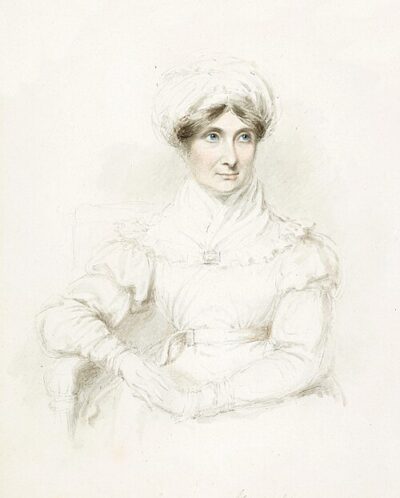
Joanna Baillie
Joanna Baillie was a Scottish poet and dramatist. Born September 11, 1762, in Bothwell. Died February 23, 1851, in Hampstead.
Facts
14 facts · 2 confirmed by two sources · 6 cited · 6 from one source
Where this comes from
Papalocal keeps its own record. It started from these sources; what each one said is kept here as it was copied, so a change on their side never changes this page by itself. Tap one to read its version.
What Wikidata says · copied November 17, 2026 · revision 2563096884
- Described as
- Scottish poet and dramatist (1762-1851)
- Other names
- Joanna Bailley, Baillie Joanna
- Born
- September 11, 1762 · 11 references
- Died
- February 23, 1851 · 11 references
- Born in
- Bothwell · 1 reference
- Died in
- Hampstead · 2 references
- Buried in
- St John-at-Hampstead church · 1 reference
- Citizen of
- United Kingdom of Great Britain and Ireland; Kingdom of Great Britain (–1801)
- Occupation
- poet · 1 reference; writer · 2 references; playwright; tragedy writer · 1 reference
- Field
- poetry
- Siblings
- Matthew Baillie
- Lived in
- Scotland
- Wikipedias with a page
- 25
Wikidata item Q463302 (wikidata.org/wiki/Q463302), public domain (CC0). Copied November 17, 2026.
What Wikipedia says · copied November 17, 2026 · revision 1382971164
Joanna Baillie (11 September 1762 – 23 February 1851) was a Scottish poet and dramatist, known for such works as Plays on the Passions (three volumes, 1798–1812) and Fugitive Verses (1840). Her work shows an interest in moral philosophy and the Gothic. She was critically acclaimed in her lifetime, and while living in Hampstead, associated with contemporary writers such as Anna Barbauld, Lucy Aikin, and Walter Scott. She died at the age of 88.
- Born, in its opening lines
- September 11, 1762
- Died, in its opening lines
- February 23, 1851
From the Wikipedia article “Joanna Baillie” (en.wikipedia.org/wiki/Joanna_Baillie), by its contributors, under CC BY-SA 4.0 (creativecommons.org/licenses/by-sa/4.0/). Copied November 17, 2026; not changed.
Confirmed Two sources agree. Cited One source, and it names where it got it. One source One source, without a reference of its own. Sources disagree The sources disagree. We show the best-supported value and keep theirs below.
