
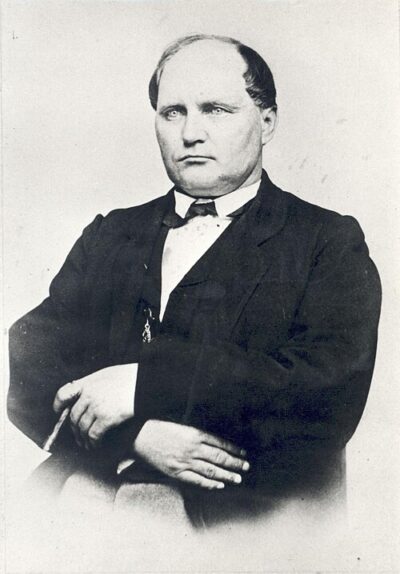
Johann Voldemar Jannsen
Johann Voldemar Jannsen was an Estonian journalist and cultural activist. Born May 16, 1819, in Vana-Vändra Rural Municipality. Died July 13, 1890, in Tartu.
Facts
14 facts · 2 confirmed by two sources · 4 cited · 8 from one source
Where this comes from
Papalocal keeps its own record. It started from these sources; what each one said is kept here as it was copied, so a change on their side never changes this page by itself. Tap one to read its version.
What Wikidata says · copied November 16, 2026 · revision 2569743462
- Described as
- Estonian journalist and cultural activist (1819–1890)
- Other names
- Johann Woldemar Jannsen, Jaan Jensen
- Born
- May 16, 1819 · 2 references
- Died
- July 13, 1890 · 2 references
- Born in
- Vana-Vändra Rural Municipality
- Died in
- Tartu · 1 reference
- Buried in
- Raadi cemetery
- Citizen of
- Russian Empire · 1 reference
- Occupation
- journalist; poet; writer · 1 reference; teacher · 1 reference; cultural activist; translator · 1 reference
- Children
- Lydia Koidula; Harry Jannsen
- Wikipedias with a page
- 36
Wikidata item Q362138 (wikidata.org/wiki/Q362138), public domain (CC0). Copied November 16, 2026.
What Wikipedia says · copied November 16, 2026 · revision 1363361081
Johann Voldemar Jannsen (16 May [O.S. 4 May] 1819 – 13 July [O.S. 1 July] 1890) was an Estonian journalist. He was one of the earliest figures of the Estonian national awakening, which he promoted through his newspaper, the Eesti Postimees, and two Estonian Song Festivals. He wrote the nationalist song "Mu isamaa, mu õnn ja rõõm", which became the national anthem of Estonia after its independence. Jannsen was the father of poet Lydia Koidula.
- Born, in its opening lines
- May 16, 1819
- Died, in its opening lines
- July 13, 1890
From the Wikipedia article “Johann Voldemar Jannsen” (en.wikipedia.org/wiki/Johann_Voldemar_Jannsen), by its contributors, under CC BY-SA 4.0 (creativecommons.org/licenses/by-sa/4.0/). Copied November 16, 2026; not changed.
Confirmed Two sources agree. Cited One source, and it names where it got it. One source One source, without a reference of its own. Sources disagree The sources disagree. We show the best-supported value and keep theirs below.
