
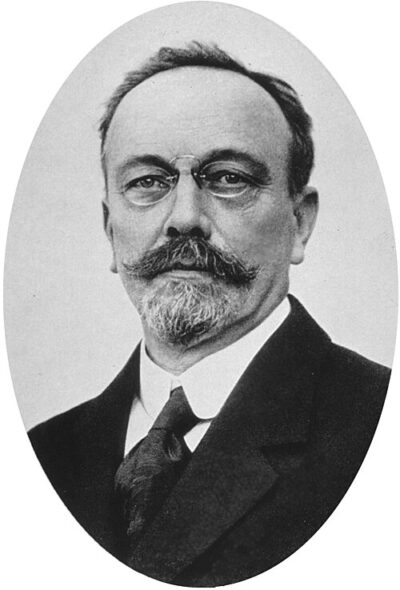
Johannes Fibiger
Johannes Fibiger was a Danish physician. Born April 23, 1867, in Silkeborg. Died January 30, 1928, in Copenhagen. Positions held include rector (1925–1926). Educated at University of Copenhagen. Awards include Nobel Prize in Physiology or Medicine, doctor honoris causa from the University of Paris and commander of the Order of the Dannebrog.
Facts
25 facts · 2 confirmed by two sources · 8 cited · 15 from one source
Where this comes from
Papalocal keeps its own record. It started from these sources; what each one said is kept here as it was copied, so a change on their side never changes this page by itself. Tap one to read its version.
What Wikidata says · copied November 16, 2026 · revision 2563196418
- Described as
- Danish physician
- Other names
- Johannes Andreas Grib Fibiger
- Born
- April 23, 1867 · 8 references
- Died
- January 30, 1928 · 10 references
- Born in
- Silkeborg · 1 reference
- Died in
- Copenhagen · 1 reference
- Buried in
- Garnison Cemetery · 1 reference
- Cause of death
- cancer
- Citizen of
- Kingdom of Denmark
- Occupation
- physician · 1 reference; chemist; university teacher; bacteriologist; parasitologist; pathologist · 1 reference; zoologist; anatomist · 1 reference
- Positions held
- rector (1925–1926)
- Worked for
- University of Copenhagen
- Education
- University of Copenhagen
- Awards
- Nobel Prize in Physiology or Medicine (1926) · 2 references; doctor honoris causa from the University of Paris (1927) · 1 reference; commander of the Order of the Dannebrog (1926)
- Field
- microbiology · 1 reference; anatomical pathology · 1 reference
- Father
- Christian Fibiger · 1 reference
- Mother
- Elfride Fibiger
- Wikipedias with a page
- 59
Wikidata item Q216324 (wikidata.org/wiki/Q216324), public domain (CC0). Copied November 16, 2026.
What Wikipedia says · copied November 16, 2026 · revision 1379549732
Johannes Andreas Grib Fibiger (23 April 1867 – 30 January 1928) was a Danish physician and professor of anatomical pathology at the University of Copenhagen. He was the recipient of the 1926 Nobel Prize in Physiology or Medicine "for his discovery of the Spiroptera carcinoma". He claimed to have shown that the roundworm which he called Spiroptera carcinoma (but is correctly named Gongylonema neoplasticum) could cause stomach cancer (squamous cell carcinoma) in rats and mice. His experimental results were later proven to be a case of mistaken conclusion.
While working at the Institute of Pathological Anatomy of University of Copenhagen, Fibiger discovered new roundworms in 1907 from wild rats. He suspected that the roundworms were responsible for stomach cancer in those rats. In 1913, he reported that he could experimentally induce cancer in healthy rats using the roundworms. His discovery was considered "the greatest contribution to experimental medicine" at the time. In 1926, he was nominated for the Nobel Prize in Physiology or Medicine along with Katsusaburo Yamagiwa, who had experimentally induced carcinoma by painting crude coal tar on the inner surface of rabbits' ears in 1915. However, they were considered undeserving, and the 1926 prize was not given. In the next year Fibiger alone was retrospectively chosen for the 1926 Nobel Prize.
After his death, independent researches proved that G. neoplasticum cannot cause cancer. Tumours and cancer produced by Fibiger were due to vitamin A deficiency. Historical reassessment of Fibiger's data revealed that he had mistaken non-cancerous tumours for cancerous tumours. Erling Norrby, who had served as the Permanent Secretary of the Royal Swedish Academy of Sciences and Professor and Chairman of Virology at the Karolinska Institute, in 2010 declared Fibiger's Nobel Prize as "one of the biggest blunders made by the Karolinska Institute."
Fibiger's research method on diphtheria is regarded as the origin of an important research methodology in medicine known as controlled clinical trial.
- Born, in its opening lines
- April 23, 1867
- Died, in its opening lines
- January 30, 1928
From the Wikipedia article “Johannes Fibiger” (en.wikipedia.org/wiki/Johannes_Fibiger), by its contributors, under CC BY-SA 4.0 (creativecommons.org/licenses/by-sa/4.0/). Copied November 16, 2026; not changed.
Confirmed Two sources agree. Cited One source, and it names where it got it. One source One source, without a reference of its own. Sources disagree The sources disagree. We show the best-supported value and keep theirs below.
