
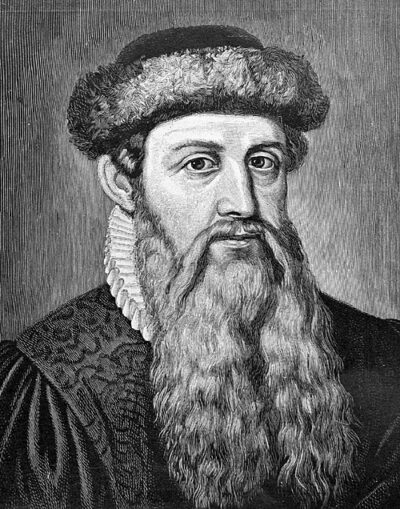
Johannes Gutenberg
Johannes Gutenberg was a German inventor and craftsman. Born 1400, in Mainz. Died 1468, in Mainz. Educated at University of Erfurt (1392-1816).
Facts
23 facts · 0 confirmed by two sources · 8 cited · 13 from one source · 2 where the sources disagree
What’s different
- Born: we show 1400 (Sources disagree). Wikipedia says 1393
- Died: we show 1468 (Sources disagree). Wikipedia says 1406
Where this comes from
Papalocal keeps its own record. It started from these sources; what each one said is kept here as it was copied, so a change on their side never changes this page by itself. Tap one to read its version.
What Wikidata says · copied November 16, 2026 · revision 2567631305
- Described as
- German inventor and craftsman (1400-1468)
- Other names
- Johann Gutenberg, Johannes Gensfleisch zur Laden, Henne Gutenburg, Henne Gensfleisch, Johann Gensfleisch zur Laden, Gensfleisch Gutenburg, Johannes Gutenburg, Johannes Gensfleisch, Johannes Gensfleisch zur Laden zum Gutenberg
- Born
- 1400 · 5 references
- Died
- 1468 · 1 reference
- Born in
- Mainz · 2 references
- Died in
- Mainz · 1 reference
- Buried in
- Mainz
- Name at birth
- Johannes Gensfleisch zur Laden zum Gutenberg
- Citizen of
- Holy Roman Empire
- Occupation
- inventor · 2 references; typographer; engraver · 1 reference; engineer · 1 reference; blacksmith; goldsmith · 1 reference; mintmaster; book printer · 1 reference
- Education
- University of Erfurt (1392-1816) (1418–)
- Field
- inventor · 1 reference
- Father
- Friele Gensfleisch zur Laden · 1 reference
- Mother
- Else Wirich · 1 reference
- Siblings
- Friele Gensfleisch; Else Vitztum · 1 reference
- Religion
- Christianity
- Lived in
- Mainz · 1 reference
- Wikipedias with a page
- 183
Wikidata item Q8958 (wikidata.org/wiki/Q8958), public domain (CC0). Copied November 16, 2026.
What Wikipedia says · copied November 16, 2026 · revision 1383488206
Johannes Gensfleisch zur Laden zum Gutenberg (c. 1393–1406 – 1468) was a German inventor and craftsman who invented the movable-type printing press. Though movable type was already in use in East Asia, Gutenberg's invention of the printing press enabled a much faster rate of printing. The printing press later spread across the world, and led to an information revolution and the unprecedented mass-spread of literature throughout Europe. It had a profound impact on the development of the Renaissance, Reformation, and humanist movements.
Gutenberg's many contributions to printing include the invention of a process for mass-producing movable type; the use of oil-based ink for printing books; adjustable molds; mechanical movable type; and the invention of a wooden printing press similar to the agricultural screw presses of the period. Gutenberg's method for making type is traditionally considered to have included a type metal alloy and a hand mould for casting type. The alloy was a mixture of lead, tin, and antimony that melted at a relatively low temperature for faster and more economical casting, cast well, and created a durable type. His major work, the Gutenberg Bible, was the first printed version of the Bible and has been acclaimed for its high aesthetic and technical quality.
Gutenberg is often cited as among the most influential figures in human history and has been commemorated around the world. To celebrate the 500th anniversary of his birth, the Gutenberg Museum was founded in his hometown of Mainz in 1900. In 1997, Time Life picked Gutenberg's invention as the most important of the second millennium.
- Born, in its opening lines
- 1393
- Died, in its opening lines
- 1406
From the Wikipedia article “Johannes Gutenberg” (en.wikipedia.org/wiki/Johannes_Gutenberg), by its contributors, under CC BY-SA 4.0 (creativecommons.org/licenses/by-sa/4.0/). Copied November 16, 2026; not changed.
Confirmed Two sources agree. Cited One source, and it names where it got it. One source One source, without a reference of its own. Sources disagree The sources disagree. We show the best-supported value and keep theirs below.
