
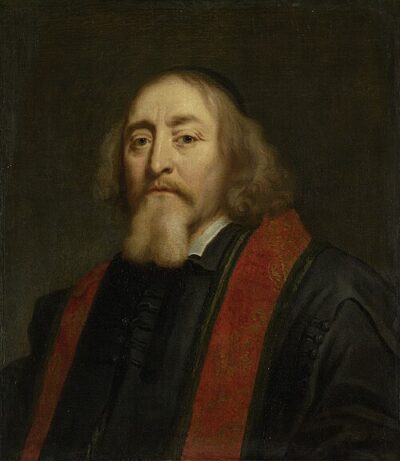
John Amos Comenius
John Amos Comenius was a Czech teacher, educator, philosopher and writer. Born March 28, 1592, in Uherský Brod. Died November 15, 1670, in Amsterdam. Positions held include head teacher and bishop. Educated at Heidelberg University.
Facts
30 facts · 2 confirmed by two sources · 15 cited · 13 from one source
Where this comes from
Papalocal keeps its own record. It started from these sources; what each one said is kept here as it was copied, so a change on their side never changes this page by itself. Tap one to read its version.
What Wikidata says · copied November 16, 2026 · revision 2569681658
- Described as
- Czech teacher, educator, philosopher and writer (1592-1670)
- Other names
- Comenius, Johann Amos Comenius, Johann Comenius, Jan Ámos Komenský, Johannes Amos Comenius, Iohannes Amos Comenius
- Born
- March 28, 1592 · 17 references
- Died
- November 15, 1670 · 17 references
- Born in
- Uherský Brod · 3 references
- Died in
- Amsterdam · 6 references
- Buried in
- Naarden
- Citizen of
- Habsburg monarchy
- Occupation
- teacher · 2 references; pedagogue · 1 reference; philosopher · 4 references; scientist · 3 references; theologian · 3 references; linguist; presbyter; writer · 4 references
- Positions held
- head teacher; bishop
- Education
- Heidelberg University (1613–1614)
- Field
- pedagogy · 1 reference; theology · 1 reference; philosophy · 1 reference; natural philosophy; science; literature · 1 reference
- Spouse
- Johanna Gajusová (1649–1670) · 2 references; Marie Dorota Cyrillová (1624–1648) · 1 reference; Magdalena Vizovská (1618–1622) · 1 reference
- Children
- Alžběta Komenská; Daniel Komenský
- Father
- Martin Komenský · 1 reference
- Religion
- Unity of the Brethren
- Wikipedias with a page
- 99
Wikidata item Q12735 (wikidata.org/wiki/Q12735), public domain (CC0). Copied November 16, 2026.
What Wikipedia says · copied November 16, 2026 · revision 1385565947
John Amos Comenius (; Czech: Jan Amos Komenský; German: Johann Amos Comenius; Polish: Jan Amos Komeński; Latinized: Ioannes Amos Comenius; 28 March 1592 – 15 November 1670) was a Czech philosopher, pedagogue and theologian who is considered the father of modern education. He served as the last bishop of the Unity of the Brethren (direct predecessor of the Moravian Church) before becoming a religious refugee and one of the earliest champions of universal education, a concept eventually set forth in his book Didactica Magna. As an educator and theologian, he led schools and advised governments across Protestant Europe through the middle of the seventeenth century and proposed the pedagogical concept of pansophism.
Comenius introduced a number of educational concepts and innovations including pictorial textbooks written in native languages instead of Latin, teaching based in gradual development from simple to more comprehensive concepts, lifelong learning with a focus on logical thinking over dull memorization, equal opportunity for impoverished children, education for women, and universal and practical instruction. He also believed heavily in the connection between nature, religion, and knowledge, in which he stated that knowledge is born from nature and nature from God.
A proud Moravian, he nevertheless for most of his life – mainly due to the difficult wartime circumstances in the homeland and fear from religious persecution – lived and worked as an exile in various regions of the Holy Roman Empire and other countries: Sweden, the Polish–Lithuanian Commonwealth, Transylvania, England, the Netherlands and Hungary. He turned down an offer to immigrate to the New England Colonies and take up the presidency of the newly founded Harvard University.
- Born, in its opening lines
- March 28, 1592
- Died, in its opening lines
- November 15, 1670
From the Wikipedia article “John Amos Comenius” (en.wikipedia.org/wiki/John_Amos_Comenius), by its contributors, under CC BY-SA 4.0 (creativecommons.org/licenses/by-sa/4.0/). Copied November 16, 2026; not changed.
Confirmed Two sources agree. Cited One source, and it names where it got it. One source One source, without a reference of its own. Sources disagree The sources disagree. We show the best-supported value and keep theirs below.
