
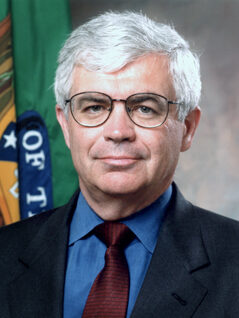
John B. Taylor is an American economist, father of Taylor Rule. Born December 8, 1946, in Yonkers. Positions held include Under Secretary of the Treasury for International Affairs (2001–2005). Educated at Princeton University and Stanford University. Awards include Adam Smith Award, Fellow of the Econometric Society and Medal of the Oriental Republic of Uruguay.
Facts
21 facts · 1 confirmed by two sources · 9 cited · 11 from one source
Where this comes from
Papalocal keeps its own record. It started from these sources; what each one said is kept here as it was copied, so a change on their side never changes this page by itself. Tap one to read its version.
What Wikidata says · copied November 18, 2026 · revision 2508771618
- Described as
- American economist, father of Taylor Rule
- Other names
- John Taylor, John Brian Taylor
- Born
- December 8, 1946 · 1 reference
- Born in
- Yonkers
- Citizen of
- United States
- Occupation
- economist · 2 references; university teacher · 1 reference; academic · 1 reference
- Positions held
- Under Secretary of the Treasury for International Affairs (2001–2005)
- Political party
- Republican Party · 1 reference
- Worked for
- Stanford University · 1 reference
- Education
- Princeton University; Stanford University (–1973) · 1 reference; Shady Side Academy · 1 reference
- Member of
- American Academy of Arts and Sciences; Econometric Society (1984–) · 1 reference
- Awards
- Adam Smith Award (2007); Fellow of the Econometric Society (1984) · 1 reference; Medal of the Oriental Republic of Uruguay (2005) · 1 reference; Guggenheim Fellowship · 1 reference; Clarivate Citation Laureates (2009) · 1 reference
- Field
- economics · 1 reference
- Website
- https://profiles.stanford.edu/john-taylor
- Wikipedias with a page
- 16
Wikidata item Q967487 (wikidata.org/wiki/Q967487), public domain (CC0). Copied November 18, 2026.
What Wikipedia says · copied November 18, 2026 · revision 1380699873
John Brian Taylor (born December 8, 1946) is an American economist who is the Mary and Robert Raymond Professor of Economics at Stanford University, and the George P. Shultz Senior Fellow in Economics at Stanford University's Hoover Institution.
He taught at Columbia University from 1973 to 1980 and the Woodrow Wilson School and Economics Department of Princeton University from 1980 to 1984 before returning to Stanford. He has received several teaching prizes and teaches Stanford's introductory economics course as well as PhD courses in monetary economics.
In research published in 1979 and 1980 he developed a model of price and wage setting—called the staggered contract model—which served as an underpinning of a new class of empirical models with rational expectations and sticky prices—sometimes called new Keynesian models. In a 1993 paper he proposed the Taylor rule, intended as a recommendation about how nominal interest rates should be determined, which then became a rough summary of how central banks actually do set them. He has been active in public policy, serving as the Under Secretary of the Treasury for International Affairs during the first term of the George W. Bush administration. His book Global Financial Warriors chronicles this period. He was a member of the President's Council of Economic Advisors during the George H. W. Bush administration and Senior Economist at the Council of Economic Advisors during the Ford and Carter administrations.
In 2012 he was included in the 50 Most Influential list of Bloomberg Markets Magazine. Thomson Reuters lists Taylor among the "citation laureates" who are likely future winners of the Nobel Prize in Economics. He was president of the Mont Pelerin Society from 2018 to 2020.
- Born, in its opening lines
- December 8, 1946
From the Wikipedia article “John B. Taylor” (en.wikipedia.org/wiki/John_B._Taylor), by its contributors, under CC BY-SA 4.0 (creativecommons.org/licenses/by-sa/4.0/). Copied November 18, 2026; not changed.
Confirmed Two sources agree. Cited One source, and it names where it got it. One source One source, without a reference of its own. Sources disagree The sources disagree. We show the best-supported value and keep theirs below.
