
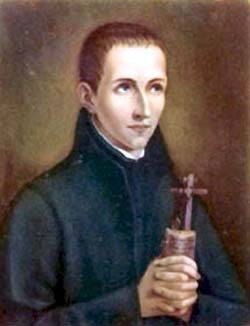
John Berchmans
John Berchmans was a Catholic Jesuit saint. Born March 13, 1599, in Diest. Died August 13, 1621, in Rome. Educated at Pontifical Gregorian University and Noviciate of Sant'Andrea, Rome.
Facts
12 facts · 2 confirmed by two sources · 3 cited · 7 from one source
Where this comes from
Papalocal keeps its own record. It started from these sources; what each one said is kept here as it was copied, so a change on their side never changes this page by itself. Tap one to read its version.
What Wikidata says · copied November 17, 2026 · revision 2568746403
- Described as
- Catholic Jesuit saint
- Born
- March 13, 1599 · 2 references
- Died
- August 13, 1621 · 8 references
- Born in
- Diest · 1 reference
- Died in
- Rome · 1 reference
- Buried in
- Sant'Ignazio Church
- Cause of death
- malaria
- Citizen of
- Spanish Netherlands
- Occupation
- Catholic seminarian; Catholic theologian · 1 reference
- Education
- Pontifical Gregorian University; Noviciate of Sant'Andrea, Rome
- Religion
- Catholic Church
- Wikipedias with a page
- 25
Wikidata item Q724169 (wikidata.org/wiki/Q724169), public domain (CC0). Copied November 17, 2026.
What Wikipedia says · copied November 17, 2026 · revision 1383168324
John Berchmans, SJ (Dutch: Jan Berchmans [jɑm ˈbɛr(ə)xmɑns]; 13 March 1599 – 13 August 1621) was a Belgian Jesuit scholastic and is revered as a saint in the Catholic Church.
In 1615, the Jesuits opened a college at Mechelen, Belgium and Berchmans was one of the first to enroll. His spiritual model was his fellow Jesuit Aloysius Gonzaga, and he was influenced by the example of the English Jesuit martyrs. Berchmans is the patron saint of altar servers, Jesuit scholastics, and students.
- Born, in its opening lines
- March 13, 1599
- Died, in its opening lines
- August 13, 1621
From the Wikipedia article “John Berchmans” (en.wikipedia.org/wiki/John_Berchmans), by its contributors, under CC BY-SA 4.0 (creativecommons.org/licenses/by-sa/4.0/). Copied November 17, 2026; not changed.
Confirmed Two sources agree. Cited One source, and it names where it got it. One source One source, without a reference of its own. Sources disagree The sources disagree. We show the best-supported value and keep theirs below.
