
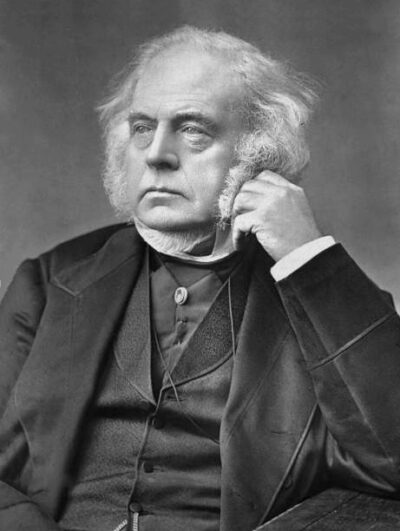
John Bright
John Bright was a British Radical and Liberal statesman. Born November 16, 1811, in Rochdale. Died March 27, 1889, in Rochdale. Positions held include President of the Board of Trade (1868–1871), Chancellor of the Duchy of Lancaster (2 times) (1873–1882) and Member of the Privy Council of the United Kingdom. Known for On the English Foreign Policy. Educated at Bootham School and Ackworth School.
Facts
41 facts · 2 confirmed by two sources · 24 cited · 15 from one source
Where this comes from
Papalocal keeps its own record. It started from these sources; what each one said is kept here as it was copied, so a change on their side never changes this page by itself. Tap one to read its version.
What Wikidata says · copied November 18, 2026 · revision 2562798791
- Described as
- British Radical and Liberal statesman (1811–1889)
- Other names
- Rt. Hon. John Bright
- Born
- November 16, 1811 · 8 references
- Died
- March 27, 1889 · 8 references
- Born in
- Rochdale · 1 reference
- Died in
- Rochdale · 1 reference
- Buried in
- Rochdale
- Citizen of
- United Kingdom of Great Britain and Ireland
- Occupation
- politician · 1 reference; writer · 1 reference
- Positions held
- President of the Board of Trade (1868–1871); Chancellor of the Duchy of Lancaster (2 times) (1873–1882); Member of the Privy Council of the United Kingdom; Member of the Queensland Legislative Assembly (1869–1870); member of the 24th Parliament of the United Kingdom (1886–1889); member of the 23rd Parliament of the United Kingdom (1885–1886) · 1 reference; member of the 22nd Parliament of the United Kingdom (1880–1885) · 1 reference; member of the 21st Parliament of the United Kingdom (1874–1880) · 1 reference; member of the 20th Parliament of the United Kingdom (1868–1874) · 1 reference; member of the 19th Parliament of the United Kingdom (1865–1868) · 1 reference; member of the 18th Parliament of the United Kingdom (1859–1865) · 1 reference; member of the 17th Parliament of the United Kingdom (1857–1859) · 1 reference; member of the 16th Parliament of the United Kingdom (1852–1857) · 1 reference; member of the 15th Parliament of the United Kingdom (1847–1852) · 1 reference; member of the 14th Parliament of the United Kingdom (1843–1847) · 1 reference
- Political party
- Liberal Party (1859–1886); Liberal Unionist Party (1886–); Radicals (1841–1859)
- Education
- Bootham School; Ackworth School · 1 reference
- Known for
- On the English Foreign Policy
- Spouse
- Margaret Elizabeth Leatham (1847–) · 3 references; Elizabeth Priestman (1839–) · 3 references
- Children
- Helen Bright Clark · 2 references; John Albert Bright · 2 references; William Leatham Bright · 2 references; Leonard Bright · 1 reference
- Father
- Jacob Bright · 2 references
- Mother
- Martha Wood · 2 references
- Siblings
- Jacob Bright · 1 reference; Margaret Bright Lucas; Priscilla Bright McLaren · 1 reference
- Religion
- Quakers
- Wikipedias with a page
- 24
Wikidata item Q176524 (wikidata.org/wiki/Q176524), public domain (CC0). Copied November 18, 2026.
What Wikipedia says · copied November 18, 2026 · revision 1385572085
John Bright (16 November 1811 – 27 March 1889) was a British Radical and Liberal statesman, one of the greatest orators of his generation and a promoter of free trade policies.
A Quaker, Bright is most famous for battling the Corn Laws. In partnership with Richard Cobden, he founded the Anti–Corn Law League, aimed at abolishing the Corn Laws, which raised food prices and protected landowners' interests by levying taxes on imported wheat. The Corn Laws were repealed in 1846. Bright also worked with Cobden in another free trade initiative, the Cobden–Chevalier Treaty of 1860, promoting closer interdependence between Great Britain and the Second French Empire. This campaign was conducted in collaboration with French economist Michel Chevalier, and succeeded despite Parliament's endemic mistrust of the French.
Bright sat in the House of Commons from 1843 to 1889, promoting free trade, electoral reform and religious freedom. He was almost a lone voice in opposing the Crimean War; he also opposed William Ewart Gladstone's proposed Home Rule for Ireland. He saw himself as a spokesman for the middle class and strongly opposed the privileges of the landed aristocracy. In terms of Ireland, he sought to end the political privileges of Anglicans, disestablished the Church of Ireland, and began land reform that would turn land over to the Catholic peasants. He coined the phrase "mother of parliaments."
- Born, in its opening lines
- November 16, 1811
- Died, in its opening lines
- March 27, 1889
From the Wikipedia article “John Bright” (en.wikipedia.org/wiki/John_Bright), by its contributors, under CC BY-SA 4.0 (creativecommons.org/licenses/by-sa/4.0/). Copied November 18, 2026; not changed.
Confirmed Two sources agree. Cited One source, and it names where it got it. One source One source, without a reference of its own. Sources disagree The sources disagree. We show the best-supported value and keep theirs below.
