
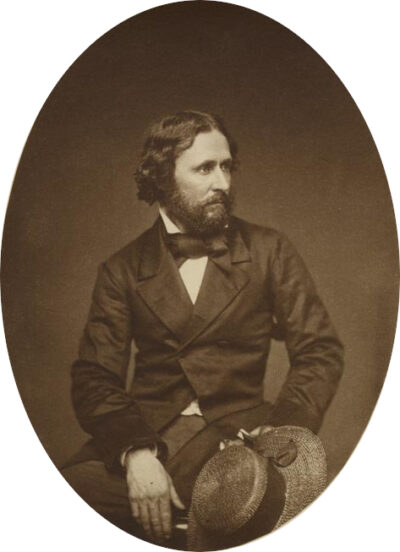
John C. Frémont
John C. Frémont was an American politician, explorer and military officer. Born January 21, 1813, in Savannah. Died July 13, 1890, in Manhattan. Positions held include Governor of the Territory of Arizona (1878–1881) and United States senator (1850–1851). Educated at College of Charleston. Awards include Pour le Mérite for Sciences and Arts order and Patron’s Medal.
Facts
34 facts · 2 confirmed by two sources · 14 cited · 18 from one source
Where this comes from
Papalocal keeps its own record. It started from these sources; what each one said is kept here as it was copied, so a change on their side never changes this page by itself. Tap one to read its version.
What Wikidata says · copied November 15, 2026 · revision 2567353197
- Described as
- American politician, explorer and military officer (1813–1890)
- Other names
- John C. Fremont, J. C. Fremont, Frem., Frém., John Charles Frémont, J. C. Frémont, John Charles Fremont
- Born
- January 21, 1813 · 7 references
- Died
- July 13, 1890 · 8 references
- Born in
- Savannah · 3 references
- Died in
- Manhattan · 1 reference
- Buried in
- Sparkill · 1 reference
- Cause of death
- peritonitis
- Name at birth
- John Charles Frémont
- Citizen of
- United States
- Occupation
- politician · 1 reference; explorer; military officer · 1 reference; botanist; engineer · 1 reference; writer · 1 reference
- Positions held
- Governor of the Territory of Arizona (1878–1881); United States senator (1850–1851) · 1 reference
- Political party
- Republican Party
- Education
- College of Charleston
- Member of
- American Academy of Arts and Sciences
- Awards
- Pour le Mérite for Sciences and Arts order; Patron’s Medal (1850) · 1 reference
- Field
- military · 1 reference; politics · 1 reference; military topography · 1 reference; research expedition · 1 reference
- Spouse
- Jessie Benton Frémont · 1 reference
- Children
- John Charles Fremont; Elizabeth Benton Frémont; Francis Preston Fremont
- Father
- Louis Rene Frémont · 1 reference
- Mother
- Anne Beverly Whiting
- Religion
- Episcopal Church
- Military branch
- United States Army
- Military rank
- major general · 1 reference
- Wikipedias with a page
- 38
Wikidata item Q169011 (wikidata.org/wiki/Q169011), public domain (CC0). Copied November 15, 2026.
What Wikipedia says · copied November 15, 2026 · revision 1384615687
Major General John Charles Frémont (January 21, 1813 – July 13, 1890) was a United States Army officer, explorer, and politician. He was a United States senator from California and was the first Republican nominee for president of the U.S. and founder of the California Republican Party upon being nominated. Frémont lost the 1856 United States presidential election to Democrat James Buchanan.
A native of Georgia, he attended the College of Charleston for two years until he was expelled after irregular attendance. In the 1840s, Frémont led five expeditions into the western states, for which he was called The Pathfinder. During this time, he directed several massacres of the indigenous peoples in California as part of the California genocide. During the Mexican–American War, he was a major in the United States Army and took control of a portion of California north of San Francisco from the short-lived California Republic in 1846. Frémont was court-martialed and convicted of mutiny and insubordination after a conflict over who was the rightful military governor of California. His sentence was commuted, and he was reinstated by President James K. Polk, but Frémont resigned from the Army. Afterwards, he settled in California at Monterey while buying cheap land in the Sierra foothills. Gold was found on his Mariposa ranch, and Frémont became a wealthy man during the California gold rush. He became one of the first two U.S. senators elected from the new state of California in 1850.
At the beginning of the American Civil War in 1861, he was given command of the Department of the West by President Abraham Lincoln. Frémont had successes during his brief tenure there, though he ran his department autocratically and made hasty decisions without consulting President Lincoln or Army headquarters. He opposed slavery and issued an unauthorized emancipation edict, which led to him being relieved of his command for insubordination by Lincoln. After a brief service tenure in the Mountain Department in 1862, Frémont resided in New York, retiring from the army in 1864. He was nominated for president in 1864 by the Radical Democratic Party, a breakaway faction of abolitionist Republicans, but he withdrew before the election. After the Civil War, he lost much of his wealth in the unsuccessful Pacific Railroad in 1866, and he lost more in the Panic of 1873. Frémont served as Governor of the Arizona Territory from 1878 to 1881. After his resignation as governor, he retired from politics and died destitute in New York City in 1890.
Historians portray Frémont as controversial, impetuous, and contradictory. Some scholars regard him as a military hero of significant accomplishment, while others view him as a failure who repeatedly defeated his own best interests. The keys to Frémont's character and personality, several historians argue, lie in his having been born "illegitimate" (to unwed parents) and in his drive for success, need for self-justification, and passive-aggressive behavior. His biographer Allan Nevins wrote that Frémont lived a dramatic life of remarkable successes and dismal failures.
- Born, in its opening lines
- January 21, 1813
- Died, in its opening lines
- July 13, 1890
From the Wikipedia article “John C. Frémont” (en.wikipedia.org/wiki/John_C._Frémont), by its contributors, under CC BY-SA 4.0 (creativecommons.org/licenses/by-sa/4.0/). Copied November 15, 2026; not changed.
Confirmed Two sources agree. Cited One source, and it names where it got it. One source One source, without a reference of its own. Sources disagree The sources disagree. We show the best-supported value and keep theirs below.
