
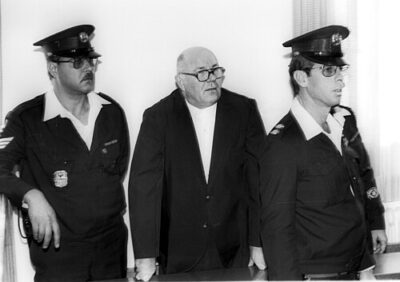
John Demjanjuk
John Demjanjuk was an Ukrainian guard at Nazi death camps. Born April 3, 1920, in Dubovi Makharyntsi. Died March 17, 2012, in Bad Feilnbach. Educated at Trawniki concentration camp.
Facts
20 facts · 2 confirmed by two sources · 3 cited · 15 from one source
Where this comes from
Papalocal keeps its own record. It started from these sources; what each one said is kept here as it was copied, so a change on their side never changes this page by itself. Tap one to read its version.
What Wikidata says · copied November 13, 2026 · revision 2554031144
- Described as
- Ukrainian guard at Nazi death camps (1920–2012)
- Other names
- İoan Demjanjuk
- Born
- April 3, 1920 · 4 references
- Died
- March 17, 2012 · 4 references
- Born in
- Dubovi Makharyntsi · 1 reference
- Died in
- Bad Feilnbach · 1 reference
- Cause of death
- disease
- Citizen of
- Soviet Union; United States (1958–2004); statelessness (2004–)
- Occupation
- torturer; military personnel; concentration camp guard; mechanic · 1 reference; soldier · 1 reference
- Worked for
- Sobibór Extermination Camp · 1 reference; Lublin-Majdanek concentration camp · 1 reference; Flossenbürg concentration camp · 1 reference
- Education
- Trawniki concentration camp · 1 reference
- Military branch
- Red Army (1940–1942); Schutzstaffel
- Military rank
- soldier
- Wikipedias with a page
- 41
Wikidata item Q152672 (wikidata.org/wiki/Q152672), public domain (CC0). Copied November 13, 2026.
What Wikipedia says · copied November 13, 2026 · revision 1384363554
John Demjanjuk (born Ivan Mykolaiovych Demjanjuk 3 April 1920 – 17 March 2012) was a Trawniki and guard at Sobibor extermination camp, Majdanek, and Flossenbürg. Demjanjuk became the center of global media attention in the 1980s, when he was tried and convicted in Israel after being identified as "Ivan the Terrible", a notoriously cruel watchman at Treblinka extermination camp. Demjanjuk was sentenced to death by hanging in 1988. In 1993, the verdict was overturned. Shortly before his death, he was tried and convicted in the Federal Republic of Germany as an accessory to the 28,060 murders that occurred during his service at Sobibor.
Born in Soviet Ukraine, Demjanjuk was conscripted into the Red Army in 1940. He fought in World War II and was taken prisoner by the Germans in spring 1942, becoming a Trawniki collaborator. After training, he served at Sobibor extermination camp and at least two concentration camps. After the war, he married a woman he met in a West German displaced persons camp, and emigrated with her and their daughter to the United States. They settled in Seven Hills, Ohio, where he worked in an auto factory and raised three children. Demjanjuk became a US citizen in 1958.
In 1977, Demjanjuk was accused of war crimes. Based on eyewitness testimony by Holocaust survivors in Israel, he was identified as the notorious Ivan the Terrible from Treblinka. Demjanjuk was extradited to Israel in 1986 for trial. In 1988, Demjanjuk was convicted and sentenced to death. He maintained his innocence, claiming that it was a case of mistaken identity. In 1993, the verdict was overturned by the Israeli Supreme Court, based on new evidence that cast reasonable doubt over his identity as Ivan the Terrible. Although the judges agreed there was sufficient evidence to show that Demjanjuk had served at Sobibor, Israel declined to prosecute. In September 1993, Demjanjuk was allowed to return to Ohio. In 1999, US prosecutors again sought to deport Demjanjuk for having been a concentration camp guard, and his citizenship was revoked in 2002. In 2009, Germany requested his extradition for over 27,900 counts of acting as an accessory to murder, one for each person killed at Sobibor during the time when he was alleged to have served there as a guard. He was deported from the US to Germany in that same year. In 2011, he was convicted and sentenced to five years in prison.
According to legal scholar Lawrence Douglas, in spite of serious missteps along the way, the German verdict brought the case "to a worthy and just conclusion". After the conviction, Demjanjuk was released pending appeal. He lived at a German nursing home in Bad Feilnbach, where he died in 2012. Having died before a final judgment on his appeal could be issued, Demjanjuk remains technically innocent under German law. In 2020, a photograph album by Sobibor guard Johann Niemann was made public; some historians have suggested that a guard who appears in two photos may have been Demjanjuk.
- Born, in its opening lines
- April 3, 1920
- Died, in its opening lines
- March 17, 2012
From the Wikipedia article “John Demjanjuk” (en.wikipedia.org/wiki/John_Demjanjuk), by its contributors, under CC BY-SA 4.0 (creativecommons.org/licenses/by-sa/4.0/). Copied November 13, 2026; not changed.
Confirmed Two sources agree. Cited One source, and it names where it got it. One source One source, without a reference of its own. Sources disagree The sources disagree. We show the best-supported value and keep theirs below.
