
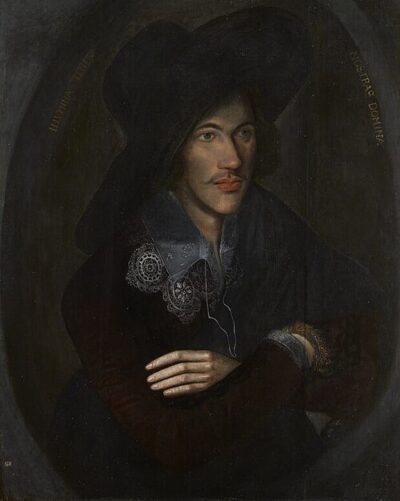
John Donne
John Donne was an English poet and cleric. Born 1572, in London. Died March 31, 1631, in London. Positions held include Member of Parliament in the Parliament of England, Member of the 1601 Parliament and Member of the 1614 Parliament. Educated at University of Cambridge.
Facts
33 facts · 0 confirmed by two sources · 21 cited · 12 from one source
Where this comes from
Papalocal keeps its own record. It started from these sources; what each one said is kept here as it was copied, so a change on their side never changes this page by itself. Tap one to read its version.
What Wikidata says · copied November 16, 2026 · revision 2567902918
- Described as
- English poet and cleric (1572–1631)
- Other names
- Very Rev. John Donne
- Born
- 1572 · 3 references
- Died
- March 31, 1631 · 11 references
- Born in
- London · 2 references
- Died in
- London · 2 references
- Buried in
- St Paul's Cathedral
- Cause of death
- stomach cancer
- Citizen of
- Kingdom of England
- Occupation
- poet · 2 references; translator; lawyer; songwriter; politician; writer · 2 references; Anglican priest · 2 references; jurist · 1 reference
- Positions held
- Member of Parliament in the Parliament of England; Member of the 1601 Parliament · 2 references; Member of the 1614 Parliament · 1 reference; Dean of St Paul's (1621–1631)
- Education
- University of Cambridge
- Genre
- metaphysical poets
- Field
- fiction · 1 reference
- Spouse
- Anne More · 2 references
- Children
- George Donne · 2 references; John Donne · 1 reference; Bridget Donne · 1 reference; Constance Donne · 1 reference; Margaret Donne · 2 references; Elizabeth Donne · 2 references; John Donne the Younger · 1 reference
- Father
- John Donne · 1 reference
- Mother
- Elizabeth Heywood · 1 reference
- Religion
- Anglicanism · 1 reference
- Wikipedias with a page
- 102
Wikidata item Q140412 (wikidata.org/wiki/Q140412), public domain (CC0). Copied November 16, 2026.
What Wikipedia says · copied November 16, 2026 · revision 1381370771
John Donne ( DUN; 1571 or 1572 – 31 March 1631) was an English poet, scholar, soldier and secretary born into a recusant family, who later became a cleric in the Church of England. Under royal patronage, he was made Dean of St Paul's Cathedral in London (1621–1631). He is considered the preeminent representative of the metaphysical poets. His poetical works are noted for their metaphorical and sensual style and include sonnets, love poems, religious poems, Latin translations, epigrams, elegies, songs and satires. He is also known for his sermons.
Donne's style is characterised by abrupt openings and various paradoxes, ironies and dislocations. These features, along with his frequent dramatic or everyday speech rhythms, his tense syntax and his tough eloquence, were both a reaction against the smoothness of conventional Elizabethan poetry and an adaptation into English of European baroque and mannerist techniques. His early career was marked by poetry that bore immense knowledge of English society. A theme in Donne's later poetry is the idea of true religion, something that he spent much time considering and about which he often theorised. He wrote secular poems as well as erotic and love poems. He is particularly famous for his mastery of metaphysical conceits.
Despite his great education and poetic talents, Donne lived in poverty for several years, relying heavily on wealthy friends. This was as a result of his secret marriage to Anne More, with whom he eventually had twelve children. He served as a member of Parliament in 1601 and in 1614. In 1615 he unwillingly was ordained Anglican deacon and then priest at the king's insistence.
From the Wikipedia article “John Donne” (en.wikipedia.org/wiki/John_Donne), by its contributors, under CC BY-SA 4.0 (creativecommons.org/licenses/by-sa/4.0/). Copied November 16, 2026; not changed.
Confirmed Two sources agree. Cited One source, and it names where it got it. One source One source, without a reference of its own. Sources disagree The sources disagree. We show the best-supported value and keep theirs below.
