
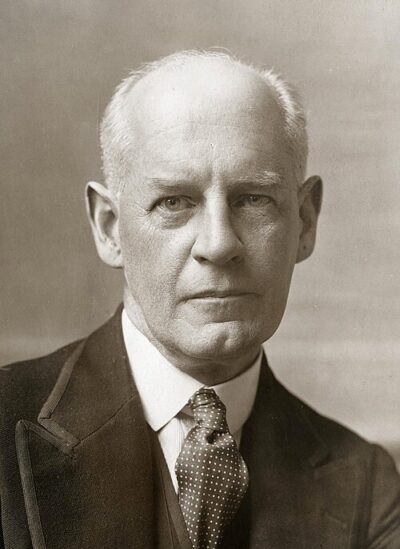
John Galsworthy
John Galsworthy was an English novelist and playwright. Born August 14, 1867, in Kingston upon Thames. Died January 31, 1933, in London. Positions held include president (1921–1932). Known for The Forsyte Saga, Saint's Progress and The Silver Box. Educated at Harrow School and New College. Awards include Nobel Prize in Literature.
Facts
27 facts · 2 confirmed by two sources · 10 cited · 15 from one source
Where this comes from
Papalocal keeps its own record. It started from these sources; what each one said is kept here as it was copied, so a change on their side never changes this page by itself. Tap one to read its version.
What Wikidata says · copied November 16, 2026 · revision 2568413179
- Described as
- English novelist and playwright (1867–1933)
- Other names
- John Sinjohn
- Born
- August 14, 1867 · 14 references
- Died
- January 31, 1933 · 15 references
- Born in
- Kingston upon Thames · 1 reference
- Died in
- London · 2 references
- Buried in
- Highgate Cemetery
- Cause of death
- brain cancer
- Citizen of
- United Kingdom · 1 reference; United Kingdom of Great Britain and Ireland
- Occupation
- playwright · 1 reference; writer · 3 references; novelist; screenwriter; prose writer · 1 reference
- Positions held
- president (1921–1932) · 1 reference
- Education
- Harrow School; New College
- Member of
- American Academy of Arts and Sciences
- Known for
- The Forsyte Saga; Saint's Progress; The Silver Box; Strife; Justice
- Awards
- Nobel Prize in Literature (1932) · 2 references
- Field
- drama · 1 reference; prose · 1 reference
- Spouse
- Ada Galsworthy
- Siblings
- Mabel Edith Reynolds
- Wikipedias with a page
- 121
Wikidata item Q82248 (wikidata.org/wiki/Q82248), public domain (CC0). Copied November 16, 2026.
What Wikipedia says · copied November 16, 2026 · revision 1372617739
John Galsworthy (; 14 August 1867 – 31 January 1933) was an English novelist and playwright. He is best known for his trilogy of novels collectively called The Forsyte Saga (1906, 1920, 1921), and two later trilogies, A Modern Comedy and End of the Chapter. He was awarded the 1932 Nobel Prize in Literature.
Born to a prosperous upper-middle-class family, Galsworthy was destined for a career as a lawyer, but found it uncongenial and turned instead to writing. He was thirty before his first book was published in 1897, and did not achieve real success until 1906, when The Man of Property, the first of his novels about the Forsyte family was published. In the same year his first play, The Silver Box was staged in London. As a dramatist, he became known for plays with a social message, reflecting, among other themes, the struggle of workers against exploitation, the use of solitary confinement in prisons, the repression of women, jingoism and the politics and morality of war.
The Forsyte family series of novels and short stories collectively known as The Forsyte Chronicles is similar in many ways to Galsworthy's family, and the patriarch, Old Jolyon, is modelled on Galsworthy's father. The main sequence runs from the late 19th century to the early 1930s, featuring three generations of the family. The books were popular when first published and their latter-day popularity was boosted considerably when BBC Television broadcast a 26-part adaptation for the author's centenary in 1967.
As well as writing plays and novels with social messages, Galsworthy campaigned continually for a wide range of causes about which he felt strongly, from animal welfare to prison reform, censorship and workers' rights. Although seen by many as a radical, he belonged to and supported no political party. His plays are seldom revived, but his novels have been frequently reissued.
- Born, in its opening lines
- August 14, 1867
- Died, in its opening lines
- January 31, 1933
From the Wikipedia article “John Galsworthy” (en.wikipedia.org/wiki/John_Galsworthy), by its contributors, under CC BY-SA 4.0 (creativecommons.org/licenses/by-sa/4.0/). Copied November 16, 2026; not changed.
Confirmed Two sources agree. Cited One source, and it names where it got it. One source One source, without a reference of its own. Sources disagree The sources disagree. We show the best-supported value and keep theirs below.
