
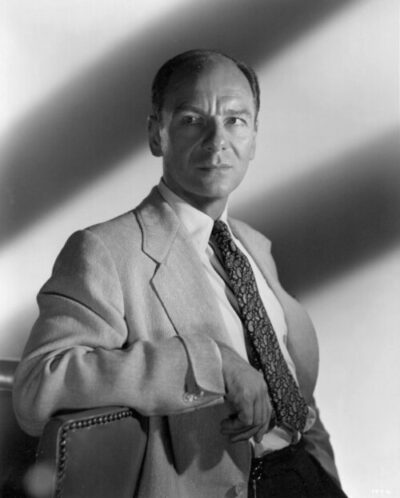
John Gielgud
John Gielgud was a British actor and theatre director. Born April 14, 1904, in South Kensington. Died May 21, 2000, in Wotton House. Educated at Royal Academy of Dramatic Art and Westminster School. Awards include Laurence Olivier Awards, Praemium Imperiale and Academy Award for Best Supporting Actor.
Facts
35 facts · 2 confirmed by two sources · 20 cited · 13 from one source
What’s different
- Born: we show April 14, 1904 (Confirmed). Wikidata also lists 1904
- Died: we show May 21, 2000 (Confirmed). Wikidata also lists 2000
Where this comes from
Papalocal keeps its own record. It started from these sources; what each one said is kept here as it was copied, so a change on their side never changes this page by itself. Tap one to read its version.
What Wikidata says · copied November 16, 2026 · revision 2557989676
- Described as
- British actor and theatre director (1904-2000)
- Other names
- Sir John Gielgud, John Gielguld, Arthur John Gielgud, Sir Arthur John Gielgud
- Born
- April 14, 1904 · 14 references; 1904 · 1 reference
- Died
- May 21, 2000 · 14 references; 2000 · 1 reference
- Born in
- South Kensington
- Died in
- Wotton House
- Buried in
- Westminster Abbey · 1 reference
- Citizen of
- United Kingdom
- Occupation
- theatre director · 1 reference; stage actor · 1 reference; film actor · 2 references; television actor · 1 reference; film director; art collector · 1 reference; actor · 1 reference; director · 1 reference
- Education
- Royal Academy of Dramatic Art (–1925) · 1 reference; Westminster School (1917–1921) · 1 reference
- Member of
- American Academy of Arts and Sciences
- Genre
- Shakespearean comedy
- Awards
- Laurence Olivier Awards; Praemium Imperiale (1994) · 1 reference; Academy Award for Best Supporting Actor (1982) · 1 reference; Tony Award for Best Direction of a Play (1961); Grammy Award for Best Audio Book, Narration & Storytelling Recording · 1 reference; Order of Merit · 1 reference; Companion of Honour · 1 reference; Knight Bachelor · 1 reference; Primetime Emmy Award for Outstanding Lead Actor in a Miniseries or a Movie (1991); Society of London Theatre Special Award; BAFTA Award for Best Actor in a Supporting Role (1975) · 1 reference; honorary doctorate (1980) · 1 reference
- Father
- Henry Lex Franciszek Adam Gielgud · 2 references
- Mother
- Kate Terry Lewis Gielgud · 2 references
- Siblings
- Frances Eleanor Gielgud · 1 reference; Lewis Gielgud · 1 reference; Val Gielgud · 1 reference
- Wikipedias with a page
- 60
Wikidata item Q204685 (wikidata.org/wiki/Q204685), public domain (CC0). Copied November 16, 2026.
What Wikipedia says · copied November 16, 2026 · revision 1382255990
Sir Arthur John Gielgud ( GHEEL-guud; 14 April 1904 – 21 May 2000) was an English actor and theatre director. With his contemporaries Laurence Olivier, Michael Redgrave and Ralph Richardson, he made up a quartet of male actors who dominated the British stage of the mid-20th century. A member of the Terry family theatrical dynasty, his career spanned eight decades. He gained his first paid acting work as a junior member of his cousin Phyllis Neilson-Terry's company in 1922. After studying at the Royal Academy of Dramatic Art (RADA), Gielgud worked in repertory theatre and in the West End before establishing himself at the Old Vic as an exponent of Shakespeare from 1929 to 1931.
During the 1930s Gielgud was a stage star in the West End and on Broadway, appearing in new works and classics. He began a parallel career as a director, and set up his own company at the Queen's Theatre, London. He was regarded by many as the finest Hamlet of his era, and was also known for high comedy roles such as John Worthing in The Importance of Being Earnest. In the 1950s Gielgud feared that his career was threatened when he was convicted and fined for a homosexual offence, but his colleagues and the public supported him loyally. When avant-garde plays began to supersede traditional West End productions in the later 1950s he found no new suitable stage roles, and for several years he was best known in the theatre for his one-man Shakespeare show The Ages of Man. From the late 1960s he found new plays that suited him, by authors including Alan Bennett, David Storey and Harold Pinter.
During the first half of his career Gielgud did not take the cinema seriously. Though he made his first film in 1924, and had successes with The Good Companions (1933) and Julius Caesar (1953), he did not begin a regular film career until his sixties. He appeared in more than sixty films between Becket (1964), for which he received his first Academy Award nomination for playing Louis VII of France, and Elizabeth (1998). As the acid-tongued Hobson in Arthur (1981) he won the Academy Award for Best Supporting Actor. His film work further earned him a Golden Globe Award and two BAFTAs.
Although largely indifferent to awards, Gielgud had the rare distinction of winning an Emmy, a Grammy, an Oscar, and a Tony (EGOT). He was famous from the start of his career for his voice and his mastery of Shakespearean verse. He broadcast more than a hundred radio and television dramas between 1929 and 1994, and made commercial recordings of many plays, including ten of Shakespeare's and three recordings from his own "Ages of Man". Among his honours, he was knighted in 1953 and the Gielgud Theatre was named after him in 1994. From 1977 to 1989, he was president of the Royal Academy of Dramatic Art.
- Born, in its opening lines
- April 14, 1904
- Died, in its opening lines
- May 21, 2000
From the Wikipedia article “John Gielgud” (en.wikipedia.org/wiki/John_Gielgud), by its contributors, under CC BY-SA 4.0 (creativecommons.org/licenses/by-sa/4.0/). Copied November 16, 2026; not changed.
Confirmed Two sources agree. Cited One source, and it names where it got it. One source One source, without a reference of its own. Sources disagree The sources disagree. We show the best-supported value and keep theirs below.
