
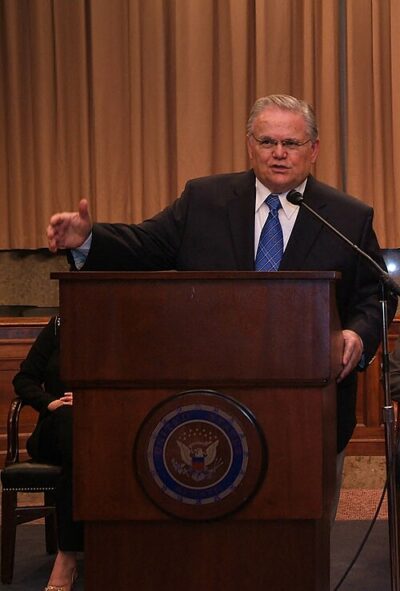
John Hagee
John Hagee is a controversial televangelist. Born April 12, 1940, in Baytown. Known for Blood Moon Prophecy and Christians United for Israel. Educated at Trinity University and Nelson University.
Facts
20 facts · 1 confirmed by two sources · 4 cited · 15 from one source
Where this comes from
Papalocal keeps its own record. It started from these sources; what each one said is kept here as it was copied, so a change on their side never changes this page by itself. Tap one to read its version.
What Wikidata says · copied November 16, 2026 · revision 2561103126
- Described as
- controversial televangelist
- Other names
- John Charles Hagee
- Born
- April 12, 1940 · 2 references
- Born in
- Baytown
- Citizen of
- United States
- Occupation
- pastor; theologian; saxophonist; writer · 1 reference; evangelist · 1 reference; parson · 1 reference
- Political party
- Republican Party
- Education
- Trinity University; Nelson University · 1 reference; University of North Texas · 1 reference
- Instrument
- saxophone
- Known for
- Blood Moon Prophecy · 1 reference; Christians United for Israel · 1 reference
- Field
- evangelism · 1 reference; televangelism · 1 reference
- Religion
- Pentecostalism · 1 reference
- Website
- https://www.jhm.org/ · 1 reference
- Wikipedias with a page
- 20
Wikidata item Q861718 (wikidata.org/wiki/Q861718), public domain (CC0). Copied November 16, 2026.
What Wikipedia says · copied November 16, 2026 · revision 1384724091
John Charles Hagee (born April 12, 1940) is an American pastor and televangelist. He founded John Hagee Ministries, which telecasts to the United States and Canada. He is also the founder and chairman of the Christian Zionist organization Christians United for Israel, the largest Zionist organization in America.
Hagee has attracted controversy over his comments on the Catholic Church, Jewish people and Islam, and promotion of the blood moon prophecy.
- Born, in its opening lines
- April 12, 1940
From the Wikipedia article “John Hagee” (en.wikipedia.org/wiki/John_Hagee), by its contributors, under CC BY-SA 4.0 (creativecommons.org/licenses/by-sa/4.0/). Copied November 16, 2026; not changed.
Confirmed Two sources agree. Cited One source, and it names where it got it. One source One source, without a reference of its own. Sources disagree The sources disagree. We show the best-supported value and keep theirs below.
