
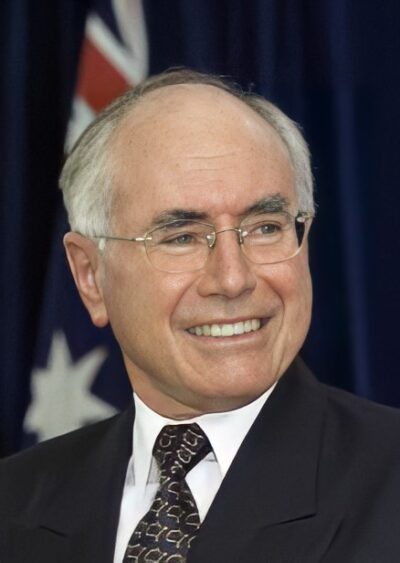
John Howard
John Howard is a Prime Minister of Australia from 1996 to 2007. Born July 26, 1939, in Earlwood. Positions held include Prime Minister of Australia (1996–2007), Treasurer of Australia (1977–1983) and Leader of the Opposition of Australia (2 times) (1985–1996). Educated at University of Sydney and Canterbury Boys' High School. Awards include Presidential Medal of Freedom, Centenary Medal and Companion of the Order of Australia.
Facts
32 facts · 1 confirmed by two sources · 8 cited · 23 from one source
Where this comes from
Papalocal keeps its own record. It started from these sources; what each one said is kept here as it was copied, so a change on their side never changes this page by itself. Tap one to read its version.
What Wikidata says · copied November 16, 2026 · revision 2562950972
- Described as
- Prime Minister of Australia from 1996 to 2007
- Other names
- John Winston Howard, The Honourable John Howard
- Born
- July 26, 1939 · 5 references
- Born in
- Earlwood
- Citizen of
- Australia · 1 reference
- Occupation
- politician · 1 reference; autobiographer; lawyer; solicitor; historian · 1 reference
- Positions held
- Prime Minister of Australia (1996–2007); Treasurer of Australia (1977–1983); Leader of the Opposition of Australia (2 times) (1985–1996); member of the Australian House of Representatives (1974–2007); Minister for Finance (Australia) (1979); Minister for Special Trade Negotiations of Australia (1977); Delegate to the Australian Constitutional Convention, 1998 (1998); Leader of the Liberal Party of Australia (1995–2007) · 2 references
- Political party
- Liberal Party of Australia (1957–)
- Education
- University of Sydney; Canterbury Boys' High School
- Awards
- Presidential Medal of Freedom (2009) · 1 reference; Centenary Medal (2001) · 1 reference; Companion of the Order of Australia (2008) · 1 reference; Order of the Rising Sun, 1st class; Order of Merit (2011) · 1 reference; James Joyce Awards; Australian National Living Treasure; Irving Kristol Award (2008) · 1 reference
- Spouse
- Janette Howard (1971–)
- Father
- Lyall Howard
- Mother
- Mona Jane Kell · 1 reference
- Siblings
- Bob Howard
- Religion
- Anglicanism
- Wikipedias with a page
- 83
Wikidata item Q51330 (wikidata.org/wiki/Q51330), public domain (CC0). Copied November 16, 2026.
What Wikipedia says · copied November 16, 2026 · revision 1385924261
John Winston Howard (born 26 July 1939) is an Australian former politician who served as the 25th prime minister of Australia from 1996 to 2007, holding office as leader of the Liberal Party of Australia. His eleven-year tenure as prime minister is the second-longest in Australian history, after that of Robert Menzies.
Howard was born in Sydney and studied law at the University of Sydney. He was a commercial lawyer before entering parliament. A former federal president of the Young Liberals, he first stood for office at the 1968 New South Wales state election, but lost narrowly. At the 1974 federal election, Howard was elected as a member of parliament (MP) for the division of Bennelong. He was promoted to cabinet in 1977, and later in the year replaced Phillip Lynch as treasurer of Australia, remaining in that position until the defeat of Malcolm Fraser's government at the 1983 election. In 1985, Howard was elected leader of the Liberal Party for the first time, thus replacing Andrew Peacock as Leader of the Opposition. He led the Liberal–National coalition to the 1987 federal election, but lost to Bob Hawke's Labor government, and was removed from the leadership in 1989. Remaining a key figure in the party, Howard was re-elected leader in 1995, replacing Alexander Downer, and subsequently led the Coalition to a landslide victory at the 1996 federal election.
In his first term, Howard introduced reformed gun laws in response to the Port Arthur massacre, and controversially implemented a nationwide value-added tax, breaking a pre-election promise. The Howard government called a snap election for October 1998, which they won, albeit with a greatly reduced majority. Going into the 2001 election, the Coalition trailed behind Labor in opinion polling. However, in a campaign dominated by national security, Howard introduced changes to Australia's immigration system to deter asylum seekers from entering the country, and pledged military assistance to the United States following the September 11 attacks. Due to this, Howard won widespread support, and his government was narrowly re-elected.
In Howard's third term in office, Australia contributed troops to the War in Afghanistan and the Iraq War, and led the International Force for East Timor. The Coalition was re-elected once more at the 2004 federal election. In his final term in office, his government introduced industrial relations reforms known as WorkChoices, which proved controversial and unpopular with the public. The Howard government was defeated at the 2007 federal election, with the Labor Party's Kevin Rudd succeeding him as prime minister. Howard also lost his own seat of Bennelong at the election to Maxine McKew, becoming only the second prime minister to do so, after Stanley Bruce at the 1929 election. Following this loss, Howard retired from politics, but has remained active in political discourse.
Howard's government presided over a sustained period of economic growth and a large "mining boom", and significantly reduced government debt by the time he left office. He was known for his broad appeal to voters across the political spectrum, and commanded a diverse base of supporters, colloquially referred to as his "battlers". Retrospectively, ratings of Howard's premiership have been polarised. His critics have admonished him for involving Australia in the Iraq War, his policies regarding asylum seekers, and his economic agenda. Nonetheless, he has been frequently ranked within the upper-tier of Australian prime ministers by political experts and the general public.
- Born, in its opening lines
- July 26, 1939
From the Wikipedia article “John Howard” (en.wikipedia.org/wiki/John_Howard), by its contributors, under CC BY-SA 4.0 (creativecommons.org/licenses/by-sa/4.0/). Copied November 16, 2026; not changed.
Confirmed Two sources agree. Cited One source, and it names where it got it. One source One source, without a reference of its own. Sources disagree The sources disagree. We show the best-supported value and keep theirs below.
