
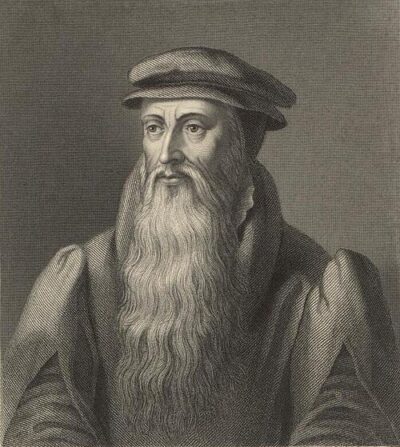
John Knox
John Knox was a Scottish clergyman, writer and historian. Born 1514, in Haddington. Died November 24, 1572, in Edinburgh. Positions held include Moderator of the General Assembly of the Church of Scotland (2 times) (1562–1569). Educated at University of Glasgow and University of St Andrews.
Facts
21 facts · 2 confirmed by two sources · 11 cited · 8 from one source
Where this comes from
Papalocal keeps its own record. It started from these sources; what each one said is kept here as it was copied, so a change on their side never changes this page by itself. Tap one to read its version.
What Wikidata says · copied November 16, 2026 · revision 2568754412
- Described as
- Scottish clergyman, writer and historian (1514–1572)
- Born
- 1514 · 3 references
- Died
- November 24, 1572 · 6 references
- Born in
- Haddington · 1 reference
- Died in
- Edinburgh · 2 references
- Buried in
- St Giles' Cathedral
- Citizen of
- Kingdom of Scotland
- Occupation
- theologian · 2 references; Christian minister · 1 reference; writer · 1 reference; politician · 1 reference
- Positions held
- Moderator of the General Assembly of the Church of Scotland (2 times) (1562–1569) · 1 reference
- Education
- University of Glasgow; University of St Andrews
- Spouse
- Margaret Knox (1564–) · 1 reference; Margery Bowes (–1560)
- Children
- Elizabeth Knox
- Father
- William Knox · 1 reference
- Mother
- NN St.Clair · 1 reference
- Religion
- Presbyterianism
- Lived in
- St Giles' Cathedral (1560–1572) · 2 references; St Andrews (1560) · 1 reference
- Wikipedias with a page
- 68
Wikidata item Q189937 (wikidata.org/wiki/Q189937), public domain (CC0). Copied November 16, 2026.
What Wikipedia says · copied November 16, 2026 · revision 1385499217
John Knox (c. 1514 – 24 November 1572) was a Scottish minister, Reformed theologian, and writer who was a leader of the country's Reformation. He was the reformer of the Church of Scotland.
Born in Giffordgate, a street in Haddington, East Lothian, Knox is believed to have been educated at the University of St Andrews and worked as a notary-priest. Influenced by early church reformers such as George Wishart, he joined the movement to reform the Scottish Church. He was caught up in the ecclesiastical and political events that involved the murder of Cardinal David Beaton in 1546 and the intervention of the regent Mary of Guise. He was taken prisoner by French forces the following year and exiled to England on his release in 1549.
While in exile, Knox was licensed to work in the Church of England, where he rose in the ranks to serve Edward VI of England as a royal chaplain. He exerted a reforming influence on the text of the Book of Common Prayer. In England, he met and married his first wife, Margery Bowes. When Queen Mary I ascended the throne of England and re-established Catholicism, Knox was forced to resign his position and leave the country. Knox moved to Geneva and then to Frankfurt. In Geneva, he met John Calvin, from whom he gained experience and knowledge of Reformed theology and presbyterian polity. He created a new order of service, The Forme of Prayers, which was eventually adopted by the Reformed Church in Scotland and came to be known as the Book of Common Order. It was the first book printed in any Gaelic language. Knox left Geneva to head the English refugee church in Frankfurt but he was forced to leave over differences concerning the liturgy, thus ending his association with the Church of England.
On his return to Scotland, Knox led the Protestant Reformation in Scotland, in partnership with the Scottish Protestant nobility. The movement may be seen as a revolution since it led to the ousting of Mary of Guise, who governed the country in the name of her young daughter Mary, Queen of Scots. Knox helped write the new confession of faith and the ecclesiastical order for the newly created Reformed Church, the Kirk. He wrote his five-volume The History of the Reformation in Scotland between 1559 and 1566. He continued to serve as the religious leader of the Protestants throughout Mary's reign. In several interviews with the Queen, Knox admonished her for supporting Catholic practices. After she was imprisoned for her alleged role in the murder of her husband Lord Darnley, and King James VI was enthroned in her stead, Knox openly called for her execution. He continued to preach until his final days.
- Born, in its opening lines
- c. 1514
- Died, in its opening lines
- November 24, 1572
From the Wikipedia article “John Knox” (en.wikipedia.org/wiki/John_Knox), by its contributors, under CC BY-SA 4.0 (creativecommons.org/licenses/by-sa/4.0/). Copied November 16, 2026; not changed.
Confirmed Two sources agree. Cited One source, and it names where it got it. One source One source, without a reference of its own. Sources disagree The sources disagree. We show the best-supported value and keep theirs below.
