
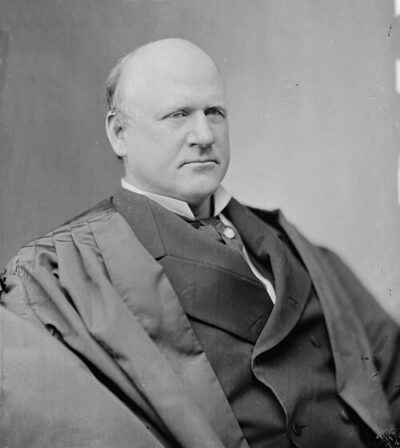
John Marshall Harlan
John Marshall Harlan was an US Supreme Court justice from 1877 to 1911. Born June 1, 1833, in Boyle County. Died October 14, 1911, in Washington, D.C.. Positions held include Associate Justice of the Supreme Court of the United States (1877–1911) and Attorney General of Kentucky (1863–1867). Educated at Centre College and Transylvania University.
Facts
20 facts · 2 confirmed by two sources · 10 cited · 8 from one source
Where this comes from
Papalocal keeps its own record. It started from these sources; what each one said is kept here as it was copied, so a change on their side never changes this page by itself. Tap one to read its version.
What Wikidata says · copied November 18, 2026 · revision 2567632547
- Described as
- US Supreme Court justice from 1877 to 1911 (1833-1911)
- Other names
- The Great Dissenter, John Marshall Harlan I
- Born
- June 1, 1833 · 2 references
- Died
- October 14, 1911 · 2 references
- Born in
- Boyle County · 1 reference
- Died in
- Washington, D.C. · 1 reference
- Buried in
- Rock Creek Cemetery · 1 reference
- Citizen of
- United States
- Occupation
- lawyer; judge · 1 reference; politician · 2 references; jurist · 2 references
- Positions held
- Associate Justice of the Supreme Court of the United States (1877–1911); Attorney General of Kentucky (1863–1867)
- Political party
- Republican Party
- Worked for
- George Washington University
- Education
- Centre College; Transylvania University
- Field
- law · 1 reference; justice and judicial activities · 1 reference
- Children
- John Maynard Harlan · 1 reference
- Father
- James Harlan · 1 reference
- Wikipedias with a page
- 17
Wikidata item Q1700972 (wikidata.org/wiki/Q1700972), public domain (CC0). Copied November 18, 2026.
What Wikipedia says · copied November 18, 2026 · revision 1385054702
John Marshall Harlan (June 1, 1833 – October 14, 1911) was an American lawyer and politician who served as an associate justice of the Supreme Court of the United States from 1877 until his death in 1911. He is often called "The Great Dissenter" due to his many dissents in cases that restricted civil liberties, including the Civil Rights Cases, Plessy v. Ferguson, and Giles v. Harris. Many of Harlan's views expressed in his notable dissents would become the official view of the Supreme Court starting from the 1950s Warren Court and onward.
Born into a prominent, slave-holding family near Danville, Kentucky, Harlan experienced a quick rise to political prominence. When the American Civil War broke out, Harlan strongly supported the Union and recruited the 10th Kentucky Infantry. Despite his opposition to the Emancipation Proclamation, he served in the war until 1863, when he was elected attorney general of Kentucky. Harlan lost his re-election bid in 1867 and joined the Republican Party in the following year, quickly emerging as the leader of the Kentucky Republican Party. In 1877, President Rutherford B. Hayes appointed Harlan to the Supreme Court.
Harlan's jurisprudence was marked by his life-long belief in a strong national government, his sympathy for the economically disadvantaged, and his view that the Reconstruction Amendments had fundamentally transformed the relationship between the federal government and the state governments. He was the sole dissenter in both the Civil Rights Cases (1883) and Plessy v. Ferguson (1896), which permitted state and private actors to engage in racial segregation. He also wrote dissents in major cases such as Pollock v. Farmers' Loan & Trust Co. (1895) that struck down a federal income tax, United States v. E. C. Knight Co. (1895) that severely limited the power of the federal government to pursue antitrust actions, Lochner v. New York (1905) that invalidated a state law setting maximum working hours on the basis of substantive due process; and Standard Oil Co. of New Jersey v. United States (1911) that established the rule of reason. He was the first Supreme Court justice to advocate the incorporation of the Bill of Rights, and his majority opinion in Chicago, Burlington & Quincy Railroad Co. v. City of Chicago (1897) incorporated the Takings Clause.
Harlan was largely forgotten in the decades after his death, but many scholars now consider him to be one of the greatest Supreme Court justices of his era. His grandson John Marshall Harlan II later served on the Supreme Court from 1955 to 1971.
- Born, in its opening lines
- June 1, 1833
- Died, in its opening lines
- October 14, 1911
From the Wikipedia article “John Marshall Harlan” (en.wikipedia.org/wiki/John_Marshall_Harlan), by its contributors, under CC BY-SA 4.0 (creativecommons.org/licenses/by-sa/4.0/). Copied November 18, 2026; not changed.
Confirmed Two sources agree. Cited One source, and it names where it got it. One source One source, without a reference of its own. Sources disagree The sources disagree. We show the best-supported value and keep theirs below.
