
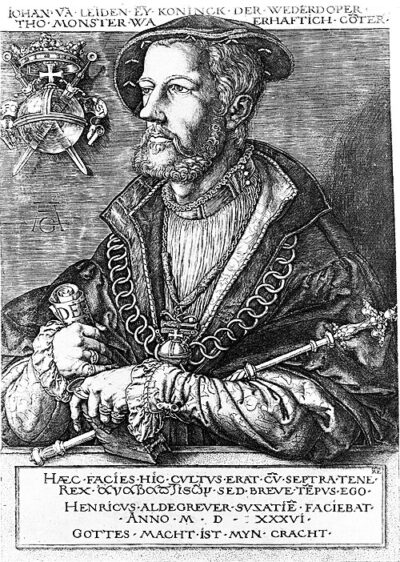
John of Leiden
John of Leiden was an Anabaptist leader, King of Munster. Born February 2, 1509, in Zevenhoven. Died January 22, 1536, in Münster.
Facts
12 facts · 2 confirmed by two sources · 3 cited · 7 from one source
Where this comes from
Papalocal keeps its own record. It started from these sources; what each one said is kept here as it was copied, so a change on their side never changes this page by itself. Tap one to read its version.
What Wikidata says · copied November 16, 2026 · revision 2563974094
- Described as
- Anabaptist leader, King of Munster (1509-1536)
- Other names
- John of Leyden
- Born
- February 2, 1509 · 2 references
- Died
- January 22, 1536 · 2 references
- Born in
- Zevenhoven
- Died in
- Münster · 1 reference
- Cause of death
- decapitation
- Citizen of
- Habsburg Netherlands
- Occupation
- Christian minister; theologian · 1 reference; Anabaptism · 1 reference
- Spouse
- Elisabeth Wandscherer · 1 reference
- Mother
- Alit Bockel
- Religion
- Anabaptism
- Wikipedias with a page
- 28
Wikidata item Q560443 (wikidata.org/wiki/Q560443), public domain (CC0). Copied November 16, 2026.
What Wikipedia says · copied November 16, 2026 · revision 1370054970
John of Leiden (born Johan Beukelszoon; 2 February 1509 – 22 January 1536) was a Dutch Anabaptist leader. In 1533 he moved to Münster, capital of the Prince-Bishopric of Münster, where he became an influential prophet, turned the city into a millenarian Anabaptist theocracy, and proclaimed himself King of New Jerusalem in September 1534. The insurrection was suppressed in June 1535 after Prince-Bishop Franz von Waldeck besieged the city and captured John. John was tortured to death in the city's central marketplace on 22 January 1536, along with Bernhard Knipperdolling and Bernhard Krechting.
- Born, in its opening lines
- February 2, 1509
- Died, in its opening lines
- January 22, 1536
From the Wikipedia article “John of Leiden” (en.wikipedia.org/wiki/John_of_Leiden), by its contributors, under CC BY-SA 4.0 (creativecommons.org/licenses/by-sa/4.0/). Copied November 16, 2026; not changed.
Confirmed Two sources agree. Cited One source, and it names where it got it. One source One source, without a reference of its own. Sources disagree The sources disagree. We show the best-supported value and keep theirs below.
