
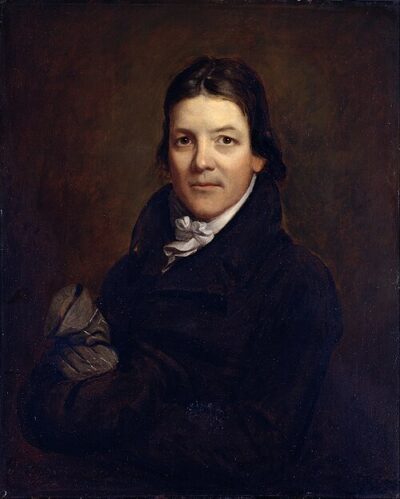
John Randolph of Roanoke
John Randolph of Roanoke was an American politician. Born June 2, 1773, in Hopewell. Died May 24, 1833, in Philadelphia. Positions held include United States representative (3 times) (1799–1833), Member of the United States House of Representatives from Virginia and United States ambassador to the Russian Empire. Educated at Columbia University and Princeton University.
Facts
23 facts · 2 confirmed by two sources · 7 cited · 14 from one source
Where this comes from
Papalocal keeps its own record. It started from these sources; what each one said is kept here as it was copied, so a change on their side never changes this page by itself. Tap one to read its version.
What Wikidata says · copied November 18, 2026 · revision 2567361945
- Described as
- American politician (1773–1833)
- Other names
- John Randolph
- Born
- June 2, 1773 · 4 references
- Died
- May 24, 1833 · 4 references
- Born in
- Hopewell
- Died in
- Philadelphia · 1 reference
- Buried in
- Hollywood Cemetery · 1 reference
- Cause of death
- tuberculosis
- Citizen of
- United States
- Occupation
- politician · 3 references; writer · 1 reference; envoy extraordinary and minister plenipotentiary · 1 reference
- Positions held
- United States representative (3 times) (1799–1833); Member of the United States House of Representatives from Virginia; United States ambassador to the Russian Empire; member of congress · 1 reference; United States senator (1825–1827) · 1 reference
- Political party
- Democratic-Republican Party
- Education
- Columbia University; Princeton University
- Member of
- American Antiquarian Society
- Father
- John Randolph
- Mother
- Frances Bland
- Siblings
- Nathaniel Beverley Tucker; Henry St. George Tucker, Sr.
- Wikipedias with a page
- 19
Wikidata item Q2341317 (wikidata.org/wiki/Q2341317), public domain (CC0). Copied November 18, 2026.
What Wikipedia says · copied November 18, 2026 · revision 1381775406
John Randolph (June 2, 1773 – May 24, 1833), commonly known as John Randolph of Roanoke, was an American planter, and a politician from Virginia, serving in the House of Representatives at various times between 1799 and 1833, and the Senate from 1825 to 1827. He was also Minister to Russia under Andrew Jackson in 1830. After serving as President Thomas Jefferson's spokesman in the House, he broke with the president in 1805 as a result of what he saw as the dilution of traditional Jeffersonian principles as well as perceived mistreatment during the impeachment of Samuel Chase, in which Randolph served as chief prosecutor. Following this split, Randolph proclaimed himself the leader of the "Old Republicans" or "Tertium Quids", a wing of the Democratic-Republican Party who wanted to restrict the role of the federal government. Specifically, Randolph promoted the Principles of '98, which said that individual states could judge the constitutionality of central government laws and decrees, and could refuse to enforce laws deemed unconstitutional.
Described as a quick-thinking orator with a remarkable wit, he was committed to republicanism and advocated a commercial agrarian society throughout his three decades in Congress. Randolph "attracted great attention from the severity of his invectives, the piquancy of his sarcasms, the piercing intonation of his voice and his peculiarly expressive gesticulation." Randolph's conservative stance, displayed in his arguments against debt and for the rights of the landed, slaveholding gentry, have been attributed to his ties to his family estate and the elitist values of his native Southside Virginia. His belief in the importance of a landed gentry led him to oppose the abolition of entail and primogeniture: "The old families of Virginia will form connections with low people, and sink into the mass of overseers' sons and daughters". Randolph vehemently opposed the War of 1812 and the Missouri Compromise of 1820; he was active in debates about tariffs, manufacturing, and currency. With mixed feelings about slavery, he was one of the founders of the American Colonization Society in 1816, to send free blacks to a colony in Africa. At the same time, he believed that slavery was a necessity in Virginia, saying, "The question of slavery, as it is called, is to us a question of life and death ... You will find no instance in history where two distinct races have occupied the soil except in the relation of master and slave." In addition, Randolph remained dependent on hundreds of slaves to work his tobacco plantation. However, he provided for their manumission and resettlement in the free state of Ohio in his will, providing money for the purchase of land and supplies. They founded Rossville, now part of Piqua, Ohio and Rumley, Ohio.
His supporters admired Randolph's fiery character, and education was one of his passions. On the other hand, others, particularly northern advocates of democracy, mocked Randolph for his eccentricities, as did many Virginians including Thomas Jefferson. He applied rousing methods in electioneering, which he also enjoyed as a hobby. Randolph appealed directly to yeomen, using entertaining and enlightening oratory, sociability, and community of interest, particularly in agriculture. This resulted in an enduring voter attachment to him. His defense of limited government appeals to modern and contemporary conservatives, most notably Russell Kirk, who wrote an influential monograph on Randolph.
Randolph is also remembered as an eccentric character with an ambiguous gender presentation, which became the subject of further speculation once an autopsy on his body revealed underdeveloped male genitalia. He also, apparently, was a descendent of Pocahontas, and self-identified as being of mixed-race ancestry.
- Born, in its opening lines
- June 2, 1773
- Died, in its opening lines
- May 24, 1833
From the Wikipedia article “John Randolph of Roanoke” (en.wikipedia.org/wiki/John_Randolph_of_Roanoke), by its contributors, under CC BY-SA 4.0 (creativecommons.org/licenses/by-sa/4.0/). Copied November 18, 2026; not changed.
Confirmed Two sources agree. Cited One source, and it names where it got it. One source One source, without a reference of its own. Sources disagree The sources disagree. We show the best-supported value and keep theirs below.
