
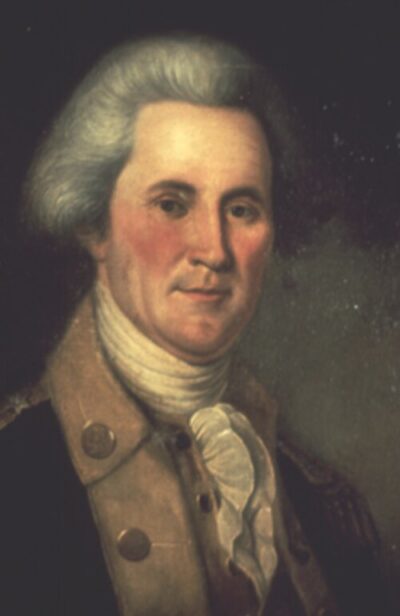
John Sevier
John Sevier was a soldier, frontiersman and politician. Born September 23, 1745, in Rockingham County. Died September 24, 1815, in Alabama Territory. Positions held include United States representative (2 times) (1790–1815), member of the North Carolina House of Commons and member of the State Senate of Tennessee.
Facts
21 facts · 2 confirmed by two sources · 4 cited · 15 from one source
Where this comes from
Papalocal keeps its own record. It started from these sources; what each one said is kept here as it was copied, so a change on their side never changes this page by itself. Tap one to read its version.
What Wikidata says · copied November 18, 2026 · revision 2568731365
- Described as
- soldier, frontiersman and politician (1745-1815)
- Born
- September 23, 1745 · 4 references
- Died
- September 24, 1815 · 4 references
- Born in
- Rockingham County
- Died in
- Alabama Territory · 1 reference
- Buried in
- Tennessee
- Citizen of
- United States
- Occupation
- politician · 1 reference
- Positions held
- United States representative (2 times) (1790–1815); member of the North Carolina House of Commons; member of the State Senate of Tennessee; Governor of Tennessee (1803–1809); member of the North Carolina Senate
- Political party
- Democratic-Republican Party
- Spouse
- Catherine Sevier · 1 reference; Sarah Jane Hawkins Sevier
- Children
- Nancy Goad Sevier King; Joseph Sevier · 1 reference; Elizabeth Hawkins Clark · 1 reference; James Sevier
- Siblings
- Valentine Sevier; Captain Robert Sevier
- Wikipedias with a page
- 15
Wikidata item Q888391 (wikidata.org/wiki/Q888391), public domain (CC0). Copied November 18, 2026.
What Wikipedia says · copied November 18, 2026 · revision 1381257267
John Sevier (September 23, 1745 – September 24, 1815) was an American soldier, frontiersman, and politician, and one of the founding fathers of Tennessee. A member of the Democratic-Republican Party, he played a leading role in Tennessee's pre-statehood period, both militarily and politically, and he was elected the state's first governor in 1796. He served as a colonel of the Washington District Regiment in the Battle of Kings Mountain in 1780, and he commanded the frontier militia in dozens of battles against the Cherokee in the 1780s and 1790s.
Sevier settled in the Tennessee Valley frontier in the 1770s. In 1776, he was elected one of five magistrates of the Watauga Association and helped defend Fort Watauga against an assault by the Cherokee. At the outbreak of the American Revolutionary War, he was chosen as a member of the Committee of Safety for the association's successor, the Washington District. Following the Battle of Kings Mountain, he led an invasion that destroyed several Cherokee towns in northern Georgia. In the 1780s, he served as the only governor of the State of Franklin, an early attempt at statehood by the trans-Appalachian settlers. He was brigadier general of the Southwest Territory militia during the early 1790s.
Sevier served six two-year terms as Tennessee's governor: from 1796 until 1801, and from 1803 to 1809, totaling 11 years. Term limits prevented a fourth consecutive term in both instances. His political career was marked by a growing rivalry with rising politician Andrew Jackson, which nearly culminated in a duel in 1803. After his last term as governor, Sevier was elected to three terms in the United States House of Representatives from Tennessee, serving from 1811 until his death in 1815.
- Born, in its opening lines
- September 23, 1745
- Died, in its opening lines
- September 24, 1815
From the Wikipedia article “John Sevier” (en.wikipedia.org/wiki/John_Sevier), by its contributors, under CC BY-SA 4.0 (creativecommons.org/licenses/by-sa/4.0/). Copied November 18, 2026; not changed.
Confirmed Two sources agree. Cited One source, and it names where it got it. One source One source, without a reference of its own. Sources disagree The sources disagree. We show the best-supported value and keep theirs below.
