
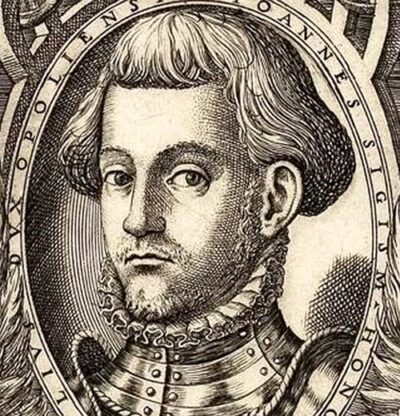
John Sigismund Zápolya
John Sigismund Zápolya was a King of Hungary and Prince of Transylvania. Born July 7, 1540, in Buda. Died March 14, 1571, in Alba Iulia. Positions held include Prince of Transylvania (1556–1571).
Facts
16 facts · 2 confirmed by two sources · 4 cited · 10 from one source
Where this comes from
Papalocal keeps its own record. It started from these sources; what each one said is kept here as it was copied, so a change on their side never changes this page by itself. Tap one to read its version.
What Wikidata says · copied November 16, 2026 · revision 2567045857
- Described as
- King of Hungary and Prince of Transylvania
- Other names
- John Sigismund Zapolya, John Sigismund, King of Hungary
- Born
- July 7, 1540 · 1 reference
- Died
- March 14, 1571
- Born in
- Buda
- Died in
- Alba Iulia · 1 reference
- Buried in
- St. Michael's Cathedral
- Citizen of
- Hungary; Principality of Transylvania
- Occupation
- organist; politician; monarch
- Positions held
- Prince of Transylvania (1556–1571) · 1 reference
- Political party
- politician before the emergence of political parties
- Instrument
- organ
- Father
- John Zápolya · 1 reference
- Mother
- Isabella Jagiellon · 1 reference
- Religion
- Unitarianism
- Wikipedias with a page
- 40
Wikidata item Q313396 (wikidata.org/wiki/Q313396), public domain (CC0). Copied November 16, 2026.
What Wikipedia says · copied November 16, 2026 · revision 1384923910
John Sigismund Zápolya or Szapolyai (Hungarian: Szapolyai János Zsigmond; 7 July 1540 – 14 March 1571) was King of Hungary as John II from 1540 to 1551 and from 1556 to 1570, and the first Prince of Transylvania, from 1570 to his death. He was the only son of John I, King of Hungary, and Isabella of Poland. John I ruled parts of the Kingdom of Hungary with the support of the Ottoman Sultan Suleiman; the remaining areas were ruled by Ferdinand I of Habsburg, who also ruled Austria and Bohemia. The two kings concluded a peace treaty in 1538 acknowledging Ferdinand's right to reunite Hungary after John I's death, though shortly after John Sigismund's birth, and on his deathbed, John I bequeathed his realm to his son. The late king's staunchest supporters elected the infant John Sigismund king, but he was not crowned with the Holy Crown of Hungary.
Suleiman invaded Hungary under the pretext of protecting John Sigismund from Ferdinand. Buda, the capital of Hungary, fell to the Ottomans without opposition in 1541, but Suleiman allowed the dowager queen, Isabella, to retain the territory east of the river Tisza on John Sigismund's behalf. Isabella and John Sigismund moved to Lippa (now Lipova in Romania). Before long, they took up residence in Gyulafehérvár in Transylvania (Alba Iulia in Romania). John Sigismund's realm was administered by his father's treasurer, George Martinuzzi, who sought to reunite Hungary under the rule of Ferdinand. Martinuzzi forced Isabella to renounce her son's realm in exchange for two Silesian duchies and 140,000 florins in 1551. John Sigismund and his mother settled in Poland, but she continued to negotiate for John Sigismund's restoration with Ferdinand's enemies.
Ferdinand was unable to protect eastern Hungary against the Ottomans. At Suleiman's urging, the Transylvanian Diet in 1556 persuaded John Sigismund and his mother to return to Transylvania, where she ruled her son's realm until her death in 1559. A wealthy lord, Melchior Balassa, rebelled against John Sigismund in late 1561, and Ferdinand gained control of most counties outside Transylvania. The Székely people, whose liberties had been restricted in the 1550s, also rose up against John Sigismund, but he crushed the rebellion. During the ensuing war against the Habsburgs, the Ottomans supported John Sigismund, and he paid homage to Suleiman in Zemun in 1566. The 1568 Treaty of Adrianople concluded the war, confirming John Sigismund in the eastern territories of the medieval Kingdom of Hungary (Transylvania and "Partium").
John Sigismund initiated a series of theological debates among the representatives of the concurring theological schools of the Reformation in the 1560s. He converted from Catholicism to Lutheranism in 1562 and from Lutheranism to Calvinism in 1564. Around five years later, accepting the Anti-Trinitarian views of his physician, Giorgio Biandrata and court preacher Ferenc Dávid, he became the only Unitarian monarch in history. In 1568, the Diet passed the Edict of Torda (now Turda in Romania), which emphasized that "faith is a gift of God" and prohibited the persecution of people for religious reasons. The edict expanded the limits of freedom of religion beyond the standards of late 16th-century Europe. John Sigismund abandoned the title "elected king of Hungary" in the Treaty of Speyer in 1570. Thereafter, he styled himself "Prince of Transylvania and Lord of Parts of the Kingdom of Hungary". He died childless. The Catholic Stephen Báthory succeeded him.
- Born, in its opening lines
- July 7, 1540
- Died, in its opening lines
- March 14, 1571
From the Wikipedia article “John Sigismund Zápolya” (en.wikipedia.org/wiki/John_Sigismund_Zápolya), by its contributors, under CC BY-SA 4.0 (creativecommons.org/licenses/by-sa/4.0/). Copied November 16, 2026; not changed.
Confirmed Two sources agree. Cited One source, and it names where it got it. One source One source, without a reference of its own. Sources disagree The sources disagree. We show the best-supported value and keep theirs below.
