
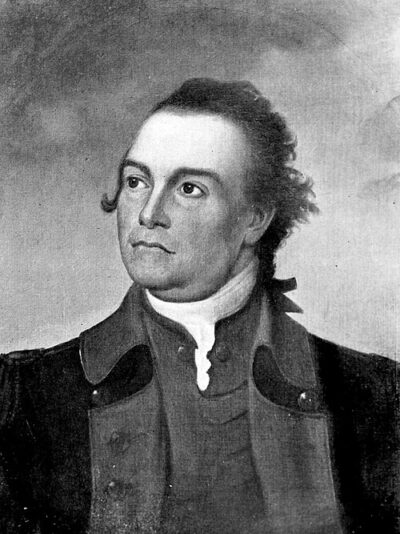
John Sullivan
John Sullivan was an American general, politician and judge from New Hampshire. Born February 17, 1740, in Somersworth. Died January 23, 1795, in Durham. Positions held include Governor of New Hampshire.
Facts
19 facts · 2 confirmed by two sources · 6 cited · 11 from one source
Where this comes from
Papalocal keeps its own record. It started from these sources; what each one said is kept here as it was copied, so a change on their side never changes this page by itself. Tap one to read its version.
What Wikidata says · copied November 16, 2026 · revision 2527876265
- Described as
- American general, politician and judge from New Hampshire (1740-1795)
- Born
- February 17, 1740 · 3 references
- Died
- January 23, 1795 · 3 references
- Born in
- Somersworth
- Died in
- Durham
- Citizen of
- United States
- Occupation
- military officer; lawyer; judge · 1 reference; politician · 2 references; governor · 1 reference; major general · 1 reference; jurist · 1 reference; soldier · 1 reference
- Positions held
- Governor of New Hampshire
- Political party
- Federalist Party
- Children
- George Sullivan
- Siblings
- James Sullivan
- Military branch
- Continental Army
- Military rank
- major general
- Wikipedias with a page
- 21
Wikidata item Q886420 (wikidata.org/wiki/Q886420), public domain (CC0). Copied November 16, 2026.
What Wikipedia says · copied November 16, 2026 · revision 1382130295
Major General John Sullivan (February 17, 1740 – January 23, 1795) was a Continental Army officer, politician and judge who served in the American Revolutionary War and participated in several key events of the conflict, most notably George Washington's crossing of the Delaware River. He was also a delegate to the Continental Congress, where Sullivan signed the Continental Association. After the war, he served as the third governor of New Hampshire and was appointed as a United States district judge of the District Court for the District of New Hampshire.
Sullivan, the third son of Irish settlers, led the Sullivan Expedition in 1779, a scorched earth campaign by the Continental Army which destroyed 40 Haudenosaunee (Iroquois) villages, killed 200 Haudenosaunee and forcibly displaced 5,000 Haudenosaunee as refugees to British-controlled Fort Niagara. There is a historiographical debate over whether or not the actions of Sullivan and his troops during the expedition constitute genocide. As a member of Congress, Sullivan worked closely with the French ambassador to the United States, the Chevalier de la Luzerne.
- Born, in its opening lines
- February 17, 1740
- Died, in its opening lines
- January 23, 1795
From the Wikipedia article “John Sullivan (general)” (en.wikipedia.org/wiki/John_Sullivan_(general)), by its contributors, under CC BY-SA 4.0 (creativecommons.org/licenses/by-sa/4.0/). Copied November 16, 2026; not changed.
Confirmed Two sources agree. Cited One source, and it names where it got it. One source One source, without a reference of its own. Sources disagree The sources disagree. We show the best-supported value and keep theirs below.
