
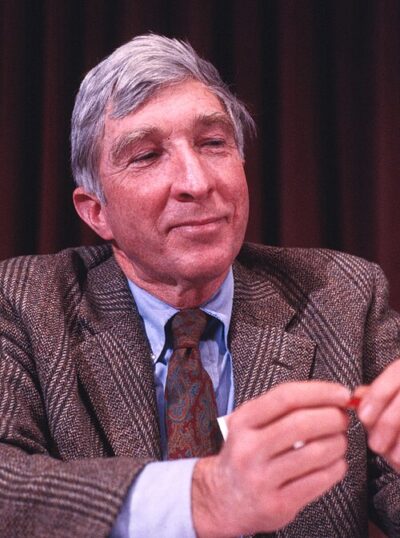
John Updike
John Updike was an American novelist, poet. Born March 18, 1932, in Reading. Died January 27, 2009, in Danvers. Known for The Witches of Eastwick. Educated at Harvard University and Ruskin School of Drawing and Fine Art. Awards include Commandeur des Arts et des Lettres, National Medal of Arts and National Humanities Medal.
Facts
45 facts · 2 confirmed by two sources · 14 cited · 29 from one source
Where this comes from
Papalocal keeps its own record. It started from these sources; what each one said is kept here as it was copied, so a change on their side never changes this page by itself. Tap one to read its version.
What Wikidata says · copied November 13, 2026 · revision 2566530818
- Described as
- American novelist, poet (1932–2009)
- Other names
- John Hoyer Updike
- Born
- March 18, 1932 · 12 references
- Died
- January 27, 2009 · 13 references
- Born in
- Reading · 4 references
- Died in
- Danvers · 4 references
- Buried in
- Robeson Lutheran Church Cemetery · 1 reference
- Cause of death
- lung cancer
- Citizen of
- United States · 1 reference
- Occupation
- poet · 3 references; writer · 4 references; novelist; essayist; playwright; art critic · 3 references; author · 3 references; literary critic · 1 reference
- Education
- Harvard University (1950–1954); Ruskin School of Drawing and Fine Art (1954–); Governor Mifflin Senior High School · 1 reference; Harvard College
- Member of
- American Academy of Arts and Letters; American Academy of Arts and Sciences; PEN America · 1 reference
- Known for
- The Witches of Eastwick
- Awards
- Commandeur des Arts et des Lettres (1995) · 1 reference; National Medal of Arts (1989); National Humanities Medal (2003) · 1 reference; PEN/Faulkner Award for Fiction (2004) · 1 reference; St. Louis Literary Award (1987); Helmerich Award (1987); Pulitzer Prize for Fiction (2 times) (1982, 1991) · 2 references; PEN/Malamud Award (1988); Common Wealth Award of Distinguished Service (1993); Rea Award for the Short Story (2006); Jefferson Lecture (2008); O. Henry Award (1966); National Book Critics Circle Award for Fiction (2 times) (1981, 1990) · 1 reference; Golden Rose Award · 1 reference; Ambassador Book Award (1997)
- Spouse
- Mary Entwistle Pennington; Martha Ruggles Bernhard
- Children
- Elizabeth Updike Cobblah; David Updike
- Father
- Wesley Russell Updike
- Mother
- Linda Grace Hoyer
- Religion
- Anglicanism
- Wikipedias with a page
- 92
Wikidata item Q105756 (wikidata.org/wiki/Q105756), public domain (CC0). Copied November 13, 2026.
What Wikipedia says · copied November 13, 2026 · revision 1385405911
John Hoyer Updike (March 18, 1932 – January 27, 2009) was an American novelist, poet, short-story writer, art critic, and literary critic. One of only four writers to win the Pulitzer Prize for Fiction more than once (the others being Booth Tarkington, William Faulkner, and Colson Whitehead), Updike published more than 20 novels, more than a dozen short-story collections, as well as poetry, art and literary criticism, and children's books during his career.
Hundreds of his stories, reviews, and poems appeared in The New Yorker starting in 1954. He also wrote regularly for The New York Review of Books. His most famous work is his "Rabbit" series (the novels Rabbit, Run; Rabbit Redux; Rabbit Is Rich; Rabbit at Rest; and the novella Rabbit Remembered), which chronicles the life of the middle-class everyman Harry "Rabbit" Angstrom over the course of several decades, from young adulthood to death. Both Rabbit Is Rich (1981) and Rabbit at Rest (1990) were awarded the Pulitzer Prize.
Describing his subject as "the American small town, Protestant middle class", critics recognized his careful craftsmanship, his unique prose style, and his prolific output – a book a year on average. Updike populated his fiction with characters who "frequently experience personal turmoil and must respond to crises relating to religion, family obligations, and marital infidelity".
His fiction is distinguished by its attention to the concerns, passions, and suffering of average Americans, its emphasis on Christian theology, and its preoccupation with sexuality and sensual detail. His work has attracted significant critical attention and praise, and he is widely considered one of the great American writers of his time. Updike's highly distinctive prose style features a rich, unusual, sometimes arcane vocabulary as conveyed through the eyes of "a wry, intelligent authorial voice that describes the physical world extravagantly while remaining squarely in the realist tradition". He described his style as an attempt "to give the mundane its beautiful due".
- Born, in its opening lines
- March 18, 1932
- Died, in its opening lines
- January 27, 2009
From the Wikipedia article “John Updike” (en.wikipedia.org/wiki/John_Updike), by its contributors, under CC BY-SA 4.0 (creativecommons.org/licenses/by-sa/4.0/). Copied November 13, 2026; not changed.
Confirmed Two sources agree. Cited One source, and it names where it got it. One source One source, without a reference of its own. Sources disagree The sources disagree. We show the best-supported value and keep theirs below.
