
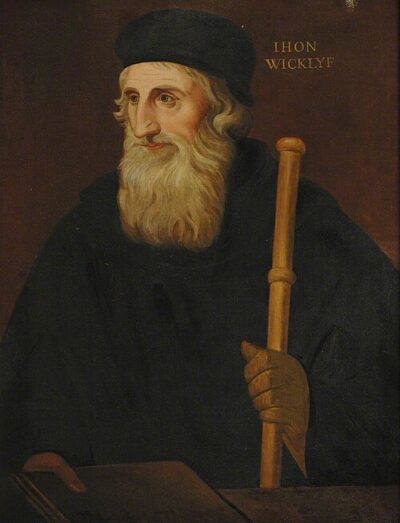
John Wycliffe
John Wycliffe was an English theologian and dissident in the Roman Catholic Church. Born 1320s, in Hipswell. Died December 31, 1384, in Lutterworth. Educated at Merton College and The Queen's College.
Facts
19 facts · 1 confirmed by two sources · 4 cited · 13 from one source · 1 where the sources disagree
What’s different
- Born: we show 1320s (Sources disagree). Wikipedia says c. 1328
Where this comes from
Papalocal keeps its own record. It started from these sources; what each one said is kept here as it was copied, so a change on their side never changes this page by itself. Tap one to read its version.
What Wikidata says · copied November 16, 2026 · revision 2568744122
- Described as
- English theologian and dissident in the Roman Catholic Church
- Other names
- John Wyclyf, Johann von Wyclif, Johann von Wiclif, Johannes von Wykliffe, Johannes Wiclef, Johannes Wiclif, Jan Viklef, Johann Wiclif, Jean Wyclef, John Wickliffe, Jan Viklyh, John Wyclif
- Born
- 1320s
- Died
- December 31, 1384 · 2 references
- Born in
- Hipswell
- Died in
- Lutterworth
- Citizen of
- Kingdom of England
- Occupation
- theologian · 2 references; translator; philosopher · 2 references; Bible translator; writer · 1 reference; parson · 1 reference
- Worked for
- University of Oxford
- Education
- Merton College; The Queen's College
- Field
- philosophy; theology; translation; priesthood
- Religion
- Proto-Protestantism
- Wikipedias with a page
- 85
Wikidata item Q173893 (wikidata.org/wiki/Q173893), public domain (CC0). Copied November 16, 2026.
What Wikipedia says · copied November 16, 2026 · revision 1385823665
John Wycliffe (; also spelled Wyclif, Wickliffe, Wicklyf etc.; c. 1328 – 31 December 1384) was an English scholastic philosopher, Christian reformer, Catholic priest, and a theology professor at the University of Oxford. Wycliffe is traditionally believed to have advocated for or made a vernacular translation of the Vulgate Bible into Middle English, though more recent scholarship has minimised the extent of his advocacy or involvement for lack of direct contemporary evidence.
He became an influential dissident within the Catholic priesthood during the 14th century and his ideas are often considered an important predecessor to Protestantism. His political-theological theory of dominion meant that the church was not allowed to own property or have ecclesiastic courts, and men in mortal sin were not entitled to exercise authority in the church or state, nor to own property. Wycliffe insisted on the radical poverty of all clergy.
Wycliffe has been characterised as the "evening star" of scholasticism and as the "morning star" or stella matutina of the English Reformation.
Certain of Wycliffe's later followers, derogatorily called Lollards by their orthodox contemporaries in the 15th and 16th centuries, adopted a number of the beliefs attributed to Wycliffe such as theological virtues, predestination, iconoclasm, and the notion of caesaropapism, with some questioning the veneration of saints, the sacraments, requiem masses, transubstantiation, monasticism, and the legitimacy or role of the Papacy. Wycliffe's writings in Latin greatly influenced the philosophy and teaching of the Czech reformer Jan Hus (c. 1369–1415).
- Born, in its opening lines
- c. 1328
- Died, in its opening lines
- December 31, 1384
From the Wikipedia article “John Wycliffe” (en.wikipedia.org/wiki/John_Wycliffe), by its contributors, under CC BY-SA 4.0 (creativecommons.org/licenses/by-sa/4.0/). Copied November 16, 2026; not changed.
Confirmed Two sources agree. Cited One source, and it names where it got it. One source One source, without a reference of its own. Sources disagree The sources disagree. We show the best-supported value and keep theirs below.
