
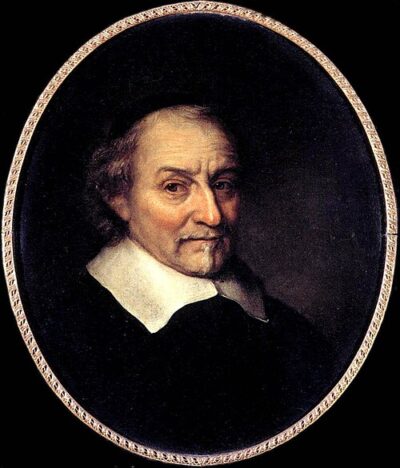
Joost van den Vondel
Joost van den Vondel was a Dutch poet and writer. Born November 17, 1587, in Cologne. Died February 5, 1679, in Amsterdam.
Facts
14 facts · 2 confirmed by two sources · 6 cited · 6 from one source
Where this comes from
Papalocal keeps its own record. It started from these sources; what each one said is kept here as it was copied, so a change on their side never changes this page by itself. Tap one to read its version.
What Wikidata says · copied November 16, 2026 · revision 2558018426
- Described as
- Dutch poet and writer (1587-1679)
- Other names
- J. V. Vondel, Joost Van den Vondel
- Born
- November 17, 1587 · 10 references
- Died
- February 5, 1679 · 11 references
- Born in
- Cologne · 3 references
- Died in
- Amsterdam · 4 references
- Buried in
- Netherlands
- Citizen of
- Dutch Republic
- Occupation
- poet · 1 reference; playwright · 1 reference; translator; writer · 2 references; rhetorician
- Father
- NN van den Vondel · 1 reference
- Mother
- Sara Cranen
- Religion
- Catholic Church
- Wikipedias with a page
- 47
Wikidata item Q312673 (wikidata.org/wiki/Q312673), public domain (CC0). Copied November 16, 2026.
What Wikipedia says · copied November 16, 2026 · revision 1375714931
Joost van den Vondel (Dutch: [ˈjoːst fɑn də(ɱ) ˈvɔndəl]; 17 November 1587 – 5 February 1679) was a Dutch playwright, poet, literary translator and writer. He is generally regarded as the greatest writer in the Dutch language as well as an important figure in the history of Western literature. In his native country, Vondel is often called the "Prince of Poets" and the Dutch language is sometimes referred to as "the language of Vondel". His oeuvre consists of 33 plays, a large number of poems in different genres and forms, an epic poem and many translations of predominantly classical literature. Vondel lived in the Dutch Republic during the Eighty Years' War and became the leading literary figure of the Dutch Golden Age.
Although Vondel was born in Cologne, his family, who were Mennonites, originally came from Antwerp, but had to flee after the fall of the city in 1585. They settled in Cologne, but were persecuted there as well. Eventually they moved to Amsterdam in the then newly formed Dutch Republic. In Amsterdam, Vondel joined the Chamber of rhetoric, a literary society where members studied and composed poetry together. This was the start of his long career as a writer. In 1610 he married Mayken de Wolff, with whom he had five children, of which three died in infancy. A pivotal moment in Vondel's life was his conversion to Catholicism, which was met with controversy in the then dominant Protestant society of the Dutch Republic. In his later life Vondel dedicated himself almost exclusively to his dramatic work and religious poetry. He wrote plays until he was 80 years old and eventually died in Amsterdam at the age of 91.
Vondel's earliest known poem dates from 1605. The first play Vondel wrote was Het Pascha in 1612 and his last Noach, written in 1667. Vondel primarily wrote tragedies, of which a great deal were written in the period between 1654 and 1667. Although his Palamedes (1625) and Gijsbrecht van Aemstel (1637) are acclaimed works, the tragedies he wrote after 1654 are considered to be the highlights of his oeuvre. Plays like Lucifer, Jeptha of Offerbelofte, Adam in ballingschap (Adam in exile) and Noach are among Vondel's most celebrated works and are consistently ranked among the greatest works of Dutch literature. Especially Lucifer is almost by common consent regarded as Vondel's masterpiece. Like his plays, Vondel's poetry is acclaimed as well, in particular for the virtuosic style and mastery of verse. Notable poems include Het stockske van Oldenbarneveldt ("The Cane of Oldenbarnevelt"), Roskam (Curry Comb) and Kinder-lijck (Childlike), about the death of his son.
- Born, in its opening lines
- November 17, 1587
- Died, in its opening lines
- February 5, 1679
From the Wikipedia article “Joost van den Vondel” (en.wikipedia.org/wiki/Joost_van_den_Vondel), by its contributors, under CC BY-SA 4.0 (creativecommons.org/licenses/by-sa/4.0/). Copied November 16, 2026; not changed.
Confirmed Two sources agree. Cited One source, and it names where it got it. One source One source, without a reference of its own. Sources disagree The sources disagree. We show the best-supported value and keep theirs below.
